



A potential opportunity that for the moment is going abegging – while the underlying pet population is growing and rather rapidly from Covid-onset, little more than 5 years ago, one segment of the market is still trying catching up. This has lessons for key Pet Industry Stakeholders..
Explosive Growth
The explosive expansion of India’s domestic pet care industry has officially collided with a structural bottleneck. While the national pet market has surged to an unprecedented ₹8,000 crore valuation, parallel structural reviews tracking the country’s macro animal healthcare grids reveal that the existing companion animal infrastructure is on the verge of a systemic breakdown.
A combination of rapid urban pet humanization, a severe deficit of specialized clinical practitioners, and an outdated “generalist” healthcare model has left India facing what healthcare architecture specialists are formally naming “The Fundamental Crisis” in veterinary care.
Macro Reality: Tracking the Dog-to-Vet Disconnect
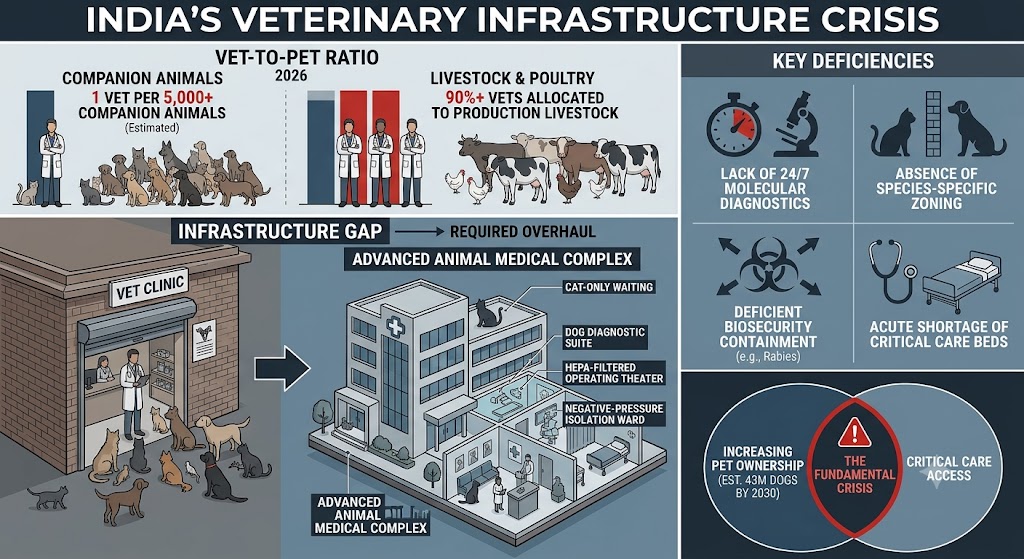
The defining catalyst of this crisis is a widening disparity between demand and clinical supply. Driven by shifts among Millennial and Gen-Z households, the companion / pet dog population in India has reached an estimated 31 million animals. This footprint is on a high-velocity trajectory, projected to reach 43 million animals by the turn of the decade.
However, the medical defense grid built to sustain this population is severely constrained. India possesses only 5,000 to 6,000 actively practicing companion veterinarians nationwide.
While macro federal statistics track approximately 72,200 registered veterinarians across the subcontinent, over 90% are strictly allocated to rural production livestock, poultry grids, and government dairy cooperatives. This leaves the urban companion animal segment operating at a critical 5,000:1 animal-to-veterinary ratio—nearly ten times higher than the internationally recommended benchmark of 500:1.
Beyond Vet Shortages: Infrastructure Bottleneck
According to technical briefs compiled by HOSMAC, a premier healthcare management and infrastructure design firm actively engineering next-generation, advanced animal medical centers across Mumbai and Dharampur (including the massive 84,788 sq. ft. Shrimad Rajchandra Animal Hospital in Gujarat), focusing solely on the shortage of doctors misdiagnoses the true issue.
The structural failure is rooted in a systemic lack of specialized, species-appropriate clinical environments. The three core institutional deficiencies compounding this crisis include:
-
Absence of Specialized Clinical Zoning: Traditional Indian veterinary setups operate primarily out of single-room, general-purpose storefront clinics. These spaces lack spatial separation, causing high-stress levels for animals and making effective triage operations impossible.
-
The Point-of-Care Diagnostic Void: A vast majority of local clinics lack integrated 24/7 molecular diagnostic equipment, digital radiography, and in-house hematology profiles. This forces practitioners to rely on human laboratory syndication, creating life-threatening 48-to-72-hour delays for acute therapeutic intervention.
-
Deficient Biosecurity Containment: Most generalist facilities lack high-efficiency particulate air (HEPA) filtration, negative-pressure isolation wards, and specialized sanitation locks. This makes them highly susceptible to spreading dangerous, highly contagious zoonotic pathogens like Rabies and Brucellosis.
Strategic Roadmap: Building Robus Vet Clinics
Resolving India’s companion animal crisis requires shifting away from basic outpatient dispensaries and embracing full-scale, tertiary-level animal medical complexes.
Redesign urban facility blueprints to enforce mandatory, completely separate clinical tracking pathways, dedicated isolation zones, and species-specific treatment rooms.
Integrate automated real-time molecular diagnostics, diagnostic ultrasound platforms, and in-house blood gas analyzers directly into frontline clinic networks to reduce diagnostic latency to under 30 minutes.
Construct positive/negative pressure air handling grids and physical decontamination airlocks at the threshold of isolation sectors to safely manage zoonotic events without risking cross-contamination.

