

HomeCorporateEurope Launches First-Ever "Livestock Strategy" to Protect €400 Billion Farming Sector

Europe Launches First-Ever “Livestock Strategy” to Protect €400 Billion Farming Sector

The European Commission has officially rolled out its first-ever unified Livestock Strategy, creating a long-term roadmap to protect and modernize Europe’s massive animal farming industry.
The livestock sector is a major economic engine for the continent, employing around 7 million people across 4 million farms and generating over €400 billion ($435 billion) in annual turnover. However, with rising animal feed prices, climate challenges, and changing animal welfare expectations, the European Union (EU) is stepping in with a comprehensive plan to keep its farms stable and competitive.

Core Pillars of the New Strategy

The new strategy is built around five major priorities designed to help everyday farmers navigate modern challenges:

  • Handling Crises Better: The EU plans to build stronger safety nets and explore new insurance options so farmers can recover quickly from disease outbreaks or extreme weather events.

  • Staying Globally Competitive: The plan focuses on boosting farm profits and making sure EU farmers can compete fairly on the global stage.

  • Improving Animal Welfare: The EU is setting up realistic transition periods and financial support to help farms upgrade their facilities, specifically focusing on healthier living spaces for pigs and poultry.

  • Supporting Vulnerable Regions: A new initiative will work to prevent farm abandonments in remote or rural areas, keeping local food supply chains alive.

  • Promoting Quality: The EU will introduce a “European Excellence” program to highlight high-quality, sustainable European meat and dairy products.
Protein Action Plan: Growing Feed Closer to Home

Alongside the farming strategy, the EU launched a crucial Protein Action Plan to address a major vulnerability in its food supply chain: its heavy reliance on imported animal feed.

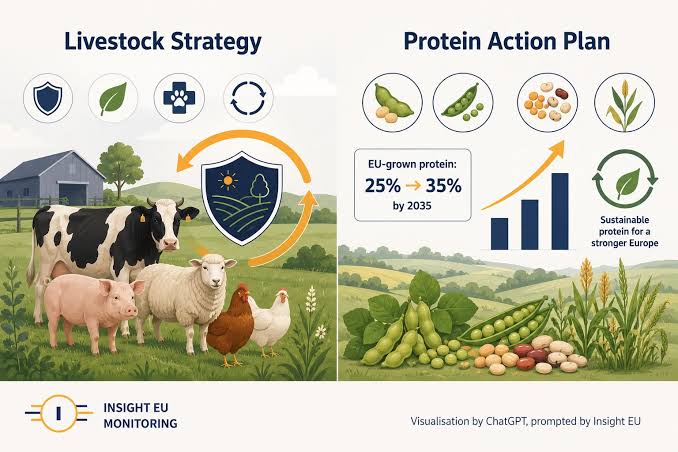
Currently, Europe imports the vast majority of its high-protein crops, like soybeans, from North and South America. In fact, only 25% of the protein crops used to feed EU livestock are actually grown inside Europe. This leaves local farmers highly vulnerable to international trade disputes, price spikes, and shipping bottlenecks.

To fix this, the EU is aiming to aggressively scale its domestic protein crop production to 35% by the year 2035. By encouraging local farmers to grow more legumes—like beans, peas, and lentils—the EU hopes to insulate its farms from global supply chain shocks while improving soil health and cutting down on transport-related emissions.

Future of Farming in EU

While environmental groups argue that the plan should do more to encourage plant-based diets, agricultural leaders view the strategy as a vital safety net. By combining financial support with a clear path toward self-sufficiency, the European Commission is trying to strike a delicate balance: protecting the livelihoods of millions of rural workers while steering one of the world’s largest agricultural sectors toward a more secure, sustainable future.

Animal Health India Editorial Team
Animal Health India Editorial Teamhttps://animalhealthindia.com
Animal Health India (AHI) is an independent news and intelligence platform covering the global animal health, veterinary, livestock, poultry, companion animal and pet food sectors. Our editorial team comprises veterinary journalists, animal health professionals, regulatory affairs specialists and industry analysts with over 30 years of combined experience covering India, Asia, Europe and North America. AHI publishes news, regulatory updates, market intelligence and company news drawn from primary sources including DAHD, EMA, USDA, AVMA and leading veterinary publications worldwide.
RELATED ARTICLES