



Regenerative Medicine makes an entry in Animal Health – with usage of Umbilical Cord Tissue Matrix, potentially rich in Mesenchymal Stem Cells
Equine Performance Labs (EPL) announced the peer-reviewed publication of a prospective, multicenter, pragmatic controlled clinical trial evaluating its flagship biological therapeutic, equicenta® CTM (eCTM). The study, published in Frontiers in Veterinary Science, establishes comparative efficacy and real-world clinical performance for the off-the-shelf, cryopreserved equine umbilical cord tissue matrix against clinician-selected Standard of Care (SOC) in active performance horses.

The clinical trial evaluated horses presenting with real-world musculoskeletal lesions—including osteoarthritis, joint synovitis, and soft-tissue (tendon and ligament) pathology. Results demonstrated that horses treated with equicenta® CTM achieved statistically significant, durable improvements in lameness, pain scores, and gait kinematics compared to conventional management.
1. Clinical Trial Design & Methodology

-
Study Design: Prospective, multicenter, pragmatic controlled comparative clinical trial.
-
Therapeutic Agent: equicenta® CTM, an off-the-shelf, cryopreserved micro-particulate connective tissue matrix harvested ethically from equine umbilical cord tissue (Wharton’s Jelly) following full-term, natural births.
-
Dosing & Administration: Single-dose 1.5 mL local administration via intra-articular (joint) or peri-articular/intralesional (tendon/ligament) injection.
-
Primary Outcomes: Lameness classification using standard American Association of Equine Practitioners (AAEP) criteria, objective computer-assisted kinematic gait analyses, soft-tissue pain/swelling parameters, and comprehensive adverse event profiling.
2. Key Trial Outcomes & Comparative Performance
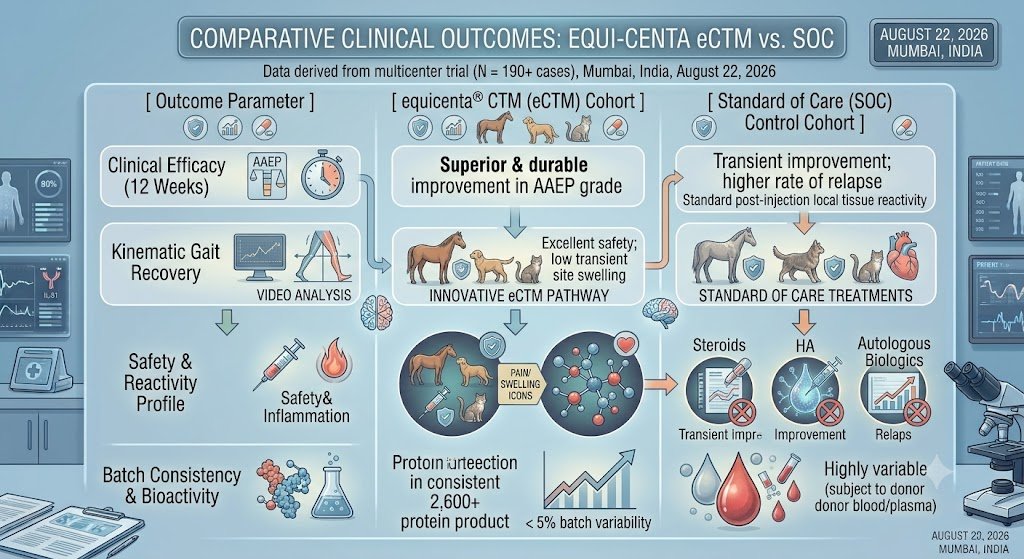
Key Findings
-
Durable Functional Recovery: Horses receiving a single intra-articular or intralesional dose of equicenta® CTM showed sustained reductions in AAEP lameness grades at weeks 2, 4, and 12, outperforming conventional treatments like intra-articular corticosteroids and autologous blood products.
-
Proteomic Scaffolding & Signaling: Liquid chromatography-mass spectrometry (LC-MS/MS) characterization of eCTM confirmed over 2,600 unique, naturally occurring proteins, including structural collagens, growth factors, and anti-inflammatory cytokines.
-
Safety & Tolerability: The trial validated an acceptable safety profile across joint and soft-tissue injection sites, with no serious product-related adverse events reported.
3. Veterinary Medicine & Regulatory Context
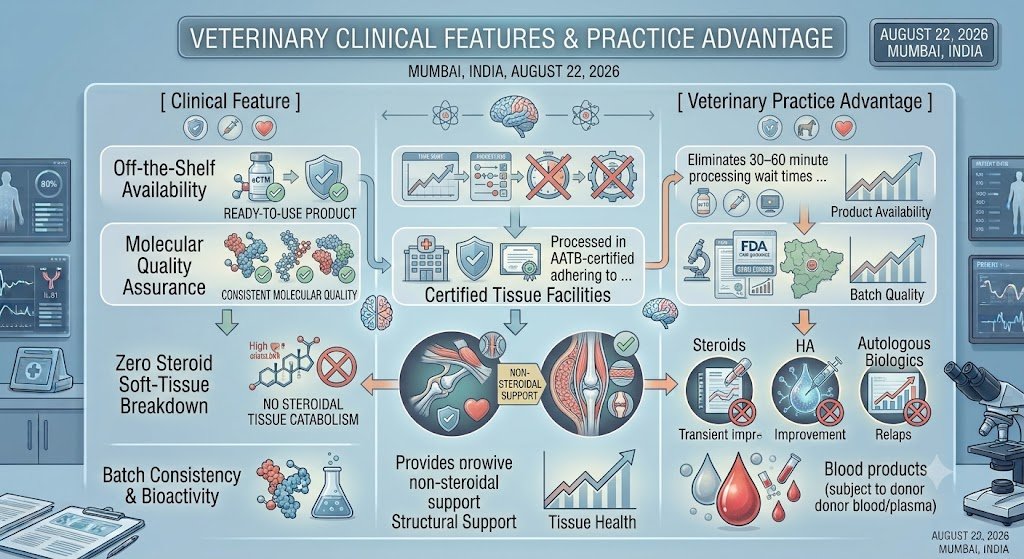
Unlike autologous biologics (e.g., PRP or autologous conditioned serum), which depend heavily on the patient’s individual age and systemic health, equicenta® CTM provides a consistent biological matrix with less than 5% batch-to-batch protein variation derived from single-source closed herds.
Executive & Scientific References
-
Equine Performance Labs. (2026). Cryopreserved umbilical allograft (equicenta® CTM) improves clinical outcomes compared with clinician-selected standard of care in performance horses: a pragmatic prospective controlled trial. Frontiers in Veterinary Science, 13:1833933.
-
U.S. Food and Drug Administration, Center for Veterinary Medicine (FDA CVM). Guidance for Industry (GFI) #218 & #254: Cell-Based Products for Animal Use.
-
American Association of Equine Practitioners (AAEP). Guide for Veterinary Service and Evaluating Equine Lameness.

