

For decades, the strategic narrative of India’s animal health sector revolved around upstream supply: Do we have the molecule? Can we manufacture affordable pharmaceuticals, biologicals, and feed additives at scale?
That era is closing. Today, supply-side capability is no longer the primary constraint. The fundamental bottleneck holding back the growth of India’s livestock economy is downstream delivery: Can the smallholder or commercial producer consistently access the right diagnosis, qualified veterinary care, optimal nutrition, and preventive interventions at the precise time of need?
As highlighted across both public policy initiatives and industry platforms—such as the 67th CLFMA National Symposium—India’s animal-agriculture agenda is pivoting. The true value creation in the market is shifting from product sales to integrated service execution: Animal Health 2.0.
The Institutional Shift: What Government and Industry Signals Reveal
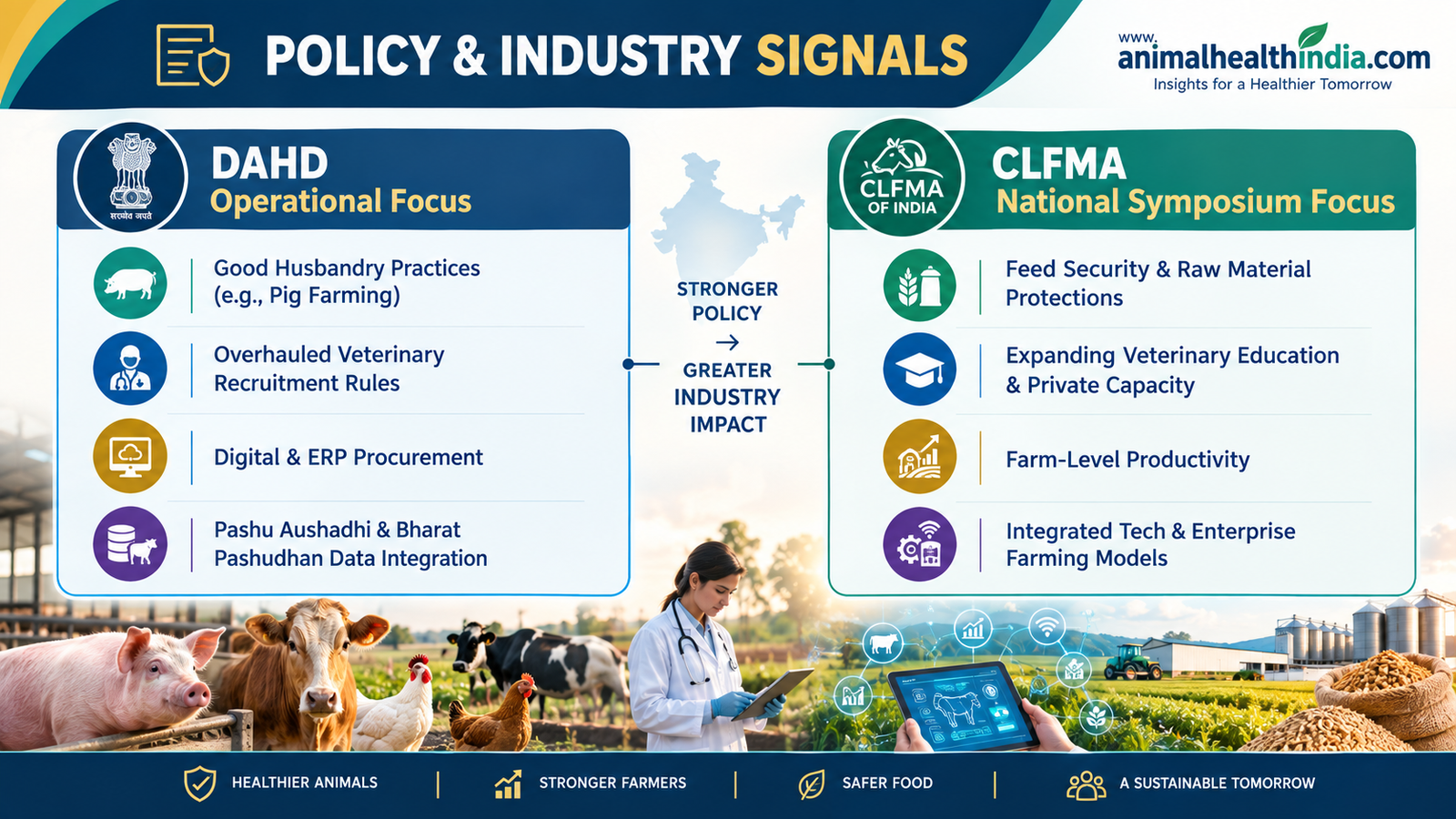
A close look at policy priorities from the Department of Animal Husbandry and Dairying (DAHD) and industry forums like the Compound Livestock Feed Manufacturers Association (CLFMA) reveals a clear pattern:
1. DAHD’s Downstream Focus
The DAHD central portal has expanded beyond traditional disease control programs (like the National Animal Disease Control Programme – NADCP) to address structural delivery gaps:
-
Good Husbandry Practices (GHPs): Standardizing daily operations for species-specific farming (such as swine and small ruminants) to build farm-level resilience.
-
Veterinary Recruitment-Rule Overhauls: Restructuring staffing rules and field-assistant cadres (e.g., Veterinary Field Assistants) to build operational capacity at the district level.
-
Digital Infrastructure & ERP Systems: Leveraging centralized systems like the Bharat Pashudhan portal and digital procurement pipelines to ensure end-to-end supply chain visibility for vaccines and essentials.
2. CLFMA’s Strategic Imperatives
At the 67th CLFMA National Symposium, discussions centered on the gap between production capacity and field execution. Key themes included:
-
Feed Security: Securing raw material access (maize, soy) amid rising domestic demand from competing sectors.
-
Veterinary Shortages: Calling for private-sector participation in veterinary education and clinical training to resolve the shortage of certified field professionals.
-
Farm Productivity: Shifting the focus from raw volume to feed conversion ratios (FCR), precision management, and enterprise-led livestock farming.
Why Downstream Is the Bottleneck
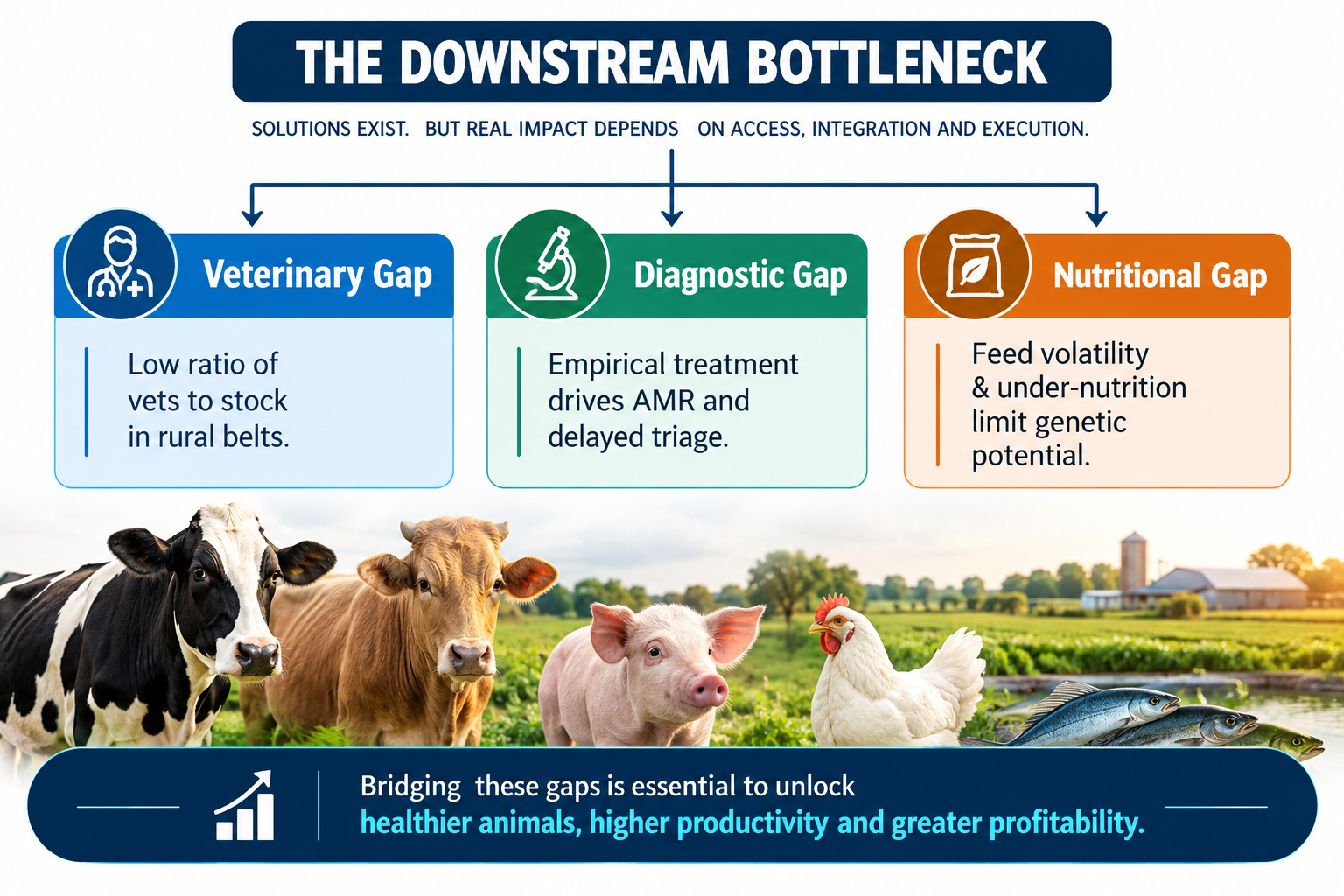
India boasts one of the world’s largest livestock populations, yet productivity metrics—such as milk yield per bovine, FCR in poultry, or mortality rates in small ruminants—often lag behind global benchmarks. The culprit is rarely a lack of therapeutics; it is a delivery friction across four core pillars:
-
The Paravet and Doctor Shortage: The ratio of qualified veterinarians to livestock units in rural India falls below recommended international guidelines. Producers frequently rely on uncertified practitioners, leading to empirical drug misuse, sub-optimal dosing, and rising Antimicrobial Resistance (AMR).
-
Diagnostic Latency: Point-of-care diagnostics remain underutilized in commercial and back-yard settings. Without diagnostic confirmation, expensive therapeutics are often administered too late or incorrectly.
-
Nutritional Volatility: Animal health products cannot overcome basic nutritional deficits. Competing demand for maize and soybean meal drives up raw material costs, forcing smallholders onto unbalanced diets that suppress immune response and yield potential.
-
Data Isolation: Farm metrics (milk yield, health logs, vaccination history) rarely flow into a unified database, preventing early intervention by technical advisory teams.
The Solution: Emerging Model of “Animal Health 2.0”
To overcome these delivery barriers, the industry is transitioning from a transactional seller model (Animal Health 1.0) to an integrated platform model (Animal Health 2.0).
Feature |
Animal Health 1.0 (Legacy Model) |
Animal Health 2.0 (Integrated Model) |
Core Offering |
Standalone molecules, feed additives, and vaccines |
Integrated stack: Product + Vet + Diagnostics + Nutrition + Data |
Monetization |
Volume of sales per unit |
Total Cost of Care / Value-Share based on farm productivity |
Customer Touchpoint |
Periodic visits by medical sales reps |
Continuous engagement via field technicians, IoT, and tele-vet apps |
Diagnostic Role |
Reactive, post-symptom confirmation |
Proactive, point-of-care, and preventative screening |
Data Strategy |
Siloed distributor ledgers |
Connected digital health records (Bharat Pashudhan integration) |
Under Animal Health 2.0, success is measured by farm-level outcomes—such as reduced calf mortality, optimized peak lactation days, or lower FCR—rather than the volume of pill bottles sold.
Commercial Strategies for Industry Stakeholders
To capture the downstream opportunity, stakeholders across the livestock value chain must adapt their operational models:
1. Veterinary Pharmaceutical & Biological Companies
-
Shift to Solution Bundling: Combine product portfolios (e.g., vaccines or anti-infectives) with point-of-care diagnostic kits and specialized veterinary support.
-
Invest in Paravet & Technician Upskilling: Partner with state agricultural universities and government schemes to offer formal training for field assistants, expanding your brand’s trusted touchpoints.
2. Compound Feed & Nutrition Manufacturers
-
Integrate Health & Feed Services: Provide precise feed testing alongside customized premix formulations, backed by veterinary consultations to adjust diets dynamically based on herd health status.
-
Mitigate Ingredient Volatility: Formulate alternative protein sources and enzyme technologies to optimize FCR despite shifting raw material prices.
3. AgTech & Digital Service Platforms
-
Bridge the Last-Mile Tele-Health Gap: Develop lightweight, offline-capable mobile tools for field technicians to record diagnostic data, order supplies, and consult certified remote veterinarians.
-
Leverage National Databases: Interface with central platforms like Bharat Pashudhan to streamline ear-tag tracking, disease tracing, and medical records.
The Strategic Path Forward
India’s animal-agriculture market is transitioning into its next phase of growth. As government policy shifts toward structural capacity and industry bodies push for integrated productivity models, the market winners will be those who solve the downstream delivery challenge.
Organisations that transition from selling inputs to delivering comprehensive health, diagnostic, and nutritional services will unlock long-term enterprise value in India’s evolving livestock ecosystem.

