


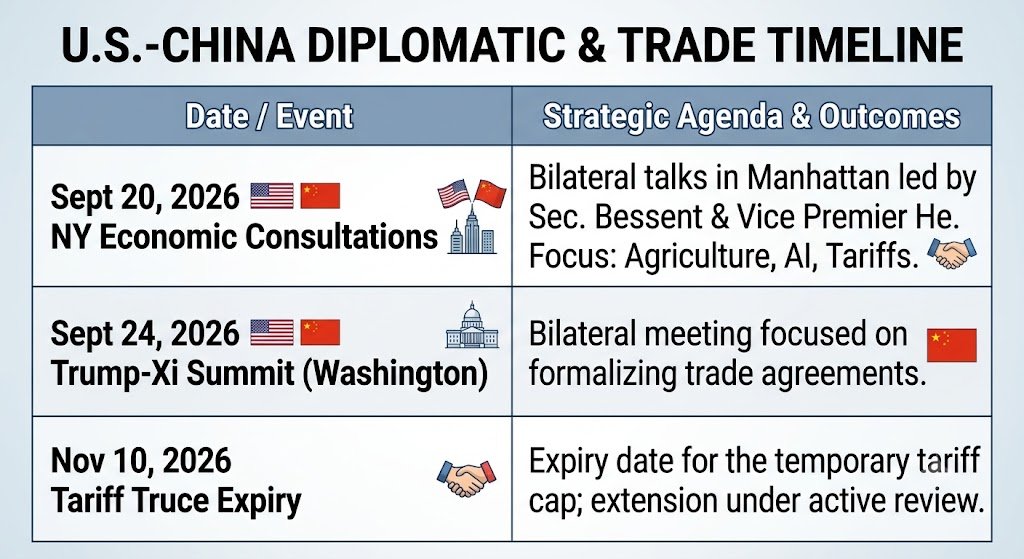
NEW YORK — Senior U.S. and Chinese economic officials concluded intensive bilateral trade consultations at JPMorgan Chase’s headquarters in Midtown Manhattan, setting a constructive tone ahead of an upcoming presidential summit. U.S. Treasury Secretary Scott Bessent characterized the weekend engagement with Chinese Vice Premier He Lifeng as “very successful,” highlighting measurable progress across trade frameworks, agricultural flows, and artificial intelligence guardrails.
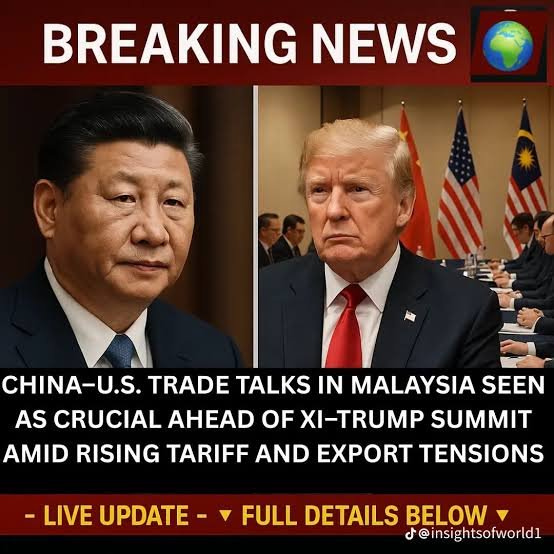
The high-stakes meetings serve as the primary runway for an upcoming bilateral summit between U.S. President Donald Trump and Chinese President Xi Jinping. With a critical tariff truce scheduled to expire on November 10, 2026, global agribusiness markets, feed-grain suppliers, and animal-health leaders are closely watching for a formal extension to stabilize cross-border supply chains.
1. The November 10 Truce & Bilateral Agenda
The Manhattan negotiations brought together key economic leaders, including U.S. Trade Representative Jamieson Greer and China’s International Trade Representative Li Chenggang. Discussions focused on maintaining market stability and converting preliminary frameworks into operational policies
Core Topics Under Negotiation
-
Board of Trade Mechanism: Negotiators confirmed that the bilateral “Board of Trade” framework is now operational. The mechanism aims to ease tariff barriers on non-sensitive goods. Proposed U.S. exports include agricultural commodities, energy products, and medical devices, balanced against Chinese consumer and low-tech goods.
-
Agricultural Commitments: Both sides reviewed implementation targets from previous agreements, including China’s purchase commitments for U.S. agricultural goods (such as soybeans, maize, and sorghum).
-
AI Safety & Notification Mechanisms: In a notable expansion of scope, the U.S. proposed a formal “U.S.–China AI Dialogue” alongside a bilateral notification mechanism for national security-level AI incidents.
-
Critical Mineral Flows: Discussions addressed restoring reliable supply chains for Chinese-produced rare-earth magnets and critical industrial inputs.
2. Agribusiness & Feed-Grain Trade Flows
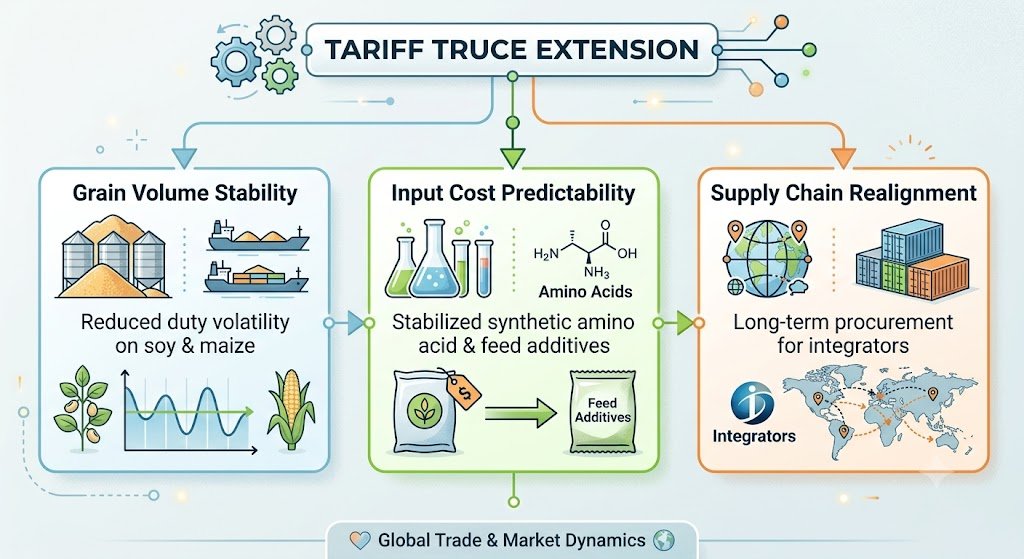
The prospect of extending the tariff truce beyond November 10 directly impacts global protein, feed-grain, and aquaculture value chains. Unpredictable trade terms between the world’s two largest economies create volatility in bulk commodity pricing and feed formulation strategies.
-
Soybean & Coarse Grain Dynamics: China remains the primary global buyer of U.S. soybeans. Tariff clarity ensures predictable ocean freight flows and reduces landed costs for Chinese swine and poultry integrators rebuilding herd efficiency.
-
Synthetic Amino Acid & Feed Additive Chains: China is a leading global producer of synthetic lysine, threonine, and methionine intermediates. Tariff stability prevents cost spikes for U.S. animal nutrition manufacturers reliant on imported premix ingredients.
-
Aquaculture & Protein Trade: Certainty around tariff caps reduces margin pressure for export-oriented marine protein and tilapia supply networks across the Pacific rim.
3. Strategic Impact on Animal Health & Agribusiness Planners
For global animal-health companies, livestock integrators, and agricultural lenders, a prolonged trade truce changes operational risk management:
-
Long-Term Contract Pricing: Clearer tariff timelines allow feed mills and commercial livestock operations to lock in multi-quarter purchasing contracts for feed-grains, vitamins, and active pharmaceutical ingredients (APIs) without building in high risk premiums.
-
Regulatory & Biosecurity Continuity: Stable commercial dialogue reduces the likelihood of sudden retaliatory administrative delays or technical barriers to trade (TBTs) at entry ports, ensuring smoother veterinary health certifications and product registrations.
-
Capital Allocation: Multi-national life science firms can plan capital expenditures in regional manufacturing and R&D facilities with greater certainty regarding tariff exposure on specialized processing equipment.

