

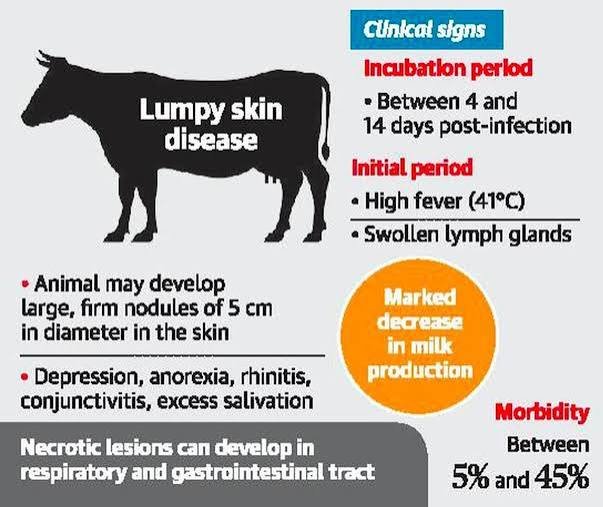
India’s latest LSD episode began with sporadic reports from July 2026 and expanded through August and September across parts of Uttar Pradesh, Rajasthan, Himachal Pradesh, Punjab, Uttarakhand, Haryana and Delhi.
State-level reporting now indicates thousands of affected cattle, while the Union government says national severity and mortality remain substantially lower than during the 2022 crisis. The key dairy-industry issue is therefore not simply mortality, but the cumulative effect of milk-yield losses, treatment costs, reproductive disruption, animal movement restrictions and pressure on smallholder dairy economics.
India is experiencing a renewed, geographically dispersed LSD episode during July–September 2026, with the most significant reported concentrations currently in Rajasthan and Uttar Pradesh, alongside outbreaks or suspected cases in Himachal Pradesh, Punjab, Uttarakhand, Haryana and Delhi.
The Department of Animal Husbandry & Dairying (DAHD) said on 8 September that sporadic cases had been reported since July, particularly among young animals and calves, and that a Central Expert Team had been sent to Uttar Pradesh in August.
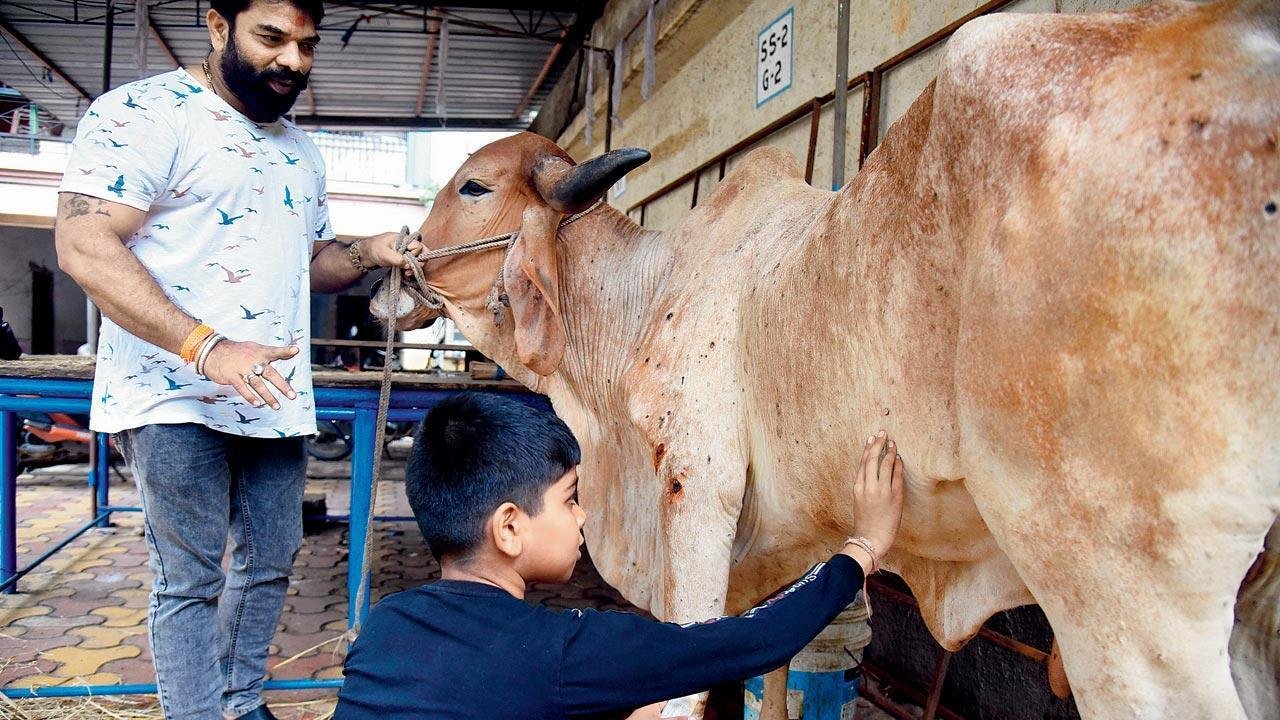
At that point, DAHD reported 3,461 active cases nationally, while also stating that disease severity and mortality were substantially lower than in earlier outbreaks. More than 36.18 crore cattle had been vaccinated/re-vaccinated against LSD.
However, state-level reports subsequently showed considerably larger cumulative affected-animal counts:
-
Rajasthan: 10,403 reported cases by 11 September; 6,905 recovered; >87% vaccination coverage
-
Uttar Pradesh: 9,003 affected animals reported by 20 September across 25 districts; 16.09 lakh animals vaccinated; 606 response teams deployed
-
Delhi: ~584 active cases on 13 September, with no mortality reported and >45,950 animals vaccinated during 2026
-
Punjab: 216 cases reported by 16 September, concentrated in Pathankot, Mohali and Patiala; no mortality reported in that report; ~94% of the state’s cattle population reportedly vaccinated since late August
-
Himachal Pradesh: Hamirpur reported 48 infections and four calf deaths in a four-to-five-day period in late August
-
Haryana: 1,356 clinically suspected cases were reported from four districts, but the state government said laboratory testing had not confirmed LSD at that point; it had vaccinated the eligible cattle population between 25 July and 30 August
What Has Happened Since July 2026?
The 2026 episode is better described as a multi-state resurgence of sporadic and clustered LSD transmission rather than one uniform nationwide epidemic. DAHD specifically states that cases have been reported since July 2026, mainly in:
-
Uttar Pradesh
-
Rajasthan
-
Himachal Pradesh
-
Haryana
-
Punjab
-
Uttarakhand
-
and several other states.
The Union government has characterised the disease as having low severity, with affected animals generally recovering within about a week in the current episode. This represents an important difference from India’s major 2022 LSD episode.
2026 versus 2022
Indicator |
2022 epidemic |
July–Sep 2026 episode |
|---|---|---|
Geographic pattern |
Large multi-state epidemic |
Multiple regional clusters |
Mortality |
Severe in several areas |
Currently substantially lower nationally |
Young animals |
Affected |
Prominent in current reports |
Vaccination |
Large-scale response developed during outbreak |
Much larger pre-existing vaccination base |
National vaccination |
~6.6 crore reported during 2022 response |
>36.18 crore vaccinated/re-vaccinated cumulatively |
Current national assessment |
Major epidemic |
DAHD says situation currently under control |
Key current risk |
Mortality + production loss |
Recurrence, productivity loss, movement restrictions and vulnerable/unvaccinated animals |
DAHD’s current response therefore reflects lessons learned from 2022: vaccination before peak transmission, ring vaccination, movement control, isolation, vector management and stronger diagnostics.
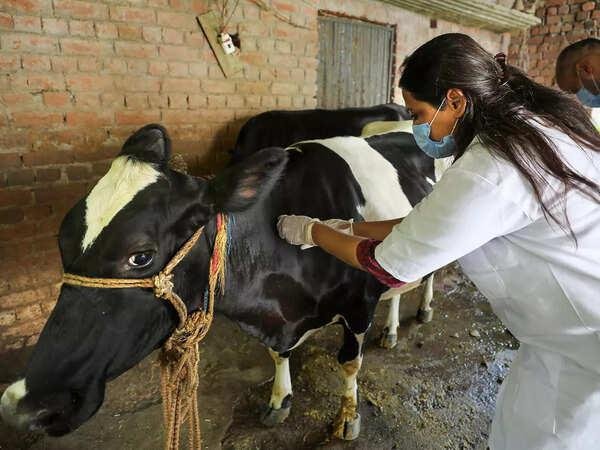
July 2026: The Start of the Current Wave
The official national account places the beginning of the current episode in July 2026. Importantly, July does not appear to have started with a single explosive national outbreak. Instead, DAHD describes sporadic cases, particularly affecting young animals and calves.
This is epidemiologically important because LSD transmission is strongly influenced by:
-
biting flies
-
mosquitoes
-
ticks
-
temperature
-
humidity
-
rainfall
-
cattle movement.
WOAH identifies blood-feeding arthropods as the predominant transmission mechanism and notes that incidence increases during periods when vectors are more active. Movement and trade of infected livestock are important mechanisms for longer-distance spread.
Why July matters – July marks the beginning of India’s monsoon/vector-risk period, creating conditions under which localized infections can expand rapidly if:
susceptible cattle + vectors + animal movement + inadequate vaccination
occur together.
August 2026: Regional Clusters Become More Visible
August was the month in which the outbreak signal became much clearer. DAHD’s response included a Central Expert Team sent to Uttar Pradesh, while national review meetings were held on 27 August and subsequently 7 September.
At the state level, significant activity emerged in Rajasthan, Himachal Pradesh, Punjab and Uttar Pradesh.
Himachal Pradesh: Significant Localised Mortality
Hamirpur became one of the clearest August hotspots. By 26 August, officials reported:
-
48 infected cattle
-
4 calf deaths
-
cases emerging over approximately four to five days
-
approximately 13,500 vaccine doses received and distributed.
The concentration among calves is particularly relevant for dairy economics.A calf is not simply an infected animal: infection → treatment → slower growth → delayed breeding → delayed first calving → delayed entry into productive herd
Thus, calf morbidity can generate an economic impact that appears months or years after the initial outbreak.
Punjab: 216 Cases After a Four-Year Gap
Punjab provides another important example of the current pattern. By 16 September, the state had reported 216 LSD cases, primarily in:
-
Pathankot
-
Mohali
-
Patiala.
No mortality had been reported in the state at that point. Punjab reportedly began intensive vaccination during the last week of August, with approximately 94% of its 23-lakh cattle population vaccinated according to the state’s animal-husbandry officials quoted by Hindustan Times. That equates to approximately:
23 lakh × 94% ≈ 21.6 lakh cattle vaccinated.
The Punjab response also included:
-
surveillance at cattle markets
-
advice against purchasing animals from other states
-
vaccination of gaushalas
-
movement monitoring.
This highlights one of the central economic-control tensions around LSD: India’s dairy economy depends on livestock mobility, but livestock mobility can also accelerate disease spread.
Rajasthan: The Largest Reported Cluster in the Current Episode
Rajasthan currently represents one of the largest reported state-level clusters. By 11 September, the Rajasthan Animal Husbandry Department reported:
10,403 LSD cases
with:
6,905 recoveries
and vaccination coverage reportedly above:
87%
The outbreak was described as concentrated primarily in eastern Rajasthan, rather than evenly distributed across the state. The recovery ratio from those reported figures is approximately:
6,905 ÷ 10,403 = 66.4%
But this should not be interpreted as a clinical recovery rate because the denominator and timing of cumulative cases and recoveries may not represent the same disease cohort. The state has responded with:
-
accelerated vaccination
-
isolation
-
veterinary teams
-
surveillance
-
quarantine
-
movement controls.
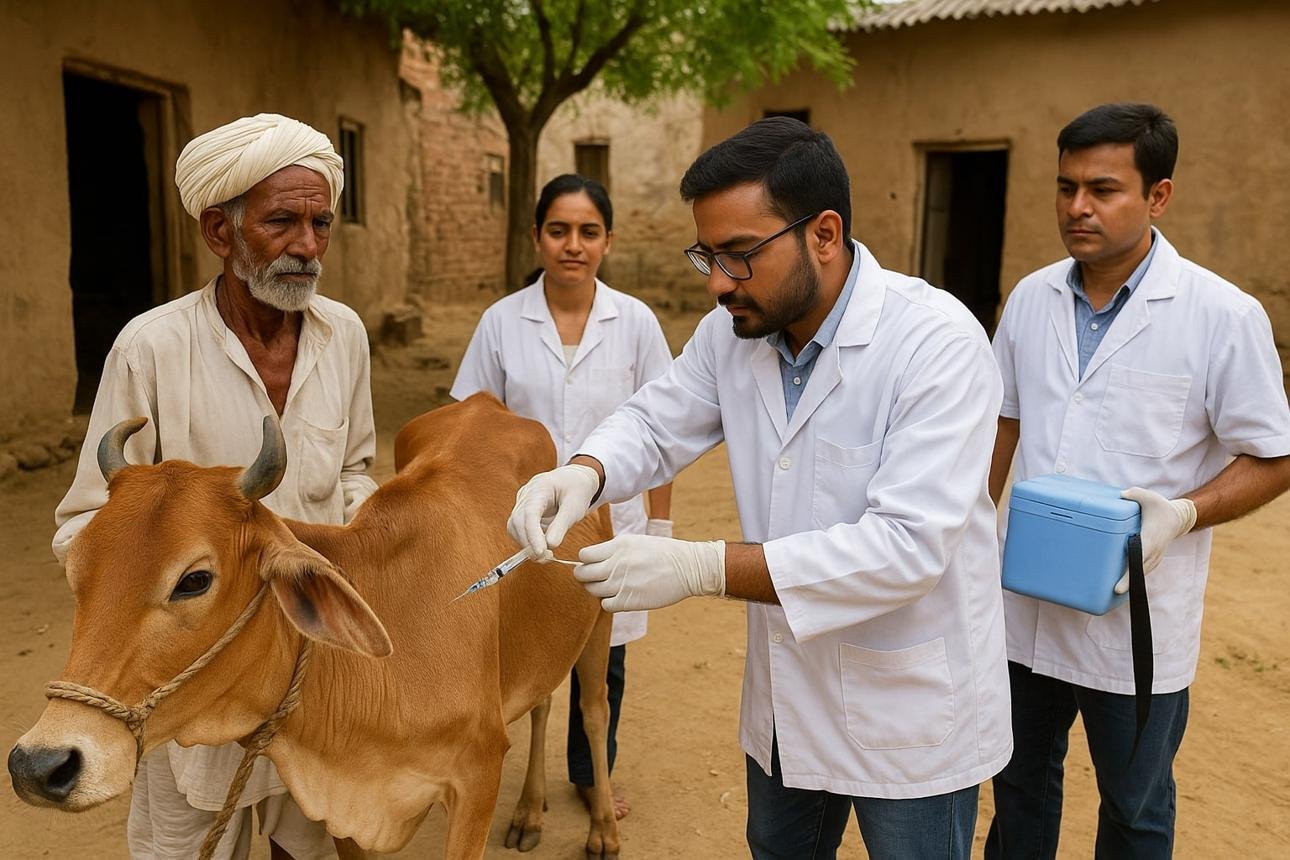
Uttar Pradesh: The Most Important Dairy-Economy Risk Zone
Uttar Pradesh deserves particular attention. The state is India’s largest milk-producing state and has one of the country’s largest cattle and buffalo populations.
By 20 September, the UP Animal Husbandry Department reported: 9,003 affected animals
across: 25 districts
with: 606 veterinary response teams
and: 1.608 million animals vaccinated during the campaign.
The geographical concentration was particularly notable in western Uttar Pradesh. The disease-control programme included:
-
ring vaccination
-
isolation
-
vector control
-
disinfection
-
village-level vaccination camps
-
continuous surveillance
-
farmer awareness.
This is potentially the most consequential development for India’s dairy industry because the economic damage from LSD is not limited to mortality.
Delhi: 584 Active Cases but No Reported Mortality
Delhi provides an important counterpoint. On 13 September, DAHD reported:
~584 active cases
but: 0 reported deaths
The disease was described as sporadic, low severity and under control.
More than: 45,950 animals
had been vaccinated in Delhi during 2026.
DAHD identified affected animals predominantly as:
-
unvaccinated
-
vulnerable
-
nutritionally weak
-
animals with co-morbidities
-
animals under stress.
The Delhi experience reinforces an important point: vaccination may reduce the severity of an outbreak without necessarily eliminating infection completely.
Haryana: High Surveillance Does Not Equal Confirmed Outbreak
Haryana is particularly important because it demonstrates why analysts should distinguish suspected cases from laboratory-confirmed disease.
The Haryana government reported: 1,356 clinically suspected cases
from:
-
Kurukshetra
-
Panchkula
-
Rewari
-
Yamunanagar.
However, it stated that the tested samples were negative and therefore no confirmed LSD case had been established in the state at that point. At the same time, Haryana conducted a vaccination campaign covering its eligible cattle population from:
25 July → 30 August 2026
using Goat Pox Vaccine, Uttarkashi strain.
This is a good example of surveillance-driven preventive intervention rather than evidence that every suspected case represents confirmed LSD.
National Numbers Need to Be Read Carefully
There is an apparent discrepancy in the current reporting:
Date |
Source |
Reported figure |
|---|---|---|
8 Sep |
DAHD |
3,461 active cases nationally |
11 Sep |
Rajasthan |
10,403 cumulative cases |
13 Sep |
Delhi |
584 active cases |
16 Sep |
Punjab |
216 cases |
20 Sep |
Uttar Pradesh |
9,003 affected animals |
Why the Dairy Industry Should Care Even When Mortality Is Low
This is perhaps the most important part of the story. LSD is often discussed primarily in terms of animal deaths. But for India’s dairy economy, milk-production losses may matter more than mortality.
WOAH states that LSD can cause:
-
temporary reduction in milk production
-
infertility
-
weight loss
-
hide damage
-
occasional mortality.
And Indian economic research provides a much more concrete estimate. A 2025 study of the 2022–23 LSD outbreak among dairy farmers in Uttar Pradesh estimated:
Crossbred cattle – Mean milk-yield loss: ₹9,630 per infected animal
Total mean economic loss: ₹12,234 per infected animal
Indigenous cattle – Mean milk-yield loss: ₹3,586 per infected animal
Total mean economic loss: ₹5,911 per infected animal. The study estimated total economic losses for UP dairy cattle at approximately:
₹11.59 billion
or approximately:
₹1,159 crore
for the 2022–23 outbreak period.
This is historical evidence, not an estimate of the 2026 loss.
But it provides an extremely useful benchmark for understanding the potential economic significance of the current episode.
Milk Loss Is the First Economic Channel
India produced: 247.87 million tonnes of milk in 2024–25 up 3.58% from 239.30 million tonnes in 2023–24.
Per-capita availability reached: 485 grams/day. That means India’s average daily milk production is approximately:
679,000 tonnes/day based on the annual production figure.
The species contribution is particularly revealing.
Species/category |
Share of India’s milk production, 2024–25 |
|---|---|
Crossbred cattle |
30.80% |
Indigenous cattle |
11.20% |
Non-descript cattle |
9.64% |
Exotic cattle |
1.89% |
Total cattle |
53.53% |
Indigenous buffalo |
31.18% |
Non-descript buffalo |
11.97% |
Total buffalo |
43.15% |
Goat |
3.32% |
Therefore, approximately 53.5% of India’s milk production is associated with cattle, based on the official species breakdown. That makes cattle disease a direct productivity issue for the national dairy system.
Research on the 2022 Uttar Pradesh outbreak found that LSD incidence peaked during August–October in several western UP agro-climatic zones, overlapping with changes in temperature, precipitation and relative humidity. The study found an incidence-rate ratio of 1.16 for each unit increase in temperature and 1.39 for each unit increase in relative humidity in its model.
This historical relationship does not prove that 2026 will follow exactly the same pattern, but it provides a strong reason for heightened surveillance during the late-monsoon period.
Vaccination Has Changed India’s Risk Profile
One of the biggest differences between 2022 and 2026 is vaccination scale.
DAHD reports: >36.18 crore cattle vaccinated/re-vaccinated against LSD to date.
This is a major national intervention. For comparison, a 2025 PIB update reported cumulative LSD vaccination of approximately 28.17 crore animals through 24 July 2025. That means the national vaccination programme has continued expanding substantially.
The result is potentially important: Higher population immunity → lower probability of explosive severe outbreaks → lower mortality and disease severity
although vaccination does not eliminate:
-
infection
-
vector transmission
-
breakthrough cases
-
unvaccinated pockets
-
movement-related spread.
A New Risk: Genomic Surveillance
An important development alongside the 2026 outbreak is India’s expanding molecular understanding of LSDV. A 2026 Frontiers in Virology study examining isolates from the 2025 Maharashtra and Karnataka outbreaks detected LSDV in 33 of 40 clinical samples.
Nasal swabs had the highest diagnostic sensitivity in the study: 95%
followed by tissue biopsies: 82%
The researchers found that the 2025 isolates formed a highly homogeneous clade closely related to the 2022 Haryana strain but distinct from earlier Indian and vaccine-associated lineages.
Another 2026 Study Raises the Immune-Pathology Question
Research published in August 2026 by ICAR-NIVEDI and Rajiv Gandhi Institute of Veterinary Education and Research examined 21 clinically affected cattle, including 17 calves. PCR detected LSDV DNA in:
-
52.4% of nasal swabs
-
57.1% of skin biopsies
The study also reported downregulation of several cytokine genes in affected animals and suggested that immune dysregulation could contribute to prolonged inflammation and susceptibility to secondary infections. This has a practical implication: LSD management is not simply about killing the virus.
It also involves:
-
wound management
-
secondary bacterial infection control
-
nutritional support
-
immune status
-
vector management
-
recovery monitoring.
The 2026 LSD episode is significant, but it is not currently comparable with India’s 2022 LSD crisis in severity. The evidence available through September 2026 points toward: A geographically expanding but comparatively lower-severity outbreak pattern
rather than: a nationwide high-mortality epidemic.
The principal reason for the improved position appears to be the combination of:
mass vaccination + earlier surveillance + faster containment + greater veterinary preparedness.
DAHD reports more than 36.18 crore cattle vaccinated/re-vaccinated, while the department currently describes the national situation as under control and mortality as substantially lower.
But “low mortality” should not be interpreted as “low economic impact.”
For India’s dairy industry, the bigger economic equation is: Milk-yield loss + treatment costs + reproductive losses + calf productivity loss + movement restrictions + farmer opportunity costs.
Historical evidence from Uttar Pradesh demonstrates that these indirect costs can reach thousands of rupees per infected animal and hundreds of crores at state scale.
With India producing 247.87 million tonnes of milk annually, and cattle accounting for approximately 53.5% of national milk production, sustained LSD transmission in major cattle-producing regions could become a meaningful productivity issue even without high mortality.
The key message for India’s dairy industry is therefore: 2026 LSD should be viewed primarily as a productivity, herd-replacement and disease-management risk — not simply a mortality event.
Key sources
-
DAHD/PIB: September 2026 national LSD situation and control measures
-
DAHD: Basic Animal Husbandry Statistics 2025 and 2025–26 Annual Report
-
WOAH: LSD transmission, morbidity, mortality and economic impacts
-
Uttar Pradesh economic-loss study, The Microbe, 2025
-
ICAR-NIVEDI/Frontiers molecular epidemiology research
-
State-level 2026 outbreak reporting from Rajasthan, UP, Punjab, Himachal Pradesh, Haryana and Delhi

