


Dechra Pharmaceuticals has launched a new UK-focused awareness campaign, “Closing In,” to encourage horse owners to take equine strangles more seriously and discuss vaccination with their veterinarians. The campaign supports Strangvac®, a recombinant protein vaccine developed to reduce the clinical signs of strangles in horses.
Announced on 12 October 2026 through veterinary-industry publication VetClick, the initiative combines targeted digital advertising with educational materials for veterinary practices. It aims to improve understanding of disease transmission, the potential consequences of outbreaks and the role of risk-appropriate vaccination in equine disease management.
The launch is a disease-awareness and product-marketing initiative, rather than a newly announced vaccine approval. Its commercial significance lies in how pharmaceutical companies are using veterinary education and owner engagement to support preventive healthcare.
What is Dechra’s ‘Closing In’ campaign?
According to the announcement authored by Dechra and published by VetClick, the campaign is designed to address what the company describes as an underestimation of the prevalence and consequences of equine strangles.
The campaign has three principal components:

Digital advertising across Meta social media platforms and programmatic advertising is intended to reach horse owners and encourage conversations with veterinary professionals. The campaign is scheduled to run until the end of December 2026.

Dechra has introduced resources to help veterinary practices discuss strangles prevention and management with clients. Materials include newsletter content, posters, client-event invitations, owner brochures and ready-to-use social media graphics.

The campaign encourages horse owners to discuss vaccination with their veterinarian, particularly where horses travel, mix with other animals or are kept at yards with frequent arrivals and departures.
Equine strangles: the disease behind the campaign
Equine strangles is a highly contagious bacterial disease caused by Streptococcus equi subsp. equi. It commonly affects the upper respiratory tract and lymph nodes of horses.
Clinical signs can include fever, nasal discharge, difficulty swallowing and abscesses in lymph nodes around the head and throat. Complications can occur, and outbreaks may disrupt the movement, training, boarding and commercial activities of affected horses.
Transmission can occur through contact with infected horses, contaminated equipment and other routes of indirect exposure. Horses entering a yard can introduce infection even when they initially appear healthy.


The financial consequences extend beyond veterinary treatment. An outbreak may require:
-
Isolation facilities and movement restrictions.
-
Diagnostic testing and veterinary visits.
-
Additional staffing, cleaning and disinfection.
-
Temporary disruption of livery yards, riding schools, studs and equestrian events.
-
Lost revenue where operations must be restricted.
Dechra’s product education materials cite a historical 2016 study reporting average monthly outbreak costs of £7,814, including staff time, supplies, blood sampling and transport. This is a historical study figure, not a current UK-wide average or a forecast of costs for every outbreak.
What does the latest surveillance evidence show?
Dechra’s campaign announcement cites the Surveillance of Equine Strangles (SES) project, reporting nearly 400 laboratory-confirmed cases already in 2026 at the time of the announcement. This is a count of reported confirmed cases, not a national prevalence estimate: the total number of horses at risk and the completeness of reporting would be needed to calculate prevalence or incidence reliably.
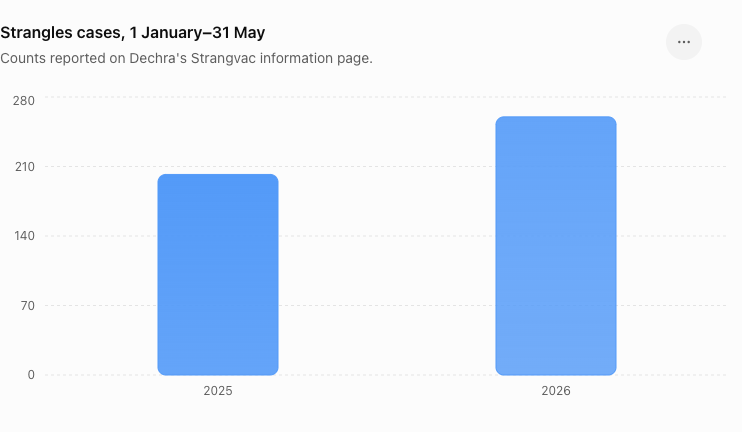
The company’s Strangvac information page separately reports the following comparison for the period 1 January to 31 May:
UK laboratory-confirmed cases reported by the SES network
For practitioners and horse owners, the central lesson is that surveillance, prompt veterinary assessment, biosecurity and appropriate vaccination decisions need to work together.
Strangvac: the vaccine at the centre of the campaign
 Product: Strangvac
Disease target: Equine strangles
Technology: Recombinant bacterial proteins
Regulatory status: The vaccine has an established European marketing authorisation; this campaign is not a new authorisation announcement.
Strangvac contains recombinant proteins derived from S. equi. According to the product information, it is indicated to reduce clinical signs and the number of abscesses in the relevant lymph nodes during the acute stage of infection.
The vaccine is not a guarantee against infection or transmission. Vaccinated horses may still become infected, so vaccination must be integrated with veterinary surveillance and appropriate biosecurity.
For product-specific indications, eligibility, administration, contraindications and adverse effects, veterinarians should consult the applicable local product information.
Business analysis: what this campaign means for the animal-health industry
The announcement illustrates several commercial strategies relevant to veterinary pharmaceutical companies.
Strategic area |
Industry implication |
|---|---|
Disease awareness |
Educational campaigns can increase recognition of diseases that owners may underestimate |
Veterinary engagement |
Practice toolkits support discussions between veterinarians and clients |
Preventive healthcare |
Vaccination can be positioned as one component of planned disease-risk management |
Digital marketing |
Targeted advertising can extend disease-awareness messaging beyond traditional veterinary channels |
Channel enablement |
Ready-to-use educational materials reduce the effort required for veterinary practices to communicate with clients |
Brand differentiation |
Product-specific education can build awareness around an established vaccine without requiring a new product launch |

