


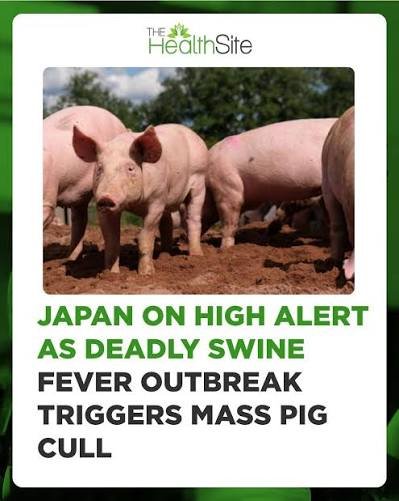
Japan has confirmed its 106th and 107th domestic classical swine fever (CSF) cases on commercial pig farms in Ehime and Gunma prefectures. Authorities are implementing culling, containment and epidemiological investigations, with the Gunma response highlighting the use of selective culling under Japan’s revised control framework.
Japan’s pig sector faces renewed disease-control pressure after classical swine fever was confirmed at farms in two prefectures within three days. The Ministry of Agriculture, Forestry and Fisheries (MAFF) confirmed infection at a farm in Ozu City, Ehime, on 7 October 2026, followed by a second outbreak in Shibukawa City, Gunma, on 10 October.
The Ehime farm held approximately 4,000 pigs. The affected Gunma farm held approximately 1,900 pigs, with a further epidemiologically linked farm in Shibukawa reported to hold around 900 pigs. The combined population on the affected and linked farms was therefore approximately 6,800 pigs, although this is not equivalent to the number culled.
Outbreak and response snapshot
Indicator |
Ehime |
Gunma |
|---|---|---|
Location |
Ozu City |
Shibukawa City |
Confirmation date |
7 October 2026 |
10 October 2026 |
Domestic case number |
106th |
107th |
Pigs on affected farm |
Approximately 4,000 |
Approximately 1,900 |
Linked farm |
Not specified in the cited announcement |
Approximately 900 pigs |
Response |
Culling, disposal and epidemiological investigation |
Selective culling, biosecurity and epidemiological investigation |
Sources: MAFF and Ehime Prefecture official updates.
Ehime: culling completed, containment subsequently reported
Ehime Prefecture reported that abnormalities at the Ozu farm were notified on 6 October. Following an on-site inspection and testing, the National Agriculture and Food Research Organization’s animal-health research institute confirmed CSF on 7 October.
The prefecture subsequently reported that culling was completed by 10 October and that farm-containment work was completed at 17:00 on 13 October. Ehime stated that vaccination of pigs in the prefecture meant that the usual movement and shipment restriction zones were not established following this incident. Authorities continue to emphasise farm hygiene, vaccination and surveillance of wild boar.
Gunma: selective culling and linked-farm surveillance
In Gunma, abnormalities were reported on 9 October at the Shibukawa farm. MAFF confirmed CSF on 10 October and ordered the response to proceed under Japan’s national control framework.
Japanese reporting on 13 October said the prefecture had applied selective culling, excluding certain asymptomatic pigs considered to have acquired immunity through vaccination, and had culled 1,935 pigs by 12 October. The final number may change as control operations continue. Authorities are also investigating the epidemiological link to a second farm holding approximately 900 pigs.
The cases underline that vaccination does not eliminate the need for surveillance, rapid reporting, strict biosecurity and targeted disease-control action.
Industry implications: biosecurity remains decisive
Classical swine fever is a highly contagious viral disease of domestic pigs and wild boar. It is distinct from African swine fever (ASF), despite similarities in the urgency of control measures. CSF does not infect humans, and Japan’s authorities state that infected pork is not permitted to enter the food market.
For commercial producers, the principal risks are production disruption, animal losses, disposal costs, movement controls where applicable, and the operational burden of epidemiological tracing and farm disinfection. The incidents also reinforce the importance of preventing virus movement through vehicles, people, equipment and contact with wild animals.
MAFF has called for timely and appropriate vaccination, compliance with livestock hygiene standards, farm disinfection, prevention of wild-animal entry and rapid notification of suspected cases. National epidemiological teams are being deployed to investigate potential routes of infection.
What the sector should watch
The next key indicators are completion of Gunma’s control operations, findings from epidemiological investigations, the status of the linked farm, and any additional detections in domestic pigs or wild boar. Producers should follow prefectural veterinary instructions and avoid visiting outbreak sites, which could inadvertently spread the virus.
Bottom Line
The Ehime and Gunma incidents are Japan’s 106th and 107th reported domestic CSF cases. The immediate priority is containment and trace-back, while the broader industry lesson is that vaccination must operate alongside rigorous biosecurity, surveillance and rapid response.
Sources: Japan MAFF — Ehime case, 7 October 2026; Japan MAFF — Gunma case, 10 October 2026; Ehime Prefecture CSF update.

