



As enforcement of the European Union Deforestation Regulation (EUDR) approaches, commercial grain exporters and multinational feed millers across South America have intensified farm-level auditing protocols. The regulatory mandate requires importers to prove that agricultural commodities—specifically soybeans and derived soybean meal—were not produced on land deforested after December 31, 2020.
In response, major agribusiness houses and crushers across Brazil and Argentina are deploying high-resolution satellite imagery, geographic information systems (GIS), and mobile plot-mapping technologies. This satellite-driven verification process aims to secure uninterrupted flow for South America’s multi-billion-dollar protein export trade into European and Asian markets.
1. Technological Scale-Up Across Brazilian and Argentine Crush Corridors
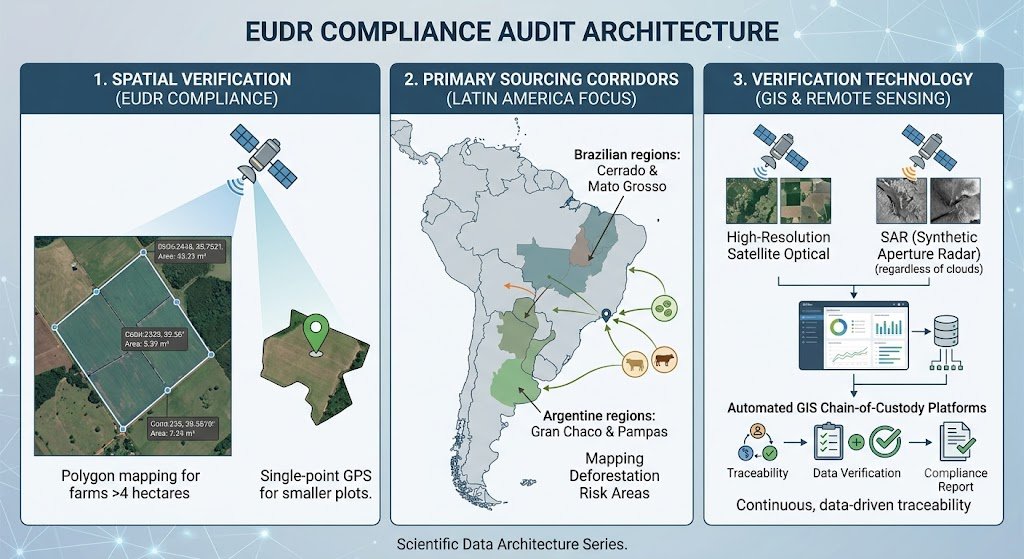
The EUDR framework requires bulk commodities entering European ports to be accompanied by a formal Due Diligence Statement (DDS) containing precise geolocation coordinates. For farm plots larger than four hectares, exporters must produce a polygon map detailing the exact spatial boundary of the cropland.
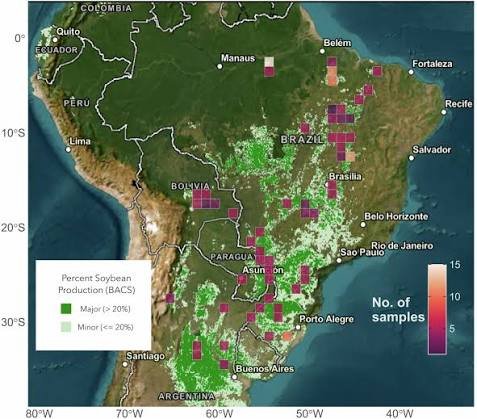
In Brazil, where soybean production spans millions of hectares across the Cerrado biome, crushers are integrating satellite radar and optical remote sensing into central procurement software. By overlaying property boundaries with national rural environmental registries (CAR) and historical deforestation tracking databases (such as PRODES), trading houses can instantly flag non-compliant soybean deliveries at rural collection elevators.
Argentine exporters are implementing similar digital tracking mechanisms across the Gran Chaco region. Processing facilities along the Paraná River are establishing identity-preserved supply channels to segregate fully traceable, deforestation-free soy from non-certified grain streams.
2. Supply Chain Segmentation and Market Bifurcation
While large integrated agribusinesses possess the capital to deploy automated GIS tracking platforms, mid-sized regional collectors and smallholder suppliers face operational hurdles
Key Drivers and Challenges in the Soy Supply Chain
-
- Strict Geolocation Requirements: For any plot of land over four hectares, the EUDR mandates precise polygon coordinates rather than a single GPS point. This ensures the entire area of production can be cross-referenced with historical satellite imagery
- Traceability to the Plot: Major agribusinesses operating in the Cerrado and Amazon biomes must trace every bean back to its specific farm polygon, creating massive data management challenges across complex, multi-tiered supply chains
- Indirect Suppliers: While tracking direct suppliers has improved, monitoring indirect suppliers—smaller farms that sell to middlemen or mix crops before final collection—remains a significant blind spot for the industry
- Data Privacy and Land Rights: Implementing widespread polygon mapping frequently runs into local legal hurdles, as land boundary data can conflict with national privacy laws or sensitive agrarian land disputes
Technological Solutions Being Deployed
Technology / Tool |
Application in EUDR Compliance |
|---|---|
High-Resolution Satellite Imagery |
Used to establish a clear baseline of forest cover as of December 31, 2020, and monitor subsequent land-use changes. |
Geospatial Platforms (e.g., MapBiomas, Trase) |
Leveraged by traders to cross-reference farm polygons with public environmental registries and illegal deforestation alerts. |
Blockchain & Secure Data Ledgers |
Integrated into supply chain logistics to securely pass polygon data from rural farms to international shipping ports without compromising proprietary commercial data. |
Financial and Logistics Implications for Feed Procurement
The administrative burden of polygon mapping and chain-of-custody certification is altering price spreads for South American soybean meal:
-
Identity-Preserved (IP) Premiums: Certified EUDR-compliant soybean meal is commanding cash premiums to offset software integration, farm auditing, and physical segregation costs at port terminals.
-
Elevator Bottlenecks: Country elevators operating without real-time GIS verification risk shipment rejections at port export terminals, forcing logistical shifts toward domestic crushing or non-EU export terminals.
-
Capital Allocation: Trading houses are increasing capital expenditure toward digital supply chain infrastructure, accelerating a structural shift toward fully digitalized bulk commodity trading.

