


The Department of Animal Husbandry and Dairying (DAHD), operating under the Ministry of Fisheries, Animal Husbandry and Dairying, has advanced the operational implementation of the Animal Feeds and Feed Ingredients (Quality Control) Order, 2026. Following its formal Gazette notification, the department is coordinating with Bureau of Indian Standards (BIS) auditors to enforce mandatory standard markings across domestic manufacturing facilities.
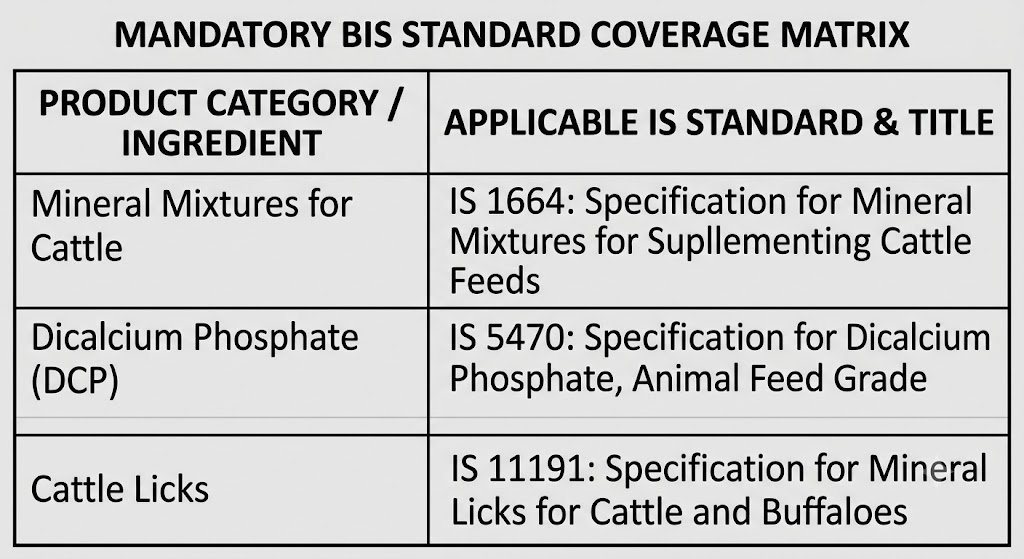
The quality framework covers core livestock nutrition categories, mandating compliance for cattle mineral mixtures, dicalcium phosphate (feed grade), and cattle licks. The policy aims to eliminate sub-standard, adulterated, or micro-nutrient-deficient feed inputs from the domestic supply chain, protecting livestock productivity and food-safety standards across India’s dairy sector.
The Department of Animal Husbandry and Dairying notified the Animal Feeds and Feed Ingredients (Quality Control) Order, 2026 published in the Gazette of India on October 12, 2026, mandating Bureau of Indian Standards (BIS) certification for key animal feed products.

Covered Categories and Standards
The order requires BIS Standard Mark compliance for mineral mixtures (IS 1664), dicalcium phosphate (IS 5470), and common salt/cattle licks (IS 920).
Implementation Timelines
Deadlines are phased by enterprise size: April 1, 2027, for general enterprises, July 1, 2027, for small enterprises, and October 1, 2027, for micro enterprises, with exemptions for export-only goods.
Enforcement and Penalties
The BIS enforces the order under Scheme-I of the BIS Regulations, 2018, and violations are punishable under the Bureau of Indian Standards Act, 2016.
Structural Impact on the Indian Feed Industry
The mandatory order is accelerating consolidation within India’s organized and unorganized feed sectors:
-
Organized Manufacturers: Large feed mills and dairy cooperatives (such as AMUL and KMF) with existing testing laboratories are streamlining compliance, leveraging ISI certification as a competitive quality indicator.
-
MSME and Small-Scale Producers: Micro, small, and medium enterprises face capital requirements to upgrade testing equipment and secure formal licensing, leading to technical partnerships and facility modernization.
-
Dairy Farmer Protection: Smallholder dairy producers benefit from guaranteed mineral bioavailability, mitigating metabolic disorders such as hypocalcemia (milk fever) and improving conception rates across rural crossbred herds.

