



WESTBROOK, Maine — November 3, 2026: IDEXX Laboratories reported strong third-quarter 2026 financial results on November 2, with revenue increasing 10% to $1.214 billion and diluted earnings per share (EPS) climbing 18% to $4.01. The veterinary diagnostics leader also raised its full-year 2026 revenue and earnings outlook, reflecting robust demand for companion-animal diagnostics, growing utilization of its diagnostic platforms and continued adoption of new technologies.
IDEXX Stock – listed on NASDAQ – was up by 22% at the close of trading hours on 2nd of November 2026 with each piece going for around USD 672 from its previos close of USD 551, thus adding over USD 8 Billion in market cap in a single trading day.
The company reported 11% growth in recurring Companion Animal Group (CAG) Diagnostics revenue, while international markets outpaced the United States. IDEXX also placed more than 1,900 inVue Dx analyzers during the quarter, taking the installed base to nearly 11,000 instruments.
The raised outlook signals management’s confidence in the durability of recurring diagnostic revenue growth, even as the company invests in artificial intelligence (AI), software capabilities and new diagnostic technologies. The acquisition of CoVet, an AI-powered clinical assistant for veterinary teams, adds another dimension to IDEXX’s strategy of integrating diagnostics and clinical workflow software.
Financial metric |
Q3 2026 |
Year-over-year performance |
|---|---|---|
Revenue |
$1,214 million |
+10% |
Gross profit |
$764.3 million |
+12% |
Gross margin |
62.9% |
+110 bps |
Operating expenses |
$362.0 million |
+10% |
Operating profit |
$402.3 million |
+13% |
Operating margin |
33.1% |
+100 bps |
Diluted EPS |
$4.01 |
+18% reported |
Comparable EPS |
$3.96 |
+22% comparable growth |
Free cash flow |
$420.8 million |
+13.35% |
bps = basis points. Comparable EPS adjusts for specified items and is not identical to reported EPS. Financial figures are in US dollars.
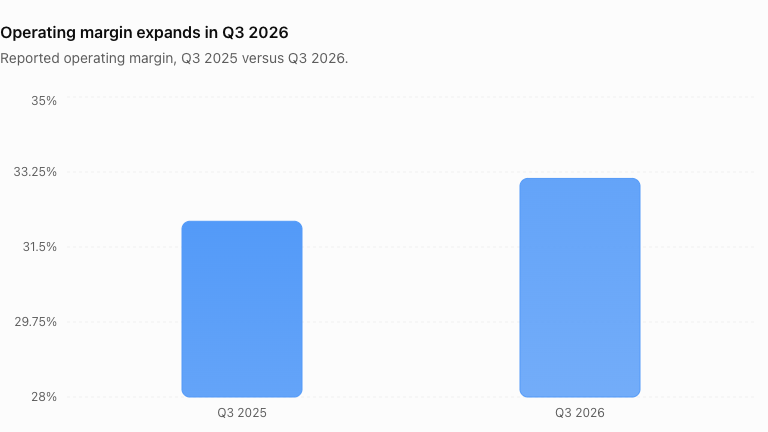
The results demonstrate that IDEXX is growing profit faster than revenue. Operating profit increased 13% against 10% revenue growth, while operating margin expanded by one percentage point. This suggests that higher diagnostic volumes, pricing, productivity improvements and operating leverage are helping the company absorb investments in innovation and commercial infrastructure.
Full-year 2026 guidance: Revenue and EPS outlook raised
The most consequential announcement was the upward revision to IDEXX’s full-year financial outlook. Management increased its revenue forecast following stronger-than-expected recurring diagnostics performance, while raising EPS guidance despite incorporating the financial impact of acquisitions.
Previous and updated full-year revenue guidance, in US$ billions. Bars show midpoint estimates.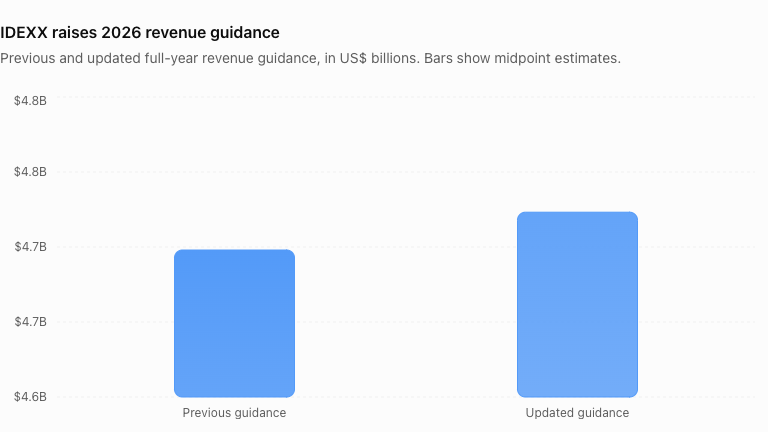
Updated versus previous guidance
Metric |
Previous outlook |
Updated outlook |
Change |
|---|---|---|---|
Full-year revenue |
$4.700–$4.745B |
$4.741–$4.767B |
Midpoint +$32M |
Reported revenue growth |
9.1%–10.3% |
10.1%–10.8% |
Raised |
Organic revenue growth |
8.5%–9.7% |
9.3%–10.0% |
Midpoint +0.6 percentage points |
CAG recurring diagnostics growth, reported |
10.1%–11.3% |
11.0%–11.7% |
Raised |
CAG recurring diagnostics growth, organic |
9.5%–10.7% |
10.3%–11.0% |
Midpoint +0.6 percentage points |
Diluted EPS |
$14.69–$14.94 |
$14.96–$15.16 |
Midpoint +$0.245 |
Operating margin |
32.3%–32.5% |
32.1%–32.3% |
Lowered |
Operating-margin expansion |
70–90 bps |
50–70 bps |
Reduced |
Revenue growth is accelerating beyond the previous forecast. The revised range implies full-year revenue of approximately $4.75 billion. The $32 million midpoint increase includes $5 million associated with the CoVet acquisition, with the remaining increase reflecting stronger operating performance and the updated outlook.
Recurring diagnostics remain the principal earnings engine. IDEXX now expects organic growth of 10.3%–11.0% in CAG Diagnostics recurring revenue. This is especially important because recurring revenues from consumables, laboratory testing and diagnostic services can provide a more durable growth foundation than one-off instrument sales.
Profitability guidance is more measured than the revenue outlook. Although the company raised EPS expectations, it reduced its projected operating-margin range by 20 basis points at both ends. Management cited acquisition-related impacts, including transaction costs, alongside continued investment in commercial capabilities and innovation. The message is therefore not simply that revenue is growing faster: IDEXX is balancing growth with spending on future capabilities.
Companion-animal diagnostics: The core growth engine
The Companion Animal Group remains the centrepiece of IDEXX’s financial performance. Revenue in the segment grew 10% in the third quarter, driven by recurring diagnostic testing, increased utilization of the installed instrument base, customer additions and product innovation.
Regional performance
Market |
CAG Diagnostics recurring revenue growth |
|---|---|
United States |
10% reported and organic |
International markets |
13% reported; 14% organic |
Total CAG Diagnostics recurring revenue |
11% reported and organic |
International markets delivered stronger organic growth than the United States, indicating that IDEXX’s growth opportunity extends beyond its domestic installed base. Currency and acquisition effects influence reported growth, so organic growth is the more useful measure for assessing underlying business momentum.
The performance also suggests that the company is gaining value from a combination of more tests per practice, new customers, product adoption and pricing rather than relying exclusively on an increase in veterinary visits.
Product-level performance: Consumables surge while rapid assays remain weak
IDEXX’s product mix provides important clues about the quality and durability of its growth.
Business line |
Q3 2026 revenue growth |
Key interpretation |
|---|---|---|
IDEXX VetLab consumables |
14% reported; 15% organic |
Strong utilization and recurring demand |
Reference laboratory diagnostics and consulting |
10% reported and organic |
Testing volumes, customer growth and pricing |
Rapid assay products |
1% reported and organic |
Pricing offset weaker testing volumes |
CAG capital instruments |
Flat reported and organic |
Strong placements did not translate into segment revenue growth |
Veterinary software, services and imaging |
11% reported; 10% organic |
Growing contribution from digital and imaging solutions |
Consumables: The installed-base advantage
VetLab consumables grew 15% organically. IDEXX also reported an 11% expansion in its global premium instrument installed base.
This relationship is strategically important. Instruments establish a presence within veterinary clinics, while the associated consumables generate revenue as tests are performed. A growing installed base can therefore create a recurring revenue stream, provided instruments are used regularly and customers remain within the ecosystem.
The combination of instrument placements, higher utilization and customer additions creates a potentially powerful compounding model: a larger installed base supports more testing, and more testing drives repeat consumables purchases.
Reference laboratories: A second recurring-revenue pillar
Reference laboratory diagnostics and consulting services grew 10% organically. This business benefits from testing volume, new customers and price realization.
Laboratory services also complement in-clinic diagnostics. Veterinary practices can use in-house instruments for immediate decisions while relying on external laboratories for tests requiring broader capabilities or specialized analysis.
Rapid assays: An area to monitor
Rapid assay revenue grew just 1%. IDEXX said pricing benefits offset lower testing volumes.
This is the clearest soft spot in the reported product-level performance. Investors should monitor whether the weakness reflects temporary utilization patterns, competitive pressures, changing test preferences or a more persistent slowdown in particular assay categories. The results announcement does not establish which explanation is dominant.
IDEXX inVue Dx: More than 1,900 placements in one quarter
IDEXX placed more than 1,900 IDEXX inVue Dx analyzers during Q3, helping take the installed base to nearly 11,000 instruments. The company also highlighted inVue Dx with fine-needle aspiration (FNA) capabilities as part of its innovation-led growth strategy.
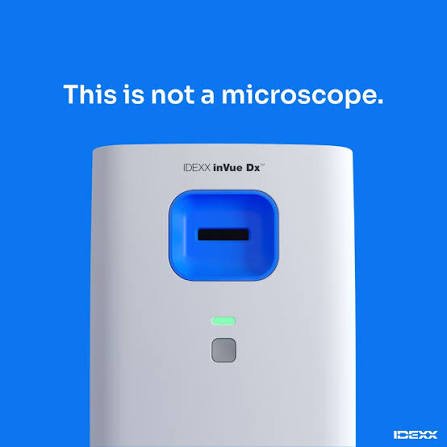
The commercial significance goes beyond the initial instrument sale.
-
Practice workflow: In-clinic diagnostic capabilities can help veterinary teams obtain clinically relevant information more efficiently.
-
Recurring consumables: A larger installed base can support subsequent consumables and testing revenue.
-
Customer retention: Integration into practice workflows may strengthen the relationship between IDEXX and veterinary clinics.
-
Cross-selling opportunities: Instrument customers may also use IDEXX laboratory services, software and other diagnostics.
Capital instrument revenue was nevertheless flat for the quarter. This distinction matters: placements are a useful indicator of future utilization potential, but placement growth should not be confused with immediate revenue growth or guaranteed future testing volumes.
IDEXX Cancer Dx expands its diagnostic ambitions
Management also highlighted the evolution of IDEXX Cancer Dx into a multi-cancer panel.
The strategic rationale is to extend diagnostic capabilities into additional disease categories and potentially support earlier or more comprehensive assessment of cancer in companion animals. It also reinforces the company’s broader strategy of expanding the clinical value of its existing veterinary customer relationships.
The earnings announcement did not provide separate revenue, adoption or clinical-outcome figures for the expanded panel. Its commercial contribution should therefore be viewed as a future growth opportunity rather than an established material earnings driver at this stage.
CoVet acquisition: AI enters the veterinary workflow
IDEXX’s acquisition of CoVet adds an AI-based clinical assistant intended to support veterinary team productivity and diagnostic utilization. The transaction is notable because IDEXX is extending its position beyond diagnostic instruments and tests into the software workflows surrounding veterinary consultations.
Potential areas of strategic value include:
-
Automating parts of clinical documentation and administrative work.
-
Helping veterinary teams manage consultation workflows more efficiently.
-
Supporting the use of diagnostic information in clinical decision-making.
-
Deepening software engagement with veterinary practices.
The acquisition is also reflected in the company’s financial guidance. IDEXX attributed $5 million of its revised full-year revenue outlook to CoVet, while management acknowledged acquisition-related impacts on profitability.
The near-term financial contribution is modest relative to IDEXX’s overall revenue base. The larger strategic question is whether AI-assisted workflow tools can increase customer retention, support diagnostic utilization and strengthen IDEXX’s software ecosystem over time. Those benefits remain prospective; the Q3 release does not quantify incremental diagnostics revenue attributable to CoVet.
Water and livestock diagnostics: Smaller businesses, broader exposure
IDEXX also reported growth outside companion-animal healthcare.
Business |
Q3 2026 revenue growth |
Main reported driver |
|---|---|---|
Water testing |
8% reported and organic |
North American growth |
Livestock, Poultry and Dairy (LPD) |
3% reported and organic |
Growth in the Americas |
Water testing provides exposure to water-quality monitoring, while LPD serves diagnostic needs associated with livestock, poultry and dairy production.
Although these businesses grew more slowly than companion-animal diagnostics, they diversify IDEXX’s revenue base and connect the company to wider animal-health, food-production and environmental-testing requirements.
For animal-health industry analysts, the contrast is useful: companion-animal diagnostics drove the strongest growth, while the livestock and poultry business expanded at a more moderate rate.
Margin expansion, operating leverage and earnings quality
IDEXX’s profitability improved alongside revenue growth.
Key risks and indicators to monitor
Issue |
Why it matters |
What to monitor |
|---|---|---|
Rapid assay growth |
Revenue rose only 1% |
Testing volumes and product-level recovery |
Veterinary visit trends |
Lower clinic traffic can pressure diagnostic demand |
Same-store visits and testing utilization |
Operating-margin guidance |
Full-year range was reduced despite higher EPS guidance |
Acquisition costs, investment spending and productivity |
Instrument placements |
Future recurring revenue depends partly on utilization |
Installed-base growth and consumables sales |
CoVet integration |
AI software may create opportunities but also costs |
Adoption, retention and measurable financial contribution |
International growth |
International organic growth outpaced US growth |
Regional revenue, currency and underlying demand |
Currency sensitivity |
Exchange rates affect reported results and guidance |
Foreign-exchange assumptions and actual movements |
The risks do not negate the strong quarter. Rather, they identify the metrics that will determine whether Q3 represents a sustainable growth trajectory or a particularly strong period within a more variable operating environment.
What IDEXX’s results mean for the animal-health industry
The results provide three broader signals for the veterinary diagnostics industry.
First, recurring diagnostics remain strategically valuable. The strong performance of consumables and reference laboratories illustrates the advantages of businesses that generate revenue from repeated testing rather than depending exclusively on equipment sales.
Second, instrument innovation is increasingly linked to workflow efficiency. The inVue Dx placements and expansion of Cancer Dx demonstrate the importance of diagnostic capabilities that can be integrated into veterinary practice operations. The commercial test is whether adoption translates into sustained utilization and recurring revenue.
Third, software and AI are becoming part of the competitive landscape. CoVet expands IDEXX’s footprint in veterinary clinical workflows. Over time, competition may increasingly involve integrated ecosystems combining instruments, laboratory services, data, software and clinical productivity tools—not just individual diagnostic products.
For companies competing with IDEXX, these developments reinforce the importance of customer retention, differentiated testing capabilities, recurring consumables revenue and integration with veterinary practice management.
Outlook: What matters most heading into the next quarter?
IDEXX exits Q3 with stronger revenue and earnings guidance, double-digit recurring diagnostics growth and continuing investment in new products and software.
The most important benchmarks for subsequent quarters are:
-
Whether CAG Diagnostics recurring revenue maintains organic growth around or above the newly projected 10.3%–11.0% full-year range.
-
Whether the expanding premium instrument base translates into further growth in consumables and testing volumes.
-
Whether operating margins stabilize within the revised full-year guidance of 32.1%–32.3%.
-
Whether rapid assay growth recovers from its current low level.
-
Whether CoVet and new diagnostic products deliver measurable commercial benefits beyond their initial launch or acquisition effects.

