


Zoetis narrows its 2026 revenue outlook but raises adjusted EPS guidance, as international livestock growth and portfolio innovation partly offset pressure in the US companion animal market.
Zoetis’ third-quarter 2026 results point to a business navigating an uneven animal-health market. The company reported revenue of $2.4 billion, down 1%, while adjusted diluted earnings per share (EPS) rose 3% to $1.75. The headline contrast is between a weaker US companion-animal business and stronger international and livestock performance.
The company narrowed its full-year revenue guidance to $9.22–$9.32 billion and raised its adjusted EPS outlook to $6.25–$6.35. The revised outlook suggests management is placing greater emphasis on earnings delivery and operational discipline while working through pricing sensitivity, competitive pressure and generic erosion in selected companion-animal categories.
Q3 2026 financial performance: earnings resilience despite softer revenue
For the three months ended September 30, 2026, Zoetis generated $2.391 billion in revenue, compared with $2.422 billion in the corresponding quarter of 2025. Revenue declined 1% on both reported and organic operational measures.
The earnings picture was more mixed. Reported net income fell 18% to $591 million, while adjusted net income declined 5% to $720 million. Reported diluted EPS decreased 12% to $1.44, but adjusted diluted EPS increased 3% to $1.75.
| Financial metric | Q3 2026 | Year-on-year change |
|---|---|---|
| Revenue | $2.391bn | -1% |
| Net income | $591m | -18% |
| Adjusted net income | $720m | -5% reported; -7% organic operational |
| Diluted EPS | $1.44 | -12% |
| Adjusted diluted EPS | $1.75 | +3% reported; +1% organic operational |
The gap between reported and adjusted earnings deserves attention. Zoetis said adjusted net income excluded a net $129 million impact from purchase-accounting adjustments, acquisition- and divestiture-related costs, and certain significant items. Adjusted measures are useful for understanding management’s view of underlying performance, but they are non-GAAP measures and should be read alongside reported earnings.
The nine-month numbers add another dimension. Revenue for the first nine months of 2026 was $7.121 billion, compared with $7.094 billion a year earlier—broadly flat on a reported basis. Over the same period, companion-animal revenue declined 4%, while livestock revenue increased 11%. This reinforces the quarter’s central theme: livestock is currently providing a stronger growth engine than companion animals.
US companion-animal business is the principal pressure point
The US segment reported Q3 revenue of $1.246 billion, down 6% from $1.322 billion in Q3 2025. The decline was driven primarily by companion-animal products. US companion-animal revenue fell 8%, with Zoetis identifying three principal pressures:
-
Greater price sensitivity: macroeconomic conditions are influencing pet-owner spending and willingness to pay for veterinary treatments.
-
Competitive pressure in dermatology: the company is facing a more challenging competitive environment in an important companion-animal therapeutic category.
-
Generic competition: generic alternatives are affecting sales in selected product areas.
This is strategically important because companion-animal medicines have been a major source of growth and innovation for the animal-health industry. Dermatology, parasiticides and chronic-pain management are particularly significant categories, supported by increasing expectations for longer-term management of pet health conditions.
The pressure is not uniform across the US business. Zoetis reported 5% growth in US livestock revenue, supported by cattle, swine and poultry. The contrast suggests that the current weakness is concentrated in parts of the companion-animal portfolio rather than reflecting a broad-based contraction across all animal-health markets.
International business delivers growth, led by livestock
The International segment generated approximately $1.1 billion in Q3 revenue, increasing 4% on both reported and organic operational bases.
| International business | Q3 2026 performance | Principal drivers |
|---|---|---|
| Companion animals | +1% reported; flat organic operational | Parasiticides and osteoarthritis pain; partly offset by weaker dermatology sales |
| Livestock | +8% reported; +9% organic operational | Growth in cattle and fish |
| Total International segment | +4% | Livestock strength and selected companion-animal categories |
International companion-animal revenue was relatively stable. Growth in parasiticides and osteoarthritis pain helped offset lower sales of key dermatology products. Livestock was the stronger contributor, with growth in cattle and fish.
The regional performance is relevant to the wider animal-health market. Livestock demand is influenced by disease prevention, herd productivity, food security, animal-protein production and the economics of commercial farming. These drivers can differ substantially from the consumer-spending factors affecting companion-animal medicines.
For Zoetis, international livestock growth provides diversification at a time when its US companion-animal franchise is under pressure. However, the company has not provided enough detail in the supplied results to attribute the international growth to individual countries or to quantify the contribution of particular livestock products.
Livestock portfolio: a key source of growth and diversification
The quarter’s species-level revenue figures provide further evidence of the shift in growth contribution.
| Business category | Q3 2026 revenue | Reported year-on-year change |
|---|---|---|
| Companion animals | $1.565bn | -5% |
| Livestock | $797m | +7% |
| Contract manufacturing and human health | $29m | +12% |
| Total | $2.391bn | -1% |
On an organic operational basis, companion-animal revenue declined 5%, while livestock revenue increased 7%. The livestock business therefore grew sufficiently to cushion the decline in the much larger companion-animal category.
This is a notable portfolio development. Companion animals still accounted for the majority of Q3 revenue, at approximately 65%, while livestock contributed about 33%. Yet livestock delivered the stronger growth rate. The remaining revenue came from contract manufacturing and human health.
The figures also highlight why a diversified animal-health portfolio matters. A company exposed to both pet medicines and production-animal health can draw on different demand drivers, although diversification does not eliminate the effect of weakness in a major business line.
Innovation and regulatory approvals: new products across companion animals and livestock
Despite the challenging revenue environment, Zoetis reported progress across its product pipeline and regulatory portfolio. The company said it remained on track for expected 2026 product approvals, with certain approvals previously anticipated in 2027 now expected in the fourth quarter of 2026.

Convenia RTU for Dogs: US FDA approval
In October 2026, Zoetis received US Food and Drug Administration approval for Convenia RTU for Dogs, a long-acting antibacterial injection.
The approval expands the company’s canine treatment portfolio and is expected to make the product available to veterinarians in Q1 2027. The launch will be worth monitoring for its commercial contribution and adoption by veterinary practices.
Lenivia and Portela: expansion of long-acting osteoarthritis treatment
Zoetis launched Lenivia for dogs in Great Britain and received Swiss approval for Portela for cats. Both expand access to long-acting osteoarthritis pain relief, with treatment intended to last for up to three months following a single injection.
Long-acting pain-management products are strategically important in veterinary medicine because they can reduce the frequency of administration and support continuity of treatment for animals with chronic conditions. Their commercial success will depend on clinical positioning, veterinary acceptance, reimbursement or affordability considerations, and competition within the OA category.
Simparica Trio: emergency authorisation for New World screwworm
Simparica Trio received US FDA Emergency Use Authorization (EUA) for the treatment of New World screwworm infestations in dogs and puppies.
The authorisation adds to Zoetis’ wider response to the New World screwworm threat, which also includes Dectomax and Dectomax-CA1 for other at-risk species.
New World screwworm is a significant animal-health concern because its larvae infest living tissue, potentially causing severe wounds, secondary infections and, in serious cases, death. The authorisation gives veterinarians an additional product option for the specified canine use. It should not be interpreted as a general approval for every species or every type of parasitic infestation.
Other regulatory approvals
The company also reported several approvals and label expansions across markets:
| Product | Market | Regulatory development |
|---|---|---|
| Fostera PRRS Needle-free microdose | US and Mexico | Approved to help protect pigs against porcine reproductive and respiratory syndrome (PRRS) |
| Vanguard B Oral | Brazil | Additional claim for protection of dogs against Bordetella bronchiseptica |
| Vanguard crLyme | Canada | Additional claim for protection of dogs against subclinical arthritis caused by Borrelia burgdorferi |
| Alfaxan Multidose 4% | Japan and Mexico | Approved for sedation of cats |
The approvals span swine respiratory disease prevention, canine infectious disease protection and feline anaesthesia. Collectively, they demonstrate the breadth of Zoetis’ regulatory activity across species and geographies.
Simparica Trio research and launch of Zoetis Medical Hub
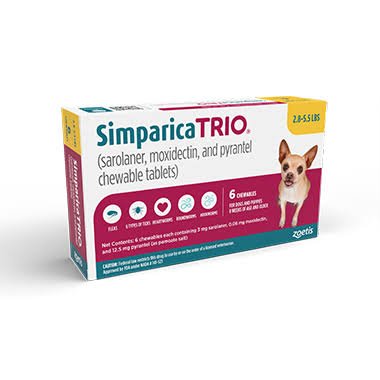
Zoetis highlighted a peer-reviewed study published in Parasites & Vectors comparing heartworm outcomes in dogs treated with Simparica Trio and NexGard Plus.
According to the company’s announcement, dogs treated with Simparica Trio had significantly lower average heartworm counts than dogs receiving NexGard Plus. At the end of the study, few dogs in the Simparica Trio group had adult heartworms.
The finding is commercially relevant because heartworm prevention is a competitive and clinically important segment of the companion-animal parasiticide market. Comparative efficacy research can influence veterinary recommendations, product differentiation and brand positioning.
However, the result should be interpreted within the study’s specific design, population, endpoints and treatment conditions. A single comparative study does not establish that one product is universally superior across all clinical settings. Veterinarians should consider the full published evidence and approved product labelling when making treatment decisions.
Zoetis has also launched the Zoetis Medical Hub, a platform intended to bring together medical expertise and peer-reviewed research. The initiative could strengthen the company’s scientific engagement with veterinarians by improving access to clinical information and product-related evidence.
Full-year 2026 guidance: revenue range narrowed, adjusted EPS raised
Zoetis has narrowed its full-year revenue guidance while raising its adjusted net income and adjusted diluted EPS outlook.
| Financial measure | Updated 2026 guidance | Previous guidance |
|---|---|---|
| Revenue | $9.220bn–$9.320bn | $9.120bn–$9.320bn |
| Organic operational revenue growth | -2% to -1% | -3% to -1% |
| Adjusted net income | $2.600bn–$2.640bn | $2.570bn–$2.620bn |
| Adjusted net income organic operational growth | -7% to -5% | -9% to -5% |
| Adjusted diluted EPS | $6.25–$6.35 | $6.15–$6.25 |

