HomeCompanion AnimalsVet Care, Pet Care Is Becoming Too Expensive: US and UK Sound...

Vet Care, Pet Care Is Becoming Too Expensive: US and UK Sound the Same Warning

Pet owners on both sides of the Atlantic are facing an identical financial squeeze. From New York to London, the rapidly climbing cost of veterinary care has turned companion animal medicine into a major household expense.

The crisis has escalated past minor complaints about prescription fees. High-level regulatory panels, national veterinary associations, and government bodies in both the United States and the United Kingdom have issued parallel warnings: the current financial model of veterinary care is becoming unsustainable for the average family.

The United States and the United Kingdom have very different veterinary systems. Yet new data from both countries are pointing to the same problem: many pet owners are finding veterinary care increasingly difficult to afford.

In the US, veterinary clinic visits are falling while customers become more sensitive to prices. At the 2026 convention of the American Veterinary Medical Association, the number of sessions specifically focused on cost, affordability and access to care more than doubled.

In the UK, the Competition and Markets Authority has gone much further. After a two-year investigation, the regulator concluded that veterinary prices had risen far faster than general inflation and announced legally binding changes covering prices, prescriptions and ownership information.

The message from both markets is becoming difficult to ignore.

Veterinary medicine may be advancing rapidly, but an increasing number of pet owners are struggling to pay for it.

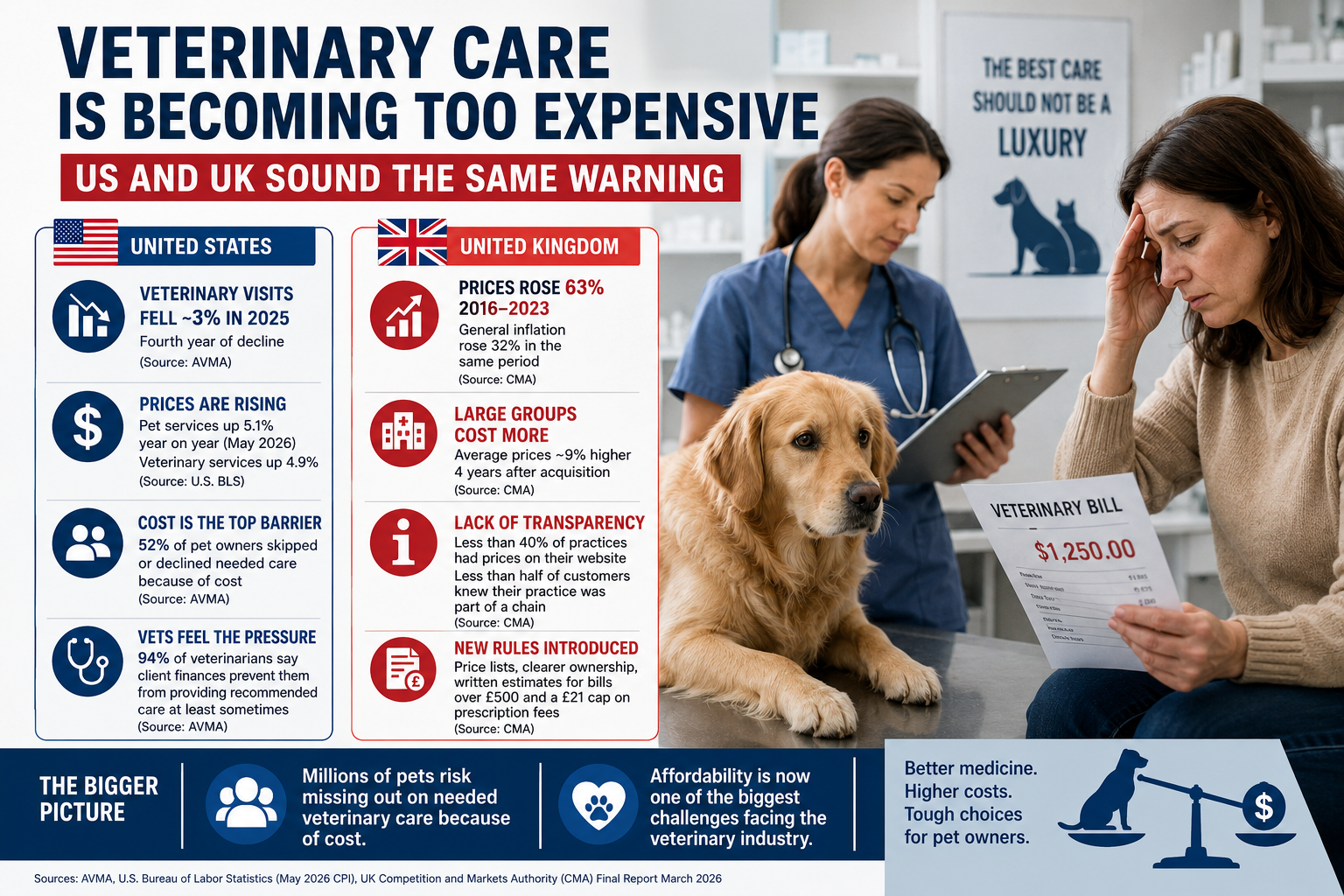
US veterinary visits fell about 3% in 2025

The latest US veterinary business data provide an early warning. According to AVMA reporting, veterinary practices recorded revenue growth of about 2.5% in 2025, but the number of visits fell by roughly 3%.

This continued a four-year pattern of declining veterinary visits. The AVMA also reported increasing price sensitivity among pet owners. The numbers matter because rising revenue does not necessarily mean that more animals are receiving veterinary care.

A clinic can earn more money by charging higher prices even while seeing fewer patients.

US government inflation data add to the picture. In May 2026, prices for pet services including veterinary care were 5.1% higher than a year earlier. Veterinary services alone were up 4.9% year on year. The concern is simple: prices are rising while visits are declining.

More than half of US pet owners have skipped needed veterinary care The affordability problem is even clearer when pet owners are asked directly.

Research highlighted in the AVMA Convention analysis found that 52% of pet owners had skipped or declined veterinary care that their pet needed. Cost was the most common reason.

A separate survey of practising veterinarians found that 94% said a client’s financial situation at least sometimes prevented them from providing the care they recommended. Cost was cited more than twice as often as any other reason for owners declining treatment.

The size of the wider care gap is substantial. PetSmart Charities has estimated that providing adequate veterinary care to pets currently receiving none could require more than $20 billion every year. This is no longer a problem affecting only low-income households.

The veterinary industry is increasingly discussing whether routine diagnostics, emergency treatment, surgery and long-term disease care are becoming financially difficult for a much broader group of pet owners.

AVMA Convention 2026 puts affordability on the main agenda

The programme at AVMA Convention 2026 shows how quickly the issue has moved up the veterinary agenda.

An analysis of the published convention programmes found 11 sessions mentioning cost, affordability, access or different levels of care in 2025. In 2026, that number has increased to 24 sessions.

Seven of the sessions were placed inside a new “Reducing Barriers to Care Symposium”. No equivalent dedicated programme existed in 2025. The wider convention programme increased from 646 core education sessions in 2025 to 723 in 2026. Yet affordability was one of the themes showing the largest increase.

Sessions covered practical questions such as treating common emergencies on a limited budget and deciding what care can realistically be offered when a pet owner’s finances are restricted. This is an important change in veterinary medicine.

The traditional discussion was often about the best possible treatment. The newer discussion is increasingly about the best treatment a pet owner can realistically afford.

UK veterinary prices rose 63% in seven years

If the US data are a warning, the UK investigation shows what can happen when veterinary affordability becomes a national political and competition issue. The UK’s Competition and Markets Authority, or CMA, published its final veterinary services investigation in March 2026.

Its findings were striking. Between January 2016 and December 2023, average veterinary prices increased by 63%.

Over the same period, general consumer inflation increased by about 32%. Average first-year veterinary treatment expenses increased by 53%.

In simple terms, veterinary prices increased at almost twice the rate of general inflation during the period studied. The CMA concluded that there were “significant and widespread problems” in the market and that weak competition and poor price information were contributing to higher costs.

Large veterinary groups were, on average, more expensive

The UK investigation also examined the growth of large veterinary groups. The CMA found that most large groups had higher average prices than independent veterinary practices.

For at least three of five large veterinary groups that had acquired independent practices since 2015, the CMA’s analysis found that average prices were about 9% higher four years after acquisition than the previous price trend would have suggested.

For at least three of the five groups, insurance claim values were also about 5% higher four years after acquisition. Customer satisfaction data showed another gap.

Net satisfaction with the cost of veterinary services was 26% among customers of large veterinary groups, compared with 47% among customers of independent practices. The CMA was careful not to blame individual veterinarians.

Its final report specifically recognised the professionalism and commitment of veterinary teams and warned that individual vets often face public anger over pricing problems they do not control. The issue, according to the regulator, is how the veterinary market operates.

Many UK pet owners did not even know who owned their veterinary clinic. Price was only part of the problem. The CMA found that less than 40% of veterinary practices had prices on their websites, and the prices shown often covered only a limited number of services.

When the investigation began, only 16% of practices had any prices on their websites. Ownership was also unclear.

Less than half of customers using a large veterinary group knew that their practice was part of a chain.

This matters because a veterinary clinic may retain its familiar local name after being bought by a large company. A pet owner may therefore believe that they are using an independent local practice when the clinic is actually owned by a national or international veterinary group.

UK introduces price lists and a £21 prescription fee cap

The UK response is now moving from investigation to action. The CMA’s final measures include mandatory price lists covering standard veterinary services, common procedures, diagnostics, written prescriptions and other charges.

Veterinary businesses will also have to make group ownership clearer. Price and ownership information will be made available through the Royal College of Veterinary Surgeons’ “Find a Vet” service and can be shared with price comparison services.

For treatments costing more than £500, pet owners will have to receive written estimates. Bills will need to be itemised. The CMA has also capped the fee for a written veterinary prescription at £21. Pet owners must be told that medicines may be available more cheaply elsewhere and that they can ask for a prescription.

The CMA believes stronger competition in veterinary medicines could save some pet owners hundreds of pounds.

US and UK are responding differently to the same issue

The two countries have not reached exactly the same point. In the United States, the affordability issue is largely being discussed through falling visits, customer behaviour and the need to offer different treatment choices.

In the UK, affordability has become a formal competition and regulatory issue. But the underlying signs are remarkably similar.

Prices are rising. Pet owners are becoming more price-sensitive. Some owners are delaying or refusing care. Veterinary professionals are increasingly having to change treatment plans because of cost.

The difference is mainly in the response. The US veterinary profession is debating how to improve access and offer care at different price levels.

The UK regulator is forcing greater price transparency and introducing direct limits on some fees. Better veterinary medicine has also made veterinary care more expensive

It would be misleading to suggest that every increase in veterinary prices is caused by corporate ownership or excessive profit. Veterinary medicine has changed dramatically.

Modern clinics increasingly use advanced blood testing, ultrasound, CT and MRI scans, specialist surgery, cancer treatment and long-term medicines. Veterinary businesses also face staff, equipment and operating costs.

The CMA itself recognised that veterinary businesses need to make a reasonable profit and invest in modern treatment. The problem arises when price increases move far ahead of wider inflation and owners cannot easily compare costs or understand their treatment choices.

The UK investigation concluded that investments and higher business costs did not fully explain the 63% rise in average veterinary prices between 2016 and 2023.

Affordability could become the biggest growth risk for the pet health industry

The animal health industry has spent years discussing the growth of the global pet healthcare market.

Pets are living longer. Owners are seeking better treatment. New medicines are being developed for pain, skin disease, cancer and long-term illness. Veterinary diagnostics are becoming more advanced. But there is a basic commercial risk.

A medicine, diagnostic test or specialist treatment has limited value if the pet owner cannot afford to enter the veterinary clinic. The US data already show declining visits. The UK has now introduced legally binding reforms after finding that prices rose 63% in seven years.

And at AVMA Convention 2026, affordability and access sessions have more than doubled from 11 to 24 in a single year. These are not isolated statistics. Together, they point to a major change in the veterinary industry.

Next veterinary battle may be over affordable care

For years, veterinary healthcare competed on better medicines, better diagnostics and more advanced treatment. Those areas will remain important.

But the next phase of competition may increasingly focus on price transparency, lower-cost treatment choices, preventive care, generic medicines, pet insurance, payment options and simpler diagnostic pathways. The warning from the US and UK is increasingly similar.

Veterinary care is becoming more advanced. It is also becoming more expensive. If prices continue to rise faster than pet owners’ ability to pay, access to veterinary care could become one of the defining animal health issues of the decade. Zoetis highlighted this briefly in its Q1′ 2026 earnings call – analysts will now pay more attention to its Q2′ call pretty soon.

Animal Health India Editorial Team
Animal Health India Editorial Teamhttps://animalhealthindia.com
Animal Health India (AHI) is an independent news and intelligence platform covering the global animal health, veterinary, livestock, poultry, companion animal and pet food sectors. Our editorial team comprises veterinary journalists, animal health professionals, regulatory affairs specialists and industry analysts with over 30 years of combined experience covering India, Asia, Europe and North America. AHI publishes news, regulatory updates, market intelligence and company news drawn from primary sources including DAHD, EMA, USDA, AVMA and leading veterinary publications worldwide.
RELATED ARTICLES