


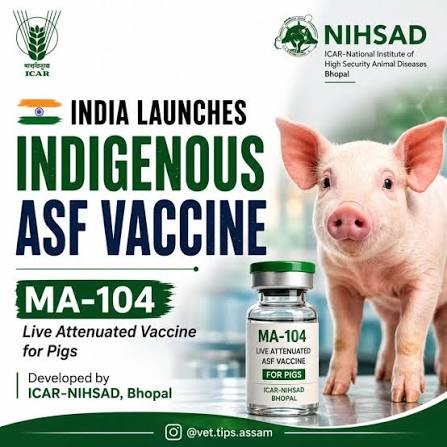
As increasing number of countries grapple with the continued threat of extensive losses due to African Swine Fever – India joins the list of select countries in having developed an indigenous Vaccine for ASF.
ICAR-developed breakthrough ASF Vaccine strengthens India’s fight against African Swine Fever and boosts self-reliance in veterinary vaccine innovation.
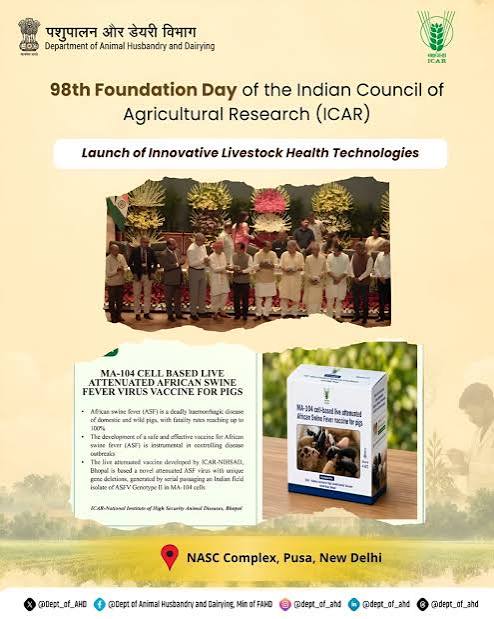
In a major milestone for India’s animal health sector, the Indian Council of Agricultural Research (ICAR) has unveiled the country’s first indigenous MA-104 cell-based live attenuated vaccine against African Swine Fever (ASF). The vaccine was introduced during the 98th Foundation Day celebrations of ICAR at the National Agricultural Science Centre (NASC) Complex in New Delhi and represents a significant advance in India’s efforts to control one of the world’s most devastating diseases affecting pigs.
Developed by scientists at the ICAR–National Institute of High Security Animal Diseases (ICAR-NIHSAD), Bhopal, the vaccine has been created using an Indian field isolate of African Swine Fever Virus (ASFV) Genotype II. Researchers attenuated the virus through serial passage in the commercially available MA-104 cell line, producing a vaccine candidate designed for scalable manufacturing and future commercial production.
Major Step Against a Devastatingly Deadly Pig Disease
African Swine Fever is one of the most serious viral diseases affecting domestic and wild pigs. The disease causes high fever, severe internal bleeding and mortality that can approach 100% in susceptible animals. Although ASF does not infect humans and does not pose a food safety risk, it causes enormous economic losses through pig deaths, movement restrictions and disruption of pork production.
Since the disease was first reported in India in 2020, outbreaks have affected several states, particularly in the North-Eastern region, where pig farming is an important source of livelihood. Thousands of pig farmers have suffered significant financial losses due to mortality and culling programmes aimed at containing the disease.
Innovative Cell-Based Vaccine Technology
The newly developed vaccine is based on MA-104 cell culture technology, an approach that supports more consistent and scalable vaccine production compared with traditional laboratory methods.
According to ICAR, scientists generated a live attenuated ASF virus with targeted genetic changes after repeated passage of the Indian virus isolate in MA-104 cells. The resulting vaccine strain demonstrated stable growth characteristics in the cell line, an important requirement for large-scale manufacturing.
Cell-based vaccine production has become increasingly important in veterinary medicine because it can improve manufacturing efficiency, product consistency and the ability to produce vaccines in larger quantities.
Strengthening India’s Disease Preparedness
The launch of the indigenous vaccine reflects India’s growing investment in veterinary research and livestock disease preparedness.
The development also supports the Government of India’s Atmanirbhar Bharat (Self-Reliant India – better than MAGA) initiative by reducing dependence on imported animal health technologies and strengthening domestic vaccine innovation. During the Foundation Day event, Union Agriculture Minister Shivraj Singh Chouhan highlighted the importance of translating publicly funded agricultural research into practical technologies that directly benefit farmers.
Potential Benefits for India’s Pig Industry
If successfully commercialised following regulatory evaluation, the vaccine could offer several advantages:
Improved protection against African Swine Fever.
Reduced pig mortality during outbreaks.
Lower economic losses for pig farmers.
Greater stability for India’s pork production sector.
Reduced dependence on imported veterinary vaccines.
Enhanced national preparedness against transboundary animal diseases.
The vaccine is expected to be particularly valuable for pig-producing states in North-East India, where ASF outbreaks have had a significant economic impact.
Regulatory Evaluation Still Required
Although the vaccine has been officially unveiled, it has not yet entered widespread commercial use. Further steps are expected to include:
- Regulatory review
- Field validation studies
- Licensing
- Commercial manufacturing
- Distribution through approved veterinary channels
Additional information on efficacy under field conditions, duration of immunity and vaccination strategies is expected as these evaluations progress.
Growing Global Interest in ASF Vaccines
African Swine Fever continues to challenge pig industries across Asia, Europe and parts of Africa. Because there is no effective treatment for infected animals, disease control currently depends on strict biosecurity, rapid diagnosis, movement controls and culling of affected herds.
The development of safe and effective vaccines has therefore become a major global research priority. India’s indigenous MA-104 cell-based vaccine places the country among a small group of nations advancing home-grown ASF vaccine technologies and highlights the increasing role of Indian research institutions in addressing major livestock health challenges.
Outlook
The unveiling of India’s first indigenous MA-104 cell-based live attenuated ASF vaccine marks an important scientific achievement for the country’s veterinary research community. While regulatory approval and large-scale field deployment remain the next critical steps, the vaccine has the potential to become an important tool in protecting India’s pig population, improving farmer livelihoods and strengthening national preparedness against one of the most economically damaging diseases affecting the global swine industry.

