


Milk output up 70% in a decade, egg production touches 149.11 billion, while disease-free zones and digital livestock tracking strengthen India’s export ambitions
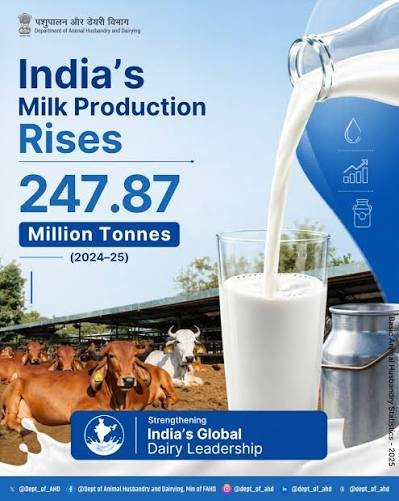
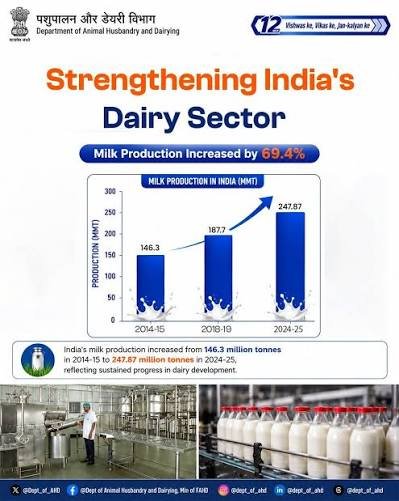
India has reinforced its position as the world’s largest milk producer, with annual milk production reaching approximately 248 million tonnes, according to the latest performance data presented in Parliament by the Ministry of Fisheries, Animal Husbandry & Dairying (MoFAH&D).
The government reported that national milk production has increased by around 70% over the past decade, significantly outpacing population growth and ensuring domestic self-sufficiency in one of the country’s most important food commodities.
Alongside record milk production, India’s egg production has reached 149.11 billion eggs annually, representing an increase of nearly 90% over the past decade, highlighting the rapid expansion of the country’s poultry sector.
The latest figures underscore the growing importance of India’s livestock economy, which continues to play a critical role in rural employment, nutritional security, agricultural income diversification and export growth.
India’s Dairy Sector Continues Global Leadership
India has remained the world’s largest milk producer for several consecutive years, contributing nearly one-quarter of global milk production. According to government data:
-
Annual milk production: ~248 million tonnes
-
Growth over the past decade: approximately 70%
-
Global ranking: No. 1 milk producer
-
Production exceeds domestic demand, supporting national food security
The sustained increase has been driven by multiple factors, including:
-
Genetic improvement programmes
-
Expanded artificial insemination services
-
Better animal nutrition
-
Improved veterinary healthcare
-
Increased adoption of scientific dairy management
-
Government support through livestock development schemes
The dairy sector remains one of India’s largest agricultural industries, providing livelihoods to millions of rural households, particularly smallholder farmers and women.
Poultry Industry Achieves Record Egg Production
India’s poultry sector also recorded significant growth. Government figures show:
-
Egg production: 149.11 billion eggs annually
-
Growth over the last decade: approximately 90%
The increase reflects sustained investment in:
-
Commercial layer farming
-
Improved poultry genetics
-
Better disease surveillance
-
Modern hatcheries
-
Enhanced feed efficiency
-
Biosecurity improvements
India is now among the world’s largest egg-producing nations, with production supporting both domestic consumption and export opportunities.
Livestock Health Becomes a National Export Strategy
While production growth remains important, the government has increasingly shifted its focus towards improving animal health infrastructure to strengthen export competitiveness. A major pillar of this strategy is the Livestock Health and Disease Control Programme (LHDCP).
The programme supports:
-
Prevention and control of major livestock diseases such as FMD and Brucellosis
-
National vaccination campaigns
-
Veterinary diagnostic laboratories
-
Disease surveillance systems
-
Strengthening veterinary infrastructure
-
Capacity building for field veterinarians
Reducing the burden of economically important diseases is expected to improve livestock productivity while helping India meet international sanitary requirements for export markets.
Disease-Free Zones Open New Export Opportunities
One of the most significant initiatives highlighted by the Ministry is the expansion of Disease-Free Zones (DFZs). These zones are established in accordance with international animal health standards to demonstrate freedom from specified livestock diseases.
Disease-Free Zones can provide several advantages:
-
Improved access to premium international markets
-
Greater confidence among importing countries
-
Reduced trade restrictions
-
Better export prices
-
Increased investment in livestock production
For exporters of dairy products, bovine meat, buffalo meat and other livestock commodities, internationally recognised disease-free areas are becoming increasingly important for market access.
Bharat Pashudhan Brings Digital Traceability to Indian Livestock
Another key initiative supporting India’s livestock transformation is the Bharat Pashudhan digital livestock database. The platform aims to improve traceability across the livestock value chain through digital animal identification and record management.
Improved traceability has become an essential requirement for many international meat and dairy importing countries. Digital livestock identification also enables faster responses during disease outbreaks and improves the efficiency of veterinary services.
Why Traceability Matters for Global Trade
Global food markets increasingly require proof of:
-
Animal identity
-
Health status
-
Vaccination history
-
Disease surveillance
-
Farm-level traceability
Major export destinations increasingly demand transparent supply chains that comply with international sanitary and phytosanitary (SPS) standards.
Digital livestock databases such as Bharat Pashudhan can help Indian producers meet these evolving requirements while strengthening consumer confidence.
Economic Importance of India’s Livestock Sector
The livestock sector is one of the fastest-growing segments of Indian agriculture. Its contribution extends beyond food production. The sector supports: Millions of dairy farmers, Poultry producers, Sheep and goat farmers, Buffalo production systems, Veterinary healthcare services, Animal nutrition companies, Vaccine manufacturers and Feed producers
For many smallholder households, livestock represents a stable source of daily income and financial resilience.
Veterinary Health at the Centre of Productivity
Higher production levels are closely linked with improved animal health. Government-supported veterinary programmes continue to focus on:
-
Foot-and-mouth disease (FMD) control
-
Brucellosis control
-
Lumpy skin disease surveillance
-
Classical swine fever management
-
Peste des petits ruminants (PPR) control
-
Avian disease monitoring
Reducing disease prevalence not only improves productivity but also lowers economic losses associated with mortality, reduced fertility and lower milk yields.
Industry Outlook
The latest government data indicate that India is entering a new phase of livestock development where productivity, disease control and digital traceability are becoming as important as production volume.
Record milk and egg production demonstrate the strength of the country’s livestock sector, while programmes such as the Livestock Health and Disease Control Programme (LHDCP) and Bharat Pashudhan are laying the foundation for improved animal health, stronger disease surveillance and enhanced export competitiveness.
If successfully implemented, these initiatives could help India expand its presence in global dairy and livestock markets while improving farmer incomes, strengthening food security and supporting the long-term growth of the country’s animal health industry.
Key Statistics
Indicator |
Latest Government Figure |
|---|---|
Annual milk production |
~248 million tonnes |
Growth in milk production (10 years) |
~70% |
Annual egg production |
149.11 billion eggs |
Growth in egg production (10 years) |
~90% |
Global milk production ranking |
1st |
Major government programmes |
LHDCP, Bharat Pashudhan |
Strategic focus |
Disease-free zones, livestock traceability, export readiness |

