


Southeast Asia’s rapidly growing food processing and animal feed sectors are placing a premium on consistency, protein quality, and supply chain transparency. As competition among global agricultural exporters intensifies, US soybean producers are leveraging superior intrinsic quality and advanced identity-preserved (IP) logistics to maintain a decisive competitive edge across Association of Southeast Asian Nations (ASEAN) markets.
At an industry summit in the region, a panel of US farmers, exporters, and trade representatives—including Jeff O’Connor, Mike Koehne, Grant Fausset, Scott Sinner, Mareyoshi Tanaka, and Will McNair—addressed the evolving dynamics of the global soy trade. While acknowledging structural headwinds, the panel emphasized that superior end-use performance remains the primary driver of ASEAN buyer preference for US soy.
Navigating Global Supply Chain and Production Headwinds
US soybean growers face an increasingly complex operating environment. Key challenges highlighted during the industry discussion include:
-
Global Supply Chain Volatility: Fluctuating freight rates, geopolitical shifts, and maritime bottlenecks necessitate resilient, multi-modal supply chains.
-
Generational Farmland Transfer: As a significant portion of US farmland transitions to the next generation of operators, maintaining long-term stewardship and production scale requires capital-intensive technology adoption.
-
Niche Demand vs. Commercial Scale: Balancing high-yield transgenic (GMO) commodity crops with specialized, food-grade non-GMO varieties tailored for traditional Asian soy foods (such as tofu, tempeh, and soy milk) requires precise field management and dedicated IP handling.
Despite these operational pressures, the commitment of US farmers to precision agriculture and sustainable land management continues to yield high-performing crops designed for demanding international buyers.
Quality Advantage: Why ASEAN Processors Prefer US Soy
For food manufacturers and feed mill operators across ASEAN nations—including Vietnam, Indonesia, Thailand, the Philippines, and Malaysia—the decision to source US soybeans extends beyond raw bulk pricing. The value proposition rests on several key biochemical and processing metrics:
1. Superior Amino Acid Profile and Digestibility
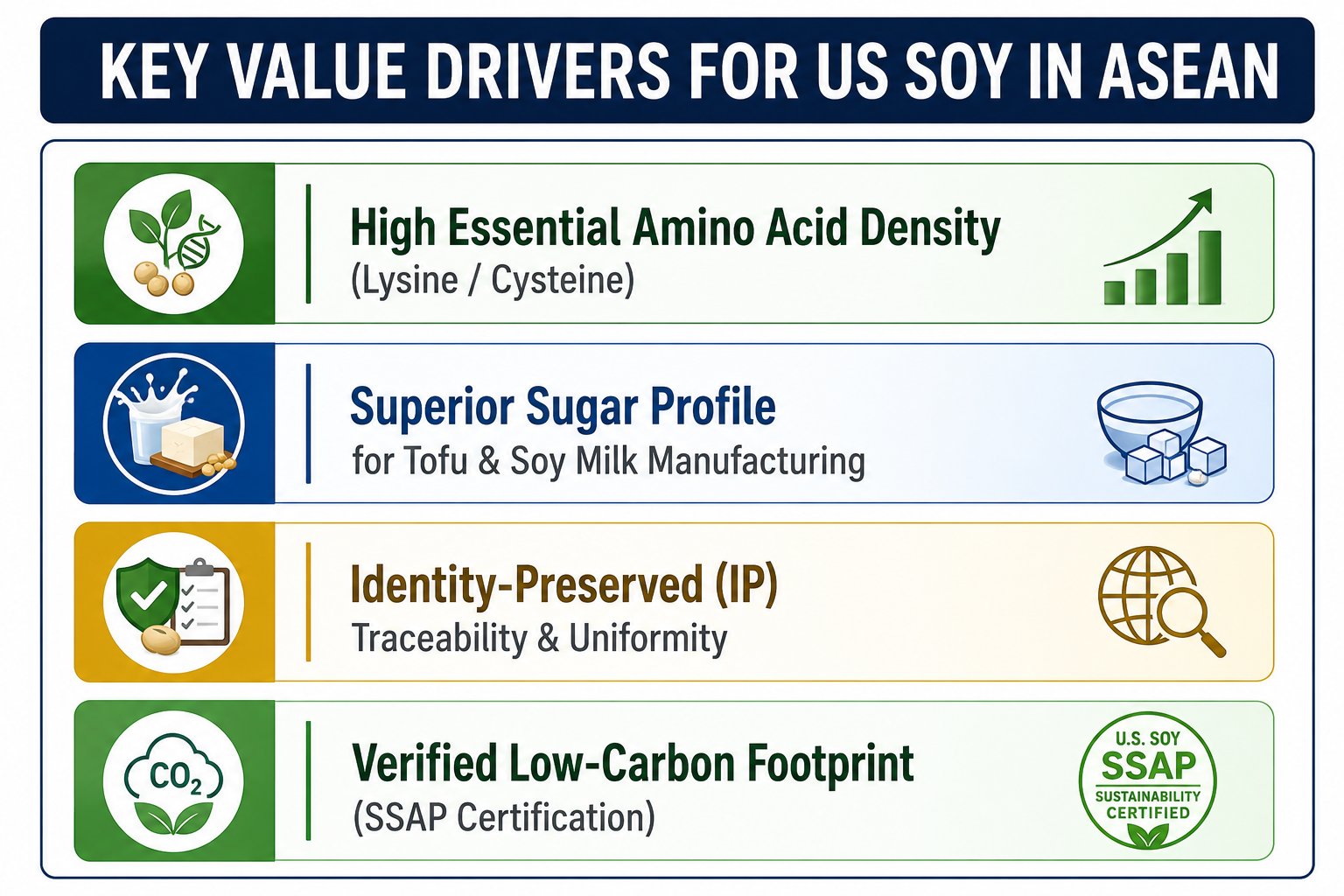
While raw crude protein percentages can fluctuate based on weather and geography, US soybeans consistently deliver an optimal essential amino acid profile—specifically high concentrations of lysine, cysteine, and methionine. In animal feed formulations, this translates to higher nutrient density, superior feed conversion ratios (FCR), and reduced reliance on synthetic amino acid additives.
2. Food-Grade Consistency for Traditional Soy Products
For human food processors producing tofu, soy milk, and fermented products, sugar content (sucrose and oligosaccharides), bean uniformity, and high water-absorption capacity are critical. US Identity-Preserved (IP) specialty soybeans offer:
-
Higher tofu yields per kilogram of dry seed.
-
Light hilum color, ensuring clean, appealing visual presentation in soy milk and curd.
-
Consistent protein solubility (NSI – Nitrogen Solubility Index) for optimal coagulation.
3. Supply Chain Traceability and Sustainability
Modern ASEAN buyers increasingly require verifiable sustainability credentials to meet corporate environmental goals. Under the U.S. Soy Sustainability Assurance Protocol (SSAP), US soy exports offer certified farm-level sustainability metrics, tracking conservation tillage, crop rotation, and carbon efficiency.
Strategic Outlook for US-ASEAN Soy Trade
As Southeast Asian populations grow and dietary preferences shift toward higher protein consumption, demand for high-quality oilseeds will continue to expand. Industry experts emphasize that maintaining market share in ASEAN will require continued investment in:
-
Custom Variety Breeding: Developing non-GMO and specialty food-grade soy lines tailored specifically to the regional taste and processing specifications of ASEAN food manufacturers.
-
Containerized IP Shipping: Expanding containerized supply chains to allow smaller and mid-sized food processors in Southeast Asia to receive direct, traceable shipments of specialized soy varieties.
-
Technical Trade Partnerships: Providing ongoing technical assistance and formulation support to feed millers and food scientists across the region to maximize processing yields.

