



The U.S. Soybean Export Council (USSEC) concluded its flagship global conference, Soy Connext 2026, in Chicago last week with a record-breaking gathering of more than 800 industry leaders, growers, and international trade buyers.
The event convened approximately 400 international buyers from 67 countries, including a delegation of 30 major Chinese customers, signalling strong global demand and renewed confidence in U.S. Soy.
Against the backdrop of shifting geopolitical trade dynamics, USSEC leaders presented market data demonstrating that the organization’s strategic emphasis on global market diversification—paired with a normalization of trade relations with China—is positioning U.S. Soy for a strong export recovery in the 2026/27 Marketing Year (MY).
Key Conference Highlights & Market Takeaways
-
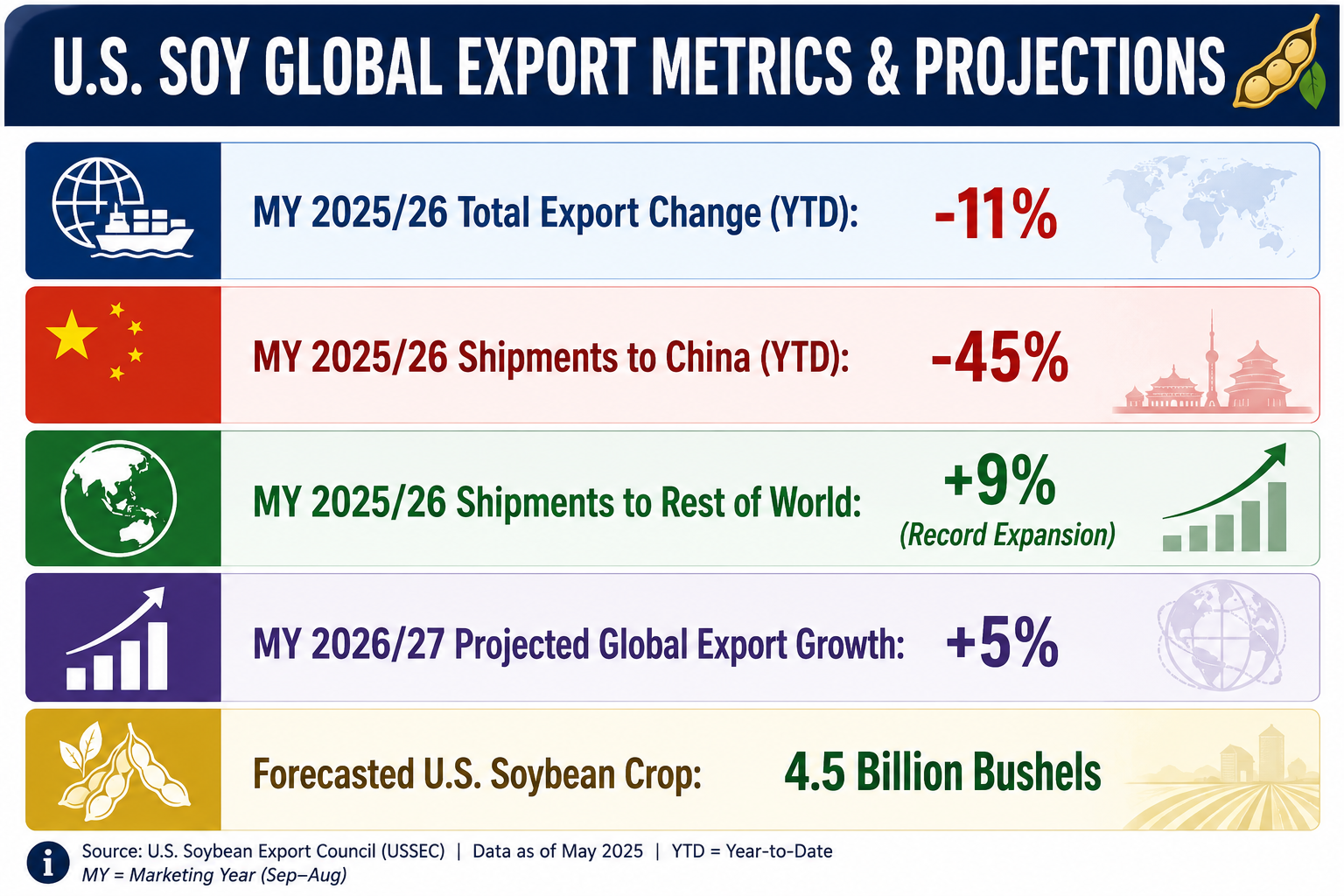
Export Rebound Projected: Total U.S. Soy exports (whole soybeans, soybean meal, and soy oil) are forecast to grow by 5% in MY 2026/27, reversing the 11% year-to-date decline experienced in MY 2025/26.
-
Rest of World (ROW) Demand Surge: Sales to non-China markets (ROW) climbed 9% year-to-date in MY 2025/26, hitting record growth led by rapid expansion in emerging markets like Egypt.
-
China Trade Normalization: Resumed purchasing agreements between President Trump and President Xi have positioned China to shift into a 25 MMT annual commitment for U.S. Soy.
-
Record Production Expected: USDA forecasts place the upcoming U.S. soybean harvest at a record 4.5 billion bushels, driven by a 5% increase in planted acreage.
U.S. Soy Export Trade Performance & Projections
1. Market Diversification Beyond China
While China remains the world’s largest soybean buyer, USSEC’s deliberate strategy to diversify export destinations is yielding measurable gains across Latin America, South Asia, and the Middle East. Mexico maintains its standing as the second-largest market for whole soybeans, while Egypt has rapidly emerged as a top-three importer due to expanding poultry and aquaculture sectors.
2. Return to Commercial Normalization with China
Recent sales data confirms China met its 12 MMT commitment for MY 2025/26 under the Busan agreement and is transitioning into a 25 MMT annual commitment, restoring export volume toward historical baselines (matching the 24.2 MMT recorded in MY 2024/25).
3. Competing on Premium Value, Not Price
Addressing attendees during the opening media conference, USSEC Chief Executive Officer Jim Sutter underscored that U.S. Soy competes on intrinsic value—highlighting higher amino acid digestibility, superior energy concentration, and lower carbon intensity:
“Diversification isn’t a talking point for us — it’s the strategy, and it’s paying off. Global demand for soy is growing faster than the world can produce it, and that gap is exactly why buyers are looking for partners they can count on. U.S. Soy competes on premium value, not on price, and ultimately that’s what is driving our growth.”
— Jim Sutter, CEO, U.S. Soybean Export Council
Key Growth Drivers: Aquaculture & Expanding Domestic Crush
-
Aquaculture Expansion: Aquaculture represents one of the fastest-growing global consumers of soybean meal. USSEC’s Soy Excellence Centers (SECs)—particularly in Egypt—are training feed manufacturers and farm managers to optimize feed conversion ratios using high-protein U.S. soy meal.
-
Increasing Processing Capacity: Expanding domestic crushing infrastructure across the U.S. Midwest is boosting the availability of high-quality soybean meal and crude soy oil for international markets, addressing protein deficits in regions lacking domestic crush infrastructure.

