


An analysis of second-quarter 2026 financial performance across the global pet care sector reveals a market undergoing a key transition. Following years of double-digit, price-driven revenue expansion, the category has entered a volume/mix-led environment characterized by decelerating inflation, retailer inventory rebalancing, and shifting pet demographic dynamics.
While demand for therapeutic and science-backed nutrition remains resilient, mass-market kibble faces volume headwinds as consumers optimize basket size and shift toward smaller dog breeds or alternative formats.
Q2 2026 Performance Matrix
Metric / Indicator |
Nestlé Purina PetCare |
Hill’s Pet Nutrition (Colgate) |
Mars Petcare (Privately Held Estimate) |
Q2 2026 Net Sales |
Undisclosed (Divisional core of Nestlé’s CHF 45.1B H1 total) |
$1.200 Billion (+3.4% YoY) |
Estimated $6.2B–$6.5B quarterly run-rate |
Organic Sales Growth |
Low-single-digit (Below mid-term targets) |
+2.1% (Includes -0.4% private label exit drag) |
Estimated +2.0% to +3.5% |
Volume (RIG) vs. Pricing |
RIG improving; U.S. destocking offset by Europe/Emerging growth |
Volume: -1.2% (-1.8% organic)Pricing: +3.9% |
Pricing moderating; volume gains led by Royal Canin & treats |
Operating Profit / Margin |
Divisional margin contributed to Nestlé’s 16.4% UTOP |
$269 Million (22.5% Operating Margin, -40 bps YoY) |
Estimated EBITDA Margin ~18%–19% |
Primary Growth Driver |
Pro Plan, Purina ONE, E-commerce, European RIG |
Prescription Diet, E-commerce, Prime100 / Fresh rollout |
Royal Canin, Champion Petfoods (Orijen/Acana), Vet Health |
1. Nestlé Purina PetCare: Volume Acceleration vs. Retailer Destocking
Financial Breakdown & Top-Line Performance
In Nestlé SA’s H1/Q2 2026 earnings report, PetCare was cited as a foundational growth engine, though top-line organic growth temporarily lagged the division’s medium-term targets.
-
Real Internal Growth (RIG) Recovery: While group-level organic growth reached 3.6% for H1 2026 (with overall Q2 RIG accelerating to 1.8%), Purina experienced a divergence between U.S. factory shipments and consumer point-of-sale (POS) sell-out data.
-
U.S. Inventory Rebalancing: Management highlighted that North American retail inventory reductions created a short-term drag on shipped volume. However, underlying retail sell-out data in North America progressively improved throughout Q2.
-
Geographic Balance: Solid RIG-led growth in Western Europe and double-digit expansion across emerging markets (Latin America and Asia-Pacific) partially mitigated North American trade destocking.
Strategic Execution & Portfolio Drivers
-
Premiumization Anchors: Purina Pro Plan, Purina ONE, and specialized veterinary diets (Pro Plan Veterinary Diets) continue to capture market share in specialist and e-commerce channels.
-
E-Commerce & Digital Omnichannel: Direct-to-consumer platforms and online retail partnerships (e.g., Chewy, Amazon) represented Purina’s fastest-growing route-to-market.
2. Hill’s Pet Nutrition (Colgate-Palmolive): Clinical Strength Offsets Mass-Market Softness
Financial Breakdown & Top-Line Performance
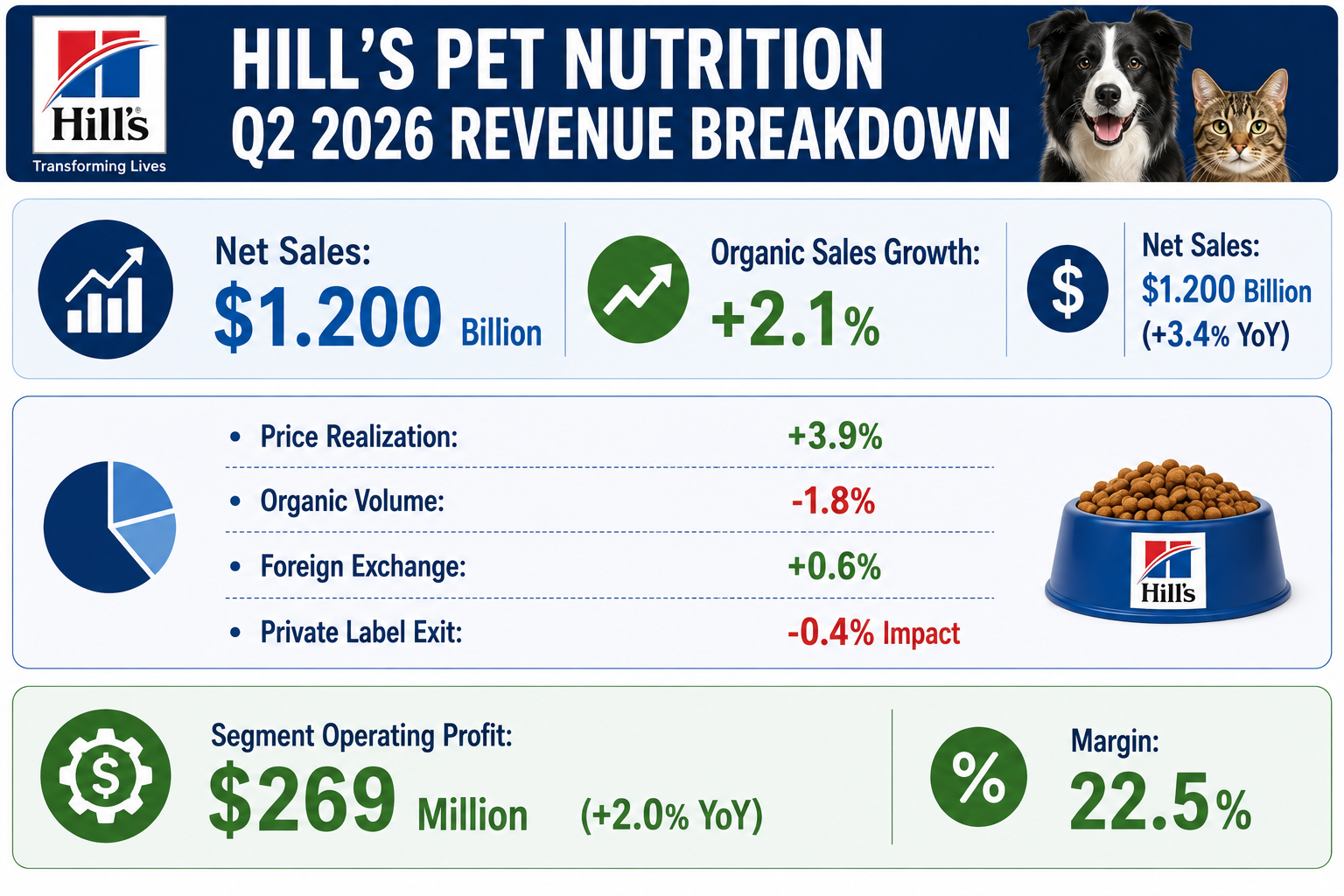
Hill’s Pet Nutrition delivered $1.200 billion in net sales for Q2 2026, representing a 3.4% YoY reported increase and accounting for 22% of Colgate-Palmolive’s global revenue.
-
Organic Growth Composition: Organic sales grew 2.1%, driven by +3.9% pricing and a -1.8% decline in organic volume, alongside a -0.4% headwind from the intentional exit of the private-label pet food business.
-
Profitability: Division operating profit reached $269 million (+2% YoY), with operating margins contracting slightly by 40 basis points to 22.5% due to higher raw material inputs and sustained brand advertising reinvestment.
Strategic Execution & Demographic Pressures
-
Prescription Diet Resilience: Hill’s Prescription Diet achieved high-single-digit growth, underpinned by therapeutic efficacy and strong veterinary recommendation rates.
-
Science Diet Dog Food Slowdown: Management flagged volume softness in standard Science Diet dog food. CEO Noel Wallace noted a structural shift in dog ownership demographics—specifically a decline in large dog adoption relative to small dogs, impacting total tonnage consumed per household.
-
Fresh Pet Expansion: Hill’s initiated the phased rollout of Science Diet Single Protein, leveraging its strategic acquisition of Australian fresh-pet manufacturer Prime100 to enter the ultra-premium, minimally processed space.
3. Mars Petcare: Strategic Positioning & Ecosystem Integration
Private Corporate Profile & Revenue Dynamics
While Mars, Incorporated does not publish public quarterly SEC filings, institutional estimates place Mars Petcare’s annual net sales well above $25 billion, representing ~55%–58% of total corporate revenues.
-
Dual Growth Engine: Growth in Q2 2026 was anchored by Royal Canin (health nutrition) and Champion Petfoods (Orijen and Acana), alongside steady cash flows from mass brands (Pedigree, Whiskas, Iams).
-
Veterinary Services Synergy: Unlike Purina or Hill’s, Mars operates a vertically integrated pet ecosystem spanning nutrition, diagnostic technology (Heska), and veterinary care networks (Banfield, VCA, AniCura). This infrastructure allows Mars to capture lifetime pet value across both clinical care and therapeutic nutrition.
Strategic Focus
-
Ultra-Premiumization: Mars continues to shift capacity toward biological, species-appropriate formulas via Champion Petfoods to counter mass-market kibble stagnation.
-
Science & Diagnostics: Integration of Heska’s point-of-care diagnostic equipment with Royal Canin’s prescription diet lines enables tailored nutritional therapies based on real-time bloodwork data.
Macro Industry Trends Shaping H2 2026 & Beyond
1. The Large-Dog vs. Small-Dog Structural Shift
Metropolitan housing constraints, higher cost-of-living index numbers, and post-pandemic lifestyle changes have shifted adoption trends toward smaller dog breeds and cats. Because small dogs consume significantly fewer calories per day, overall volume (tonnage) growth is slowing, forcing manufacturers to drive value through higher price-per-pound formulations (e.g., freeze-dried, fresh toppers, targeted health diets).
2. Bifurcation of the Pet Consumer
-
Upper-Tier Inelasticity: High-income households continue to premiumize, favoring prescription diets, fresh food (e.g., Prime100 integration at Hill’s), and specialized health formulations.
-
Mid-Tier Price Sensitivity: Middle- and lower-income pet owners are exhibiting value-seeking behavior—trading down from super-premium mass kibble to value brands, switching to club channels, or purchasing store brands (private label).
3. Channel Shift & E-Commerce Dominance
Pure-play e-commerce and omnichannel platforms now account for over 35%–40% of premium pet food sales in North America and Western Europe. Subscriptions and auto-ship models provide recurring revenue stability for Purina Pro Plan, Hill’s Science Diet, and Royal Canin.
Key Operational Challenges Facing Major Players
-
Retailer Margin Compression & Destocking: Retail giants (Walmart, Target, Petco) are actively optimizing working capital by reducing safety stock levels, resulting in volatile manufacturer shipment patterns despite steady consumer end-demand.
-
Input Cost Disparity & Foreign Exchange Drag: While agricultural commodities (wheat, corn) have moderated, protein inputs, specialized vitamins, and packaging costs remain elevated. Furthermore, currency fluctuations (such as a strong Swiss Franc impacting Nestlé’s reporting) present conversion headwinds.
-
Capacity Reallocation: Manufacturers are shedding low-margin private-label contracts (exemplified by Colgate’s private-label exit) to reallocate factory floor space toward high-margin wet food, pouches, and clinical diets.

