


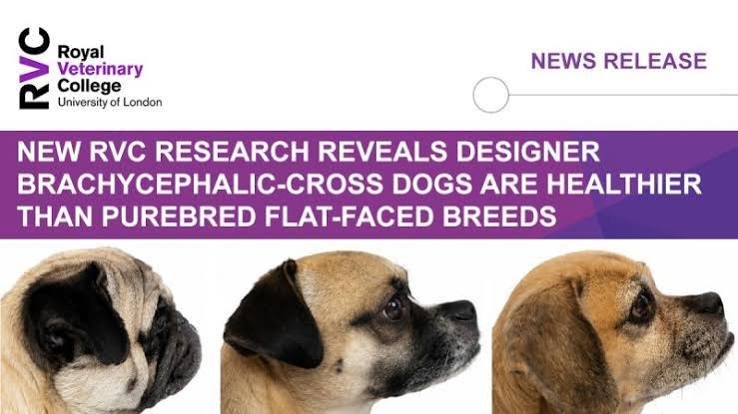
A new Royal Veterinary College-led study is adding important evidence to the debate over the health consequences of extreme brachycephalic conformation in dogs, finding that carefully selected crosses involving Pugs were associated with substantially better health outcomes than the purebred dogs studied.
Published in Animal Welfare, the study compared 150 UK pet dogs comprising 51 purebred Pugs, 51 Pug–Jack Russell Terrier crosses, known as Jugs, and 48 Pug–Beagle crosses, known as Puggles. The researchers assessed physical health, respiratory function, body shape, owner-reported quality of life, behaviour and the dog–owner relationship.
The findings suggest that moving away from highly exaggerated facial structure through purposeful crossbreeding may offer a potentially faster route to reducing some conformation-associated health problems.

Longer Muzzles, Better Respiratory Outcomes
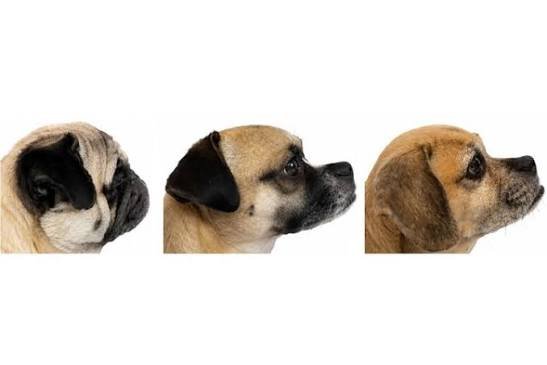
One of the clearest differences involved facial structure. The Pug crosses had significantly longer relative muzzle lengths and less severe nostril narrowing than the purebred Pugs. These differences were accompanied by markedly better respiratory assessments.
The study found that all 51 purebred Pugs had some degree of respiratory impairment, with 47.1% classified with severe airway disease. By contrast, all 51 Jugs and 47 of the 48 Puggles were classified as unaffected under the study’s respiratory grading assessment.
The distinction matters because brachycephalic obstructive airway syndrome (BOAS) is closely linked to extreme facial conformation. The researchers note that the risk of BOAS increases as the relative muzzle length becomes shorter.
The study’s respiratory comparison
Group |
Dogs |
Respiratory finding |
|---|---|---|
Purebred Pug |
51 |
All had affected breathing; 47.1% had severe airway disease |
Jug |
51 |
100% graded as unaffected |
Puggle |
48 |
97.9% graded as unaffected |
These findings are striking, but they should be interpreted as results from a relatively small, UK-based observational comparison—not as proof that every crossbred dog will be healthier.
Health Differences Extended Beyond Breathing
The research was not limited to airway disease. Purebred Pugs had significantly higher prevalence of respiratory, eye, skin and musculoskeletal disorders compared with the two crossbred groups. The purebred dogs also accumulated higher veterinary costs.
Vet Times reported median monthly veterinary costs of approximately £45 for purebred Pugs versus £10 for the crossbred dogs in the study.
The researchers also identified substantial differences in physical features associated with brachycephalic health problems, including nostril narrowing and facial proportions. The results reinforce an important principle in canine breeding: body shape is not simply an aesthetic characteristic—it can influence disease risk and welfare.
Crossbreeding Did Not Appear to Erase the Traits Owners Value
One of the more commercially and socially important findings concerns behaviour. A common argument against moving away from breed purity is that changing physical characteristics could also change the behavioural traits and human–animal relationships that make particular breeds popular.
The study found that behaviour profiles and dog–owner relationship measures were broadly similar between the Pugs and the two crossbred groups.
This finding is significant because it challenges the assumption that improving physical health necessarily means losing the behavioural characteristics valued by owners.
The researchers therefore argue that strategic crossbreeding could potentially address welfare problems while retaining some of the characteristics that sustain demand for these dogs.
Why the Findings Matter for Dog Breeding
The RVC team argues that conventional within-breed selection may face a structural limitation in highly extreme breeds.
If most breeding animals already have very similar, highly exaggerated conformations, selecting only within that population may make it difficult to move rapidly toward substantially more moderate body shapes.
Crossbreeding introduces genetic and physical variation from another breed, potentially allowing breeders to move more rapidly toward a less extreme phenotype.
The paper describes brachycephaly as a continuous trait rather than an all-or-nothing characteristic. Relative muzzle length, craniofacial ratio, nostril shape and other facial features vary between individual dogs and breeds, with shorter facial proportions associated with greater BOAS risk.
But This Is Not a Case for “Designer Dogs Are Healthier”
This is perhaps the most important qualification. The study does not establish that crossbred dogs are universally healthier than purebred dogs. It examined three specific groups:
-
Pugs
-
Pug × Jack Russell Terrier crosses
-
Pug × Beagle crosses

