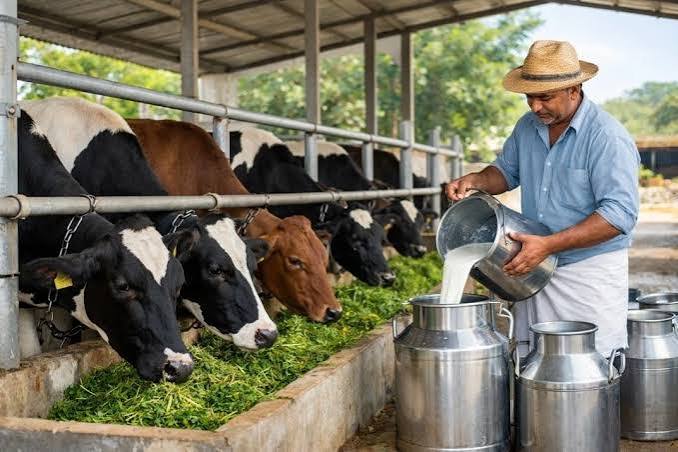
A project in Shuozhou, Shanxi Province, is highlighting an increasingly important proposition for modern dairy production: forage security can be built by converting marginal land into a productive feed resource rather than competing for prime cropland.
Alfalfa, known as the “queen of forage”, is being cultivated on formerly barren saline-alkali land in Shuozhou, where locally produced forage is supporting dairy farms while contributing to the rehabilitation and productive use of degraded soils. The development was highlighted by China Global Television Network (CGTN) on August 23.
The Chinese experience is particularly relevant to India because the country faces a persistent feed-and-fodder challenge at the same time that millions of hectares of salt-affected land remain economically constrained.
The opportunity is not to copy China’s crop choice blindly. It is to copy the system: map degraded land → develop locally adapted forage varieties → establish seed supply → connect forage directly to dairy clusters → conserve the crop → measure feed-cost and milk-productivity gains.
China’s “Queen of Forage” Strategy
The Shuozhou story centres on alfalfa (Medicago sativa), a perennial legume valued for its protein content, digestible fibre and suitability for high-producing dairy cattle.
CGTN reports that saline-alkali land in Shuozhou that was previously considered barren has been brought into forage production, creating a local source of feed for dairy farms and reducing reliance on externally sourced feed.
The significance is therefore larger than simply planting another crop. It creates a three-way economic linkage:
Degraded land → forage production → dairy feed security
At the same time: Forage cultivation → soil improvement → higher productive value of land
That combination makes forage production particularly attractive in regions where conventional food crops may be difficult or uneconomic to cultivate.
Why Alfalfa Matters to Dairy
Alfalfa has a strong nutritional profile for ruminants, particularly dairy cattle. The National Dairy Development Board (NDDB) describes Indian lucerne as a winter-season forage producing approximately 60–70 tonnes of green fodder per hectare, with 18–22% crude protein, depending on production conditions. NDDB lists improved Indian varieties including Anand 2, RL-88 and Anand Lucerne 3.
An older but detailed NDDB technical guide describes lucerne as the “queen of fodder”, with seven to eight cuts possible between November and June and an average green-fodder yield of 60–80 tonnes/ha, with approximately 20% crude protein.
This matters because feed economics increasingly determine dairy economics. A cow does not convert grain, fodder and supplements into milk at the same efficiency under every ration. Forage quality, digestibility, protein supply, fibre, energy balance and ration formulation all influence productivity.
India therefore has an opportunity to view forage not as a low-value agricultural residue, but as a strategic dairy input.
Bigger Problem: India Has a Feed Gap
India’s livestock sector is expanding, but feed availability and quality remain constraints. A recent ICAR assessment, “Comprehensive Assessment of Feed and Fodder Resources for Increased Livestock Production in India,” estimates that under a practical feeding scenario India faces:
Feed category
|
Estimated deficit
|
Concentrate feed
|
37.5%
|
Green fodder
|
14.1%
|
Dry fodder
|
2.4%
|
The assessment estimates that if livestock were fed according to standard nutritional recommendations, annual requirements would be approximately 254.86 million tonnes of concentrate, 931.12 million tonnes of green fodder and 488.55 million tonnes of dry fodder.
The distinction between theoretical nutritional requirement and practical feeding is important. Indian farmers do not have unlimited access to feed resources and often allocate available feed according to animal productivity, economics and availability.
This makes the Chinese model particularly interesting. India does not only need “more feed.” It needs more feed from land and resources that are currently underutilised.
India Already Has a Major Salinity Opportunity
According to ICAR’s Central Soil Salinity Research Institute (CSSRI), salt-affected soils occupy approximately 6.73 million hectares in India.
The institute describes these lands as a major ecological and agricultural challenge, particularly across arid and semi-arid regions. Uttar Pradesh alone has approximately 1.37 million hectares of salt-affected soils.
Historical CSSRI estimates indicate approximately 3.60 million hectares of India’s salt-affected land is sodic, with a substantial concentration in the Indo-Gangetic Plains. This creates a potentially powerful intersection:
India has degraded land.
India has a forage deficit.
India has a rapidly growing dairy sector.
India already has lucerne technology and seed infrastructure. The missing component is large-scale integration.
India Is Not Starting From Zero
One of the most important findings from this comparison is that India already possesses much of the technical foundation. NDDB actively promotes green-fodder production and demonstrates improved varieties of cereals, legumes and perennial grasses, including lucerne, berseem, cowpea and guar.
Its current information also identifies established lucerne seed suppliers and institutions across states including Gujarat, Maharashtra, Rajasthan and Telangana, among others. Mahatma Phule Krishi Vidyapeeth in Maharashtra, Anand Agricultural University in Gujarat and other agricultural institutions are already listed within the Indian forage-seed network for lucerne.
So the challenge is not discovering lucerne. The challenge is scaling a commercially integrated forage ecosystem.
India’s Policy Framework Already Points in the Same Direction
There is another important similarity with the Chinese approach. India’s National Livestock Mission (NLM) already supports fodder development from:
-
non-forest wasteland
-
rangeland
-
grassland
-
non-arable land
-
degraded land
The Department of Animal Husbandry and Dairying also reports support for 100 fodder Farmer Producer Organisations (FPOs) and capital subsidies for activities such as hay, silage, total mixed ration and fodder blocks.
The government has also provided support for quality fodder-seed production and fodder-seed processing infrastructure. This is strategically significant. The policy architecture exists. What is needed is a stronger land-to-feed-to-dairy business model.
But India Should Not Simply Plant Alfalfa Everywhere
This is where scientific caution is essential. Alfalfa is not a universally salt-tolerant crop.
Research characterises alfalfa as having moderate salt tolerance, and salinity can reduce germination, growth and yield. However, considerable genetic variation exists among alfalfa populations, creating opportunities for selection and breeding of more salt-tolerant material.
Recent research also demonstrates that biological interventions can improve alfalfa performance under saline-alkaline stress. Therefore, the Indian strategy should not be:
“Put alfalfa on all saline land.”
It should be: “Match forage genotype and production system to soil salinity, sodicity, water quality and climate.”
That is a much more scientifically defensible proposition.
China’s Bigger Lesson: Breed for the Land You Actually Have
China’s broader saline-alkali strategy increasingly combines soil management, biological technologies and crop breeding.
A Chinese national programme involving the Chinese Academy of Agricultural Sciences and research institutions has focused on developing crops—including forage crops—with tolerance to moderate salinity and improving the productivity of saline land.
Research on alfalfa has similarly identified substantial genetic diversity in salt tolerance, creating opportunities for breeding and selection. This is perhaps the most important lesson for India.
Instead of asking: “Which crop gives the highest yield on good soil?”
India should increasingly ask: “Which crop gives the best economic return on degraded soil with the water we actually have?” That is a fundamentally different agricultural strategy.
Feed-Cost Equation Could Be More Important Than Yield
A forage project should not be judged solely by tonnes of green fodder produced. The correct economic indicators should include:
₹/kg dry matter
₹/kg crude protein
₹/kg digestible energy
milk yield per animal
feed cost per litre of milk
replacement of purchased concentrate
land productivity
water productivity
soil-quality improvement
This is particularly important because NDDB notes that feed and fodder account for a very large share of the resource footprint of milk production.
In one Gujarat study, NDDB reported that nutritionally balanced rations reduced the freshwater footprint of milk by approximately 14–15%, from about 1,046 to 891 litres of freshwater per kg of fat-and-protein-corrected milk. The lesson is clear:
Better feed is not simply a livestock-health intervention. It is a resource-efficiency intervention.
Water Is the Critical Indian Question
This is where India must be more cautious than the headline “alfalfa on barren land” might suggest. NDDB’s water-footprint data show an estimated water footprint of approximately:
Feed
|
Water footprint, L/kg dry matter
|
Paddy grain
|
2,157
|
Maize grain
|
1,395
|
Sorghum grain
|
1,055
|
Wheat grain
|
1,044
|
Wheat bran
|
485
|
Groundnut residue
|
302
|
Sorghum residue
|
613
|
Lucerne
|
1,029
|
Maize green fodder
|
463
|
Sorghum green fodder
|
256
|
Hybrid Napier
|
306
|
These figures are context-specific rather than universal constants, but they demonstrate why water productivity must be built into any Indian forage strategy. For water-stressed regions, a high-protein forage may still make economic sense if it reduces imported or purchased concentrate sufficiently—but that must be demonstrated locally.
What India Could Learn From Shuozhou
1. Treat degraded land as an economic asset
India should create a national “Degraded Land → Fodder” mapping programme. The objective would be to identify:
-
saline land
-
sodic land
-
non-arable land
-
degraded grazing land
-
low-productivity government land
-
suitable community land
and match each land class with appropriate forage species.
2. Build dairy-feed corridors
China’s model works because forage production is connected to dairy demand. India should replicate this at the district level. Example:
10,000 ha degraded land
↓
salt-tolerant forage production
↓
silage/hay processing
↓
fodder FPO
↓
nearby dairy clusters
↓
contracted feed supply
↓
lower feed procurement cost
↓
higher dairy margins
This is much stronger than simply distributing forage seed.
3. Develop Indian Salt-Tolerant Forage Breeding
India should establish dedicated breeding programmes around: salt tolerance + drought tolerance + heat tolerance + biomass yield + protein + digestibility + persistence.
The goal should be a new generation of Indian forage varieties designed specifically for saline, semi-arid and climate-stressed dairy regions.
India already has world-class soil-salinity expertise through ICAR-CSSRI. The institute works on salt-tolerant crops, reclamation and biological technologies for salt-affected soils.
The next step should be stronger integration between:
CSSRI + IGFRI + ICAR forage institutes + agricultural universities + NDDB + dairy cooperatives + seed companies + dairy farms.
4. Build a “Forage Bank” Model
India’s fodder problem is highly seasonal. A productive forage field does not automatically solve the problem six months later. The solution is therefore:
Grow → harvest → dry/ensile → store → contract → deliver
The NLM already supports hay, silage, TMR and fodder-block enterprises, creating a foundation for this model. Fodder FPOs could become the missing commercial link.
5. Measure Milk, Not Just Fodder
A pilot should be considered successful only if it demonstrates measurable dairy economics. For every participating dairy cluster, India should monitor:
KPI
|
Target metric
|
Fodder yield
|
tonnes/ha
|
Dry matter yield
|
tonnes/ha
|
Crude protein
|
% DM
|
Digestibility
|
%
|
Cost of production
|
₹/tonne DM
|
Purchased feed replacement
|
%
|
Milk yield
|
kg/cow/day
|
Milk protein
|
%
|
Milk fat
|
%
|
Feed cost/litre
|
₹/litre
|
Water productivity
|
L water/kg milk
|
Soil EC/ESP
|
annual change
|
Farmer net income
|
₹/animal/year
|
This would turn a forage programme into a measurable dairy productivity programme.
Where India Should Start
India does not need a nationwide alfalfa programme immediately. A better strategy would be 10–20 demonstration clusters across different agro-ecological conditions.
Potential pilot regions – Rajasthan: Salinity + water stress + large dairy potential
Haryana – Established dairy and forage ecosystem
Uttar Pradesh – Large salt-affected land base + enormous dairy population
Gujarat – Strong dairy cooperative network + existing lucerne ecosystem
Maharashtra – Existing lucerne expertise + dairy clusters
Telangana – Existing lucerne seed and forage infrastructure
NDDB’s existing seed and demonstration network provides a useful starting point for such pilots.
A China–India Comparison
Strategic parameter
|
Shuozhou, China
|
India: Current position
|
India: Opportunity
|
Problem
|
Saline-alkali barren land
|
Feed/fodder shortages + degraded land
|
Combine the two problems
|
Crop
|
Alfalfa
|
Lucerne already established
|
Develop location-specific varieties
|
Dairy linkage
|
Direct
|
Fragmented
|
Dairy-cluster contracts
|
Land strategy
|
Productive use of saline land
|
NLM permits non-arable-land fodder
|
Scale substantially
|
Seed system
|
Salt-tolerant varieties
|
Existing lucerne varieties
|
Intensify breeding
|
Processing
|
Local feed utilisation
|
Growing FPO/silage infrastructure
|
Build regional forage hubs
|
Main objective
|
Land + feed + dairy economics
|
Usually separate programmes
|
Integrated value chain
|
Key lesson
|
Make marginal land productive
|
Connect marginal land to feed demand
|
Build a national forage economy
|
Strategic Opportunity for India
The Chinese example arrives at an important moment for Indian livestock.
India’s dairy sector is growing, but feed costs remain a major constraint. Meanwhile, the country has 6.73 million hectares of salt-affected soils and a newly documented 37.5% concentrate-feed deficit under a practical feeding scenario. These are usually treated as two separate problems.
They should not be. They can potentially be one solution.
Degraded land
→ salt-tolerant forage
→ high-quality protein
→ lower purchased feed requirement
→ better ration quality
→ potentially higher milk productivity
→ higher dairy profitability
→ greater economic value from degraded land
That is the strategic lesson India can take from Shuozhou.
Analyst Verdict: India Should Copy the Model, Not the Crop
The strongest conclusion from the China example is not that India should plant millions of hectares of alfalfa. That would be scientifically and economically premature.
The lesson is more powerful: India should build a national “marginal land to livestock feed” strategy.
Alfalfa/lucerne should be one component, alongside berseem, sorghum, pearl millet, hybrid Napier, cowpea, forage maize, drought-tolerant grasses, salt-tolerant forages and potentially halophytic species where agronomically appropriate.
The crop should be selected according to: soil salinity + sodicity + rainfall + irrigation water + temperature + dairy demand + forage quality + economics.
India already possesses the institutional pieces—ICAR-CSSRI, IGFRI, NDDB, agricultural universities, NLM, dairy cooperatives and fodder FPOs.
What is missing is a coordinated commercial architecture connecting them. China is demonstrating that degraded land does not necessarily have to remain a liability.
For India, the opportunity is to turn millions of hectares of constrained land into a strategic national feed-security asset—while simultaneously improving dairy economics and soil resilience.