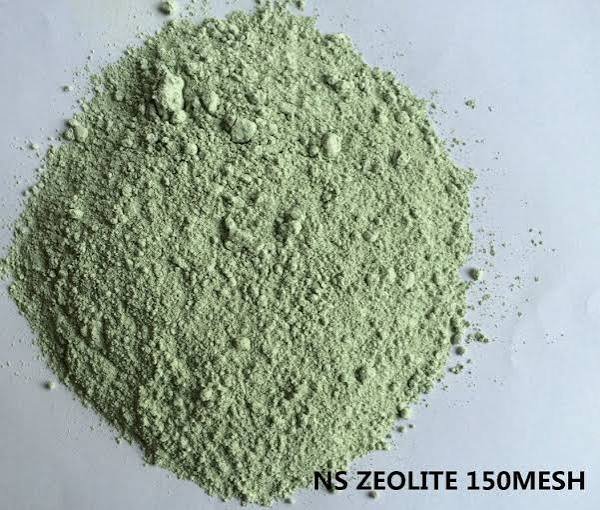
Zeolites are naturally occurring, microporous aluminosilicate minerals with a unique three-dimensional cage-like structure and a negative electrical charge.
Why Zeolites Are Used in Animal Feed
Zeolites work as a functional feed additive to improve livestock health, digestion, and environmental conditions.
Toxin Binding: Their porous structure traps harmful mycotoxins and aflatoxins from contaminated feed, preventing them from entering the animal’s bloodstream
Ammonia and Odor Control: Their negative charge allows them to bind excess ammonium ions in the gut, reducing toxic ammonia levels and cutting down unpleasant odors in manure
Improved Digestion: They slow down the passage of food through the digestive tract, which helps animals absorb nutrients more efficiently and promotes better growth
Reduced Diarrhea: Supplementation helps stabilize the pH in the digestive tract and absorbs excess moisture, which decreases the severity and duration of diarrhea or scours in animals like pigs and calves
Global Market for Zeolites
Indicator
2026–2035 Outlook
Global zeolite-for-feed CAGR
4–6%
IndexBox baseline CAGR
~5.0%
Market index
100 in 2025 → ~160 by 2035
Asia-Pacific consumption share
35–40%
Poultry feed share
~35%
Swine feed share
~25%
Aquaculture feed share
~15%
Aquaculture growth rate
~6–8% CAGR
Typical zeolite inclusion
1–3% of feed
Premium/specialty price premium
30–50% vs. standard grades
Import-dependent-market freight component
25–35% of delivered price
IndexBox’s latest assessment puts global zeolite-for-feed demand on a 4–6% CAGR trajectory through 2035, with its baseline scenario at approximately 5% CAGR.
Regional Demand
Asia-Pacific:35–40% of global consumption
The region is led by China, India and Southeast Asia, supported by poultry production, aquaculture expansion and increasing demand for feed-safety technologies.
Region
Estimated share
Asia-Pacific
35–40%
North America
~18%
Europe
~15%
Latin America
~12%
Middle East & Africa
~17%
The regional numbers are IndexBox estimates and should be treated as market-sizing estimates rather than audited industry statistics.
End-Use Structure
Poultry remains the largest identified feed application, accounting for approximately 35% of zeolite-for-feed demand.
Application
Estimated share
Growth signal
Poultry
~35%
~4–5% CAGR
Swine
~25%
~4–6% CAGR
Aquaculture
~15%
~6–8% CAGR
Ruminants/other
Balance
~3–5%
Aquaculture represents the strongest growth opportunity, with IndexBox estimating 6–8% annual growth through 2035, driven by shrimp and fish farming in Asia-Pacific and Latin America.
Global Zeolite Market Size and Outlook 2026
Market Drivers
1. Mycotoxin management
Tighter feed-safety requirements are increasing demand for mineral adsorbents and other mycotoxin-management products. IndexBox identifies regulatory tightening in markets including the EU and Japan as an important driver of higher-purity zeolite adoption.
2. Feed efficiency
Zeolite demand is increasingly linked to efforts to improve nutrient utilisation, feed conversion and production efficiency rather than being viewed solely as a commodity mineral.
3. Poultry intensification
Poultry remains the largest application, supported by the use of zeolite for mycotoxin binding, pellet quality and ammonia/litter management.
4. Aquaculture expansion
Aquafeed is becoming a disproportionately important growth market because zeolite can be used in formulations and, depending on the application, for ammonia and water-quality management.
India Market Signal
India is strategically positioned within the Asia-Pacific growth story.
IndexBox’s Asia-Pacific assessment identifies India, Indonesia, Vietnam and the Philippines as major growth engines, with regional feed production in these emerging markets projected to expand substantially faster than in mature markets.
For India specifically, the adjacent mycotoxin-binder market is forecast by IndexBox to grow at approximately 8–11% CAGR in volume terms during 2026–2035, considerably faster than the broader global zeolite-for-feed forecast.
The distinction is important: Zeolite-for-feed growth ≠ total mycotoxin-binder growth.
Zeolite competes with bentonite, HSCAS, yeast-derived products, enzymatic binders, polymers and multi-component formulations. India’s opportunity is therefore broader than zeolite alone.
Pricing & Product Premiumization
The market is separating into commodity and functional grades. Premium and specialty zeolites: approximately 30–50% price premium over standard feed-binder grades.
The premium reflects tighter specifications around purity, mineralogy, particle size, consistency and demonstrated functional performance.
This creates a potentially important commercial shift: Commodity mineral → standardized functional ingredient → application-specific feed additive
Supply-Side Risk
Risk factor
Quantified indicator
Freight in some import-dependent markets
25–35% of delivered price
Typical inclusion
1–3%
Premium-grade price premium
30–50%
Global market index
100 → ~160 by 2035
Mineralogical variability between deposits and differences in particle-size specifications remain significant qualification issues for feed manufacturers. IndexBox notes that buyers may require multi-batch certification before approving suppliers.
1. Asia-Pacific — dominant, 35–40% 2. North America — mature/high functional adoption 3. Europe — regulation-driven premiumization 4. Latin America — emerging growth 5. Middle East & Africa — import-dependent
2035 Data Point
At IndexBox’s baseline trajectory, the global zeolite-for-feed market index rises from 100 in 2025 to approximately 160 in 2035. That represents roughly 60% cumulative market expansion over the decade under the baseline scenario.
Bottom Line
The stronger opportunity is the transition toward high-purity, standardized and performance-validated mineral solutions for mycotoxin management, feed efficiency, ammonia control and aquaculture applications.
For India and Southeast Asia, the combination of expanding poultry/aquaculture production, feed-safety concerns and increasing professionalisation of feed manufacturing makes the region one of the most strategically important demand centres through 2035.
Animal Health India (AHI) is an independent news and intelligence
platform covering the global animal health, veterinary, livestock,
poultry, companion animal and pet food sectors. Our editorial team
comprises veterinary journalists, animal health professionals,
regulatory affairs specialists and industry analysts with over 30
years of combined experience covering India, Asia, Europe and North
America. AHI publishes news, regulatory updates, market intelligence
and company news drawn from primary sources including DAHD, EMA,
USDA, AVMA and leading veterinary publications worldwide.