
HomeCorporateDiverse Grazing Systems Cut Nitrogen Losses and Alter the Nutritional Profile of...

Diverse Grazing Systems Cut Nitrogen Losses and Alter the Nutritional Profile of Meat and Milk

A new report published September 8 highlights growing evidence that how livestock graze can influence environmental performance, animal wellbeing and the biochemical composition of foods produced from them.

Research from New Zealand’s pastoral livestock production programme compared conventional grazing with multispecies and functional-diversity pasture systems involving cattle, sheep and deer. The findings point to a potential shift in livestock production—from focusing primarily on yield and feed efficiency toward managing the plant–animal–human health connection.

Nitrogen losses fall substantially

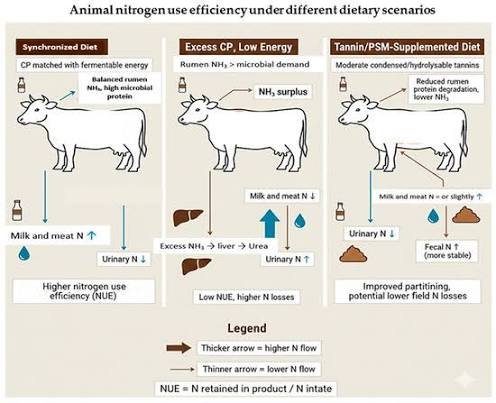
One of the clearest environmental findings was the reduction in nitrogen losses. Functional-diversity grazing systems reduced nitrogen loss to the environment by approximately:

Livestock

Reported reduction

Sheep

30%

Dairy cows

42%

Nitrogen loss from grazing systems is an important environmental issue because livestock urine and manure can create concentrated nitrogen loads that exceed plant uptake capacity, contributing to nitrate leaching and gaseous nitrogen losses.

The New Zealand work suggests that greater forage diversity can become a farm-level nitrogen-management tool, rather than relying exclusively on changes in fertiliser application or livestock numbers.

From pasture diversity to food composition

The more unusual finding concerns the composition of animal products. Researchers analysed milk, beef, lamb and venison using untargeted metabolomics, measuring thousands of metabolites associated with biological processes.

Milk from cows grazing functional-diversity pastures showed changes in metabolites involved in energy metabolism, red-blood-cell formation and neurological pathways. Researchers also reported approximately a 50% reduction in one compound associated with cardiovascular and dementia risk. The strongest changes were reported in venison.

Venison from deer managed on functional-diversity pastures showed:

  • approximately 27-fold higher levels of metabolites associated with antioxidant and anti-inflammatory properties

  • approximately 59-fold higher levels of metabolites involved in oxidative-stress regulation

  • additional changes involving pathways associated with brain development and mental health.

Lamb and beef also showed changes in metabolites associated with antioxidant activity, cardiovascular health, mental health, nutrient absorption and other biological pathways.

The human-health question

The researchers went beyond analysing meat and milk. Human feeding trials examined whether consuming beef or lamb from different grazing systems produced measurable changes in consumers’ blood metabolites. Participants consumed products from conventional, multispecies and functional-diversity systems, with each participant serving as their own control.

Following consumption of beef from functional-diversity systems, researchers observed changes in circulating metabolites associated with cholesterol metabolism, vascular function, energy regulation, kidney-related stress and colon-cancer-related pathways.

Similar metabolic changes were observed following consumption of lamb, including pathways associated with neuroprotection, cardiovascular function, antioxidant defence, inflammation, lipid metabolism and nutrient absorption.

However, the distinction is important: these are metabolic biomarkers and pathway changes, not proof that eating meat from a particular grazing system prevents cancer, cardiovascular disease, diabetes or other chronic diseases.

Animal welfare becomes part of the food-quality equation

The research also adds another dimension to the pasture debate.

The functional-diversity approach combines grasses, herbs and legumes—including species such as plantain, chicory and clovers—to provide animals with a more varied grazing environment.

The research programme reported improvements in growth, feed efficiency, milk production and animal wellbeing alongside the environmental effects.

This creates a potentially important production model: Pasture diversity → animal nutrition → animal wellbeing → altered food composition → human metabolic response

The concept effectively moves livestock nutrition upstream into the broader preventive-health discussion.

Why this matters for animal health and nutrition

The findings are strategically important for the livestock industry because they broaden the definition of animal-health management. Traditional production metrics focus on: growth + milk yield + feed conversion + reproduction + disease control

The emerging model adds:

soil health + forage diversity + animal wellbeing + metabolic resilience + food nutritional quality + human health

This could create new commercial opportunities around functional forages, precision grazing, pasture-based dairy, regenerative livestock systems, nutritional biomarkers and premium animal-derived foods.

For animal-health companies, the implications extend beyond pharmaceuticals. Nutrition, microbiome management, forage science, diagnostics and precision livestock technologies could increasingly become part of an integrated One Health production system.

Analyst view

The significance of this research is not that it proves “healthy pasture produces disease-preventing meat.” The stronger and more defensible conclusion is that pasture composition and grazing management can measurably influence nitrogen losses, animal performance and the metabolomic profile of animal-derived foods—and some of those metabolic changes can also be detected in humans after consumption.

That creates a potentially important new value proposition for livestock agriculture: the farm itself can become part of the preventive-nutrition chain.

The underlying research is identified as Connecting plant, animal, and human health using untargeted metabolomics, published in the Journal of Animal Science.

Animal Health India Editorial Team
Animal Health India Editorial Teamhttps://animalhealthindia.com
Animal Health India (AHI) is an independent news and intelligence platform covering the global animal health, veterinary, livestock, poultry, companion animal and pet food sectors. Our editorial team comprises veterinary journalists, animal health professionals, regulatory affairs specialists and industry analysts with over 30 years of combined experience covering India, Asia, Europe and North America. AHI publishes news, regulatory updates, market intelligence and company news drawn from primary sources including DAHD, EMA, USDA, AVMA and leading veterinary publications worldwide.
RELATED ARTICLES