


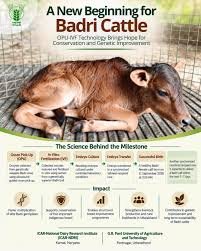
The successful birth of a healthy female Badri calf on September 11, 2026, at the Academic Dairy Farm of G.B. Pant University of Agriculture and Technology, Pantnagar, represents a major milestone in Indian animal biotechnology.
Accomplished through a joint three-year initiative between the ICAR-National Dairy Research Institute (ICAR-NDRI), Karnal, and G.B. Pant University, with funding from the Uttarakhand Biotechnology Council, this event marks the first successful application of Ovum Pick-Up and In Vitro Fertilization (OPU-IVF) technology specifically tailored to the Badri cattle breed—Uttarakhand’s small, hardy state animal.
Technical Breakdown of the OPU-IVF Protocol
Unlike traditional breeding or standard Multiple Ovulation Embryo Transfer (MOET)—which rely on heavy hormonal superovulation—OPU-IVF is a minimally invasive, repeatable technology that allows scientists to harvest immature eggs (oocytes) directly from the ovaries of live, un-sedated elite cows.
Under local epidural anesthesia and ultrasound guidance, a specialized sector probe fitted with a needle guide is inserted transvaginally. Scientists aspirate immature cumulus-oocyte complexes (COCs) from ovarian follicles of elite Badri donor cows selected for superior traits. Because OPU does not exhaust the ovarian reserve, eggs can be collected twice a week from a single high-value donor.
Recovered oocytes are washed, graded, and placed in specialized maturation media containing gonadotropins (FSH/LH) inside a controlled CO₂ incubator (38.5 C, 5% CO2) for approximately 24 hours to reach Metaphase-II (M-II) stage.
Matured oocytes are co-incubated with cryopreserved, high-grade, motility-selected sperm sourced from a genetically superior Badri bull provided by the Uttarakhand Livestock Development Board. Capacitation agents (e.g., heparin) trigger the acrosome reaction in vitro.
Presumptive zygotes are cultured in specialized synthetic oviductal fluid (SOF) media for 7 days until they develop into transferable compact morulae or blastocysts.
The grade-1 blastocyst is non-surgically transferred into the uterine horn of a synchronized recipient cow. In this case, a surrogate Sahiwal cow (and a secondary crossbred cow) acted as gestational hosts. The recipient cow provides the maternal uterine environment without altering the calf’s pure Badri nuclear DNA.
Why Use a Sahiwal Cow as a Surrogate Host?
The project transferred the pure Badri embryo into a larger Sahiwal recipient cow. This offers distinct physiological benefits:
-
Genetic Purity Unchanged: The nuclear genome of the offspring comes 100% from the Badri donor mother and Badri bull father. The surrogate acts purely as a incubator
-
Maternal Safety & Size Balance: Badri cattle are small, high-altitude hill animals weighing 200–250 kg. Using a larger, well-nourished plain breed like Sahiwal provides an optimal uterine space, robust vascular perfusion, and lower risk of dystocia (birthing complications) during experimental gestational trials
-
Conserving Badri Female Donors: By delegating the 9-month pregnancy to surrogate cows (Sahiwal or crossbreds), elite Badri donor females can remain dedicated solely to frequent oocyte collection, maximizing egg yield
Implications for Indigenous Genetic Conservation
Badri cattle (Bos indicus) are native to the high-altitude Himalayan regions of Uttarakhand. Though low in daily milk yield compared to commercial breeds, they possess valuable genetic adaptations:
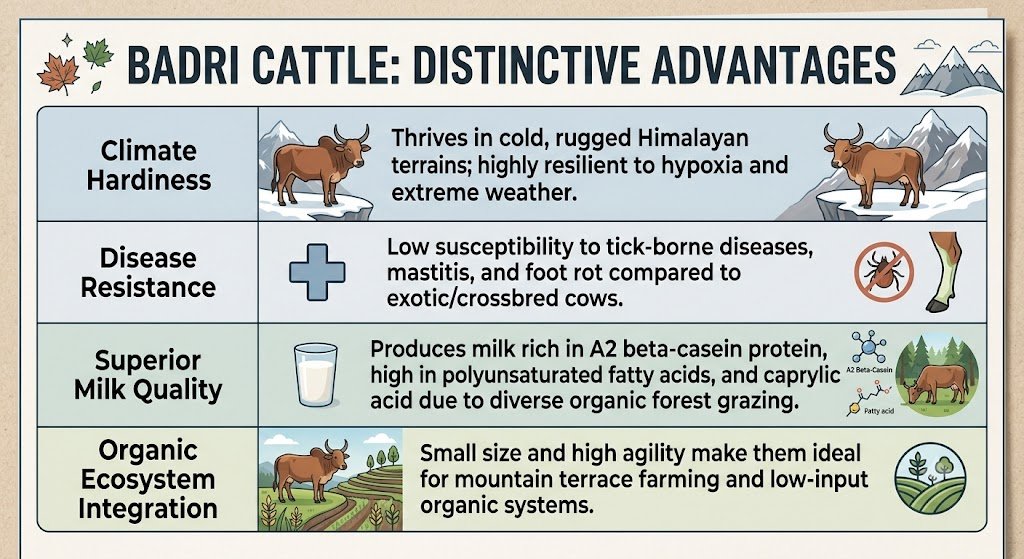
Strategic Conservation & Breeding Benefits
-
Exponential Multiplication of Elite Germplasm: Under natural breeding, a top-tier Badri cow produces 6 to 8 calves in her lifetime. With OPU-IVF, an elite female can yield 30 to 50 viable embryos annually, drastically shortening the generation interval for genetic improvement programs
-
Preventing Population Bottlenecks: Indiscriminate crossbreeding with exotic breeds (Jersey/Holstein-Friesian) has threatened the purity of indigenous hill cattle. OPU-IVF creates a bio-bank of high-value pure embryos that can be propagated across surrogate herds without losing native genetic traits
-
Paving the Way for Somatic Cell Nuclear Transfer (Cloning): The NDRI and G.B. Pant University team are also integrating OPU-IVF with cloning research (SCNT) using somatic tissue cells from exceptional Badri cows. The initial production of cloned Badri embryos is already underway, setting up a dual-track strategy to copy and multiply top-performing indigenous livestock

