HomeCompanion AnimalsChile Becomes First South American Country Validated by WHO for Eliminating Dog-Transmitted...

Chile Becomes First South American Country Validated by WHO for Eliminating Dog-Transmitted Rabies

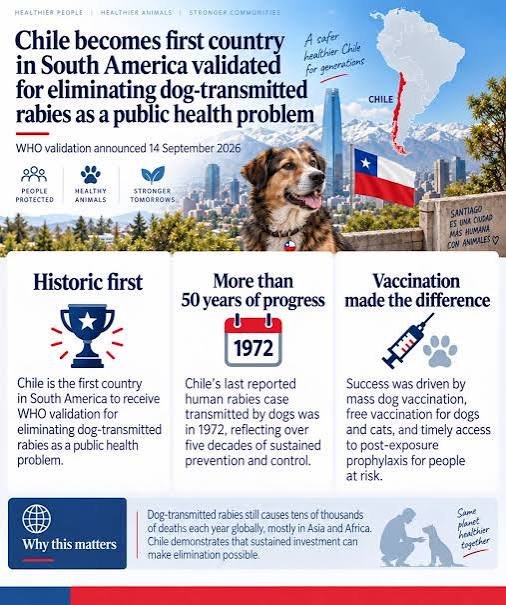
More than five decades without a human case of dog-transmitted rabies and sustained investment in vaccination, surveillance and post-exposure care have earned Chile WHO validation for elimination of dog-transmitted rabies as a public-health problem.

Chile has become the first country in South America to receive World Health Organization validation for eliminating dog-transmitted rabies as a public-health problem.

The WHO announcement, issued September 14, 2026, marks the culmination of more than five decades of sustained rabies-control activity. Chile’s last reported human case of dog-transmitted rabies occurred in 1972.

Chile Becomes First South American Country Validated by WHO for Eliminating Dog-Transmitted Rabies

What Chile actually achieved

The WHO validation does not mean rabies virus has disappeared from Chile’s animal population.

Rather, the country demonstrated that dog-mediated transmission to humans has been interrupted and that the systems required to prevent re-emergence remain in place. Chile continues to operate a national rabies prevention and control programme incorporating:

  • mass vaccination of dogs and cats;

  • epidemiological surveillance;

  • laboratory diagnostics;

  • monitoring of rabies-virus circulation in animals;

  • timely post-exposure prophylaxis;

  • community surveillance; and

  • risk assessment in areas vulnerable to reintroduction.

More than vaccination alone

Chile’s experience demonstrates that elimination depends on multiple layers of intervention. Door-to-door vaccination campaigns helped maintain high coverage among dogs, while surveillance and laboratory capacity provided the ability to detect potential transmission.

Human health systems also played a critical role through timely access to post-exposure prophylaxis.

Dog-population management and community education complemented these interventions. In other words, elimination was not achieved through a single vaccine programme but through a long-term One Health system.

A major regional achievement

According to WHO, human dog-mediated rabies cases in the Americas have fallen by more than 98% since 1983. The Americas have consequently become one of the world’s leading regions for dog-rabies control.

Chile’s validation contributes to the broader PAHO Disease Elimination Initiative, which aims to eliminate more than 30 communicable diseases and related conditions by 2030.

Implications for veterinary public health

The Chilean experience has particular relevance for countries where dog-mediated rabies remains endemic. The critical lesson is that vaccination alone cannot deliver sustainable elimination without surveillance, diagnostics, rapid response and access to human post-exposure treatment.

For animal-health systems, this translates into a requirement for sustained funding rather than short-term campaigns.

India relevance

The Chile development has direct relevance to India because India remains one of the countries where dog-mediated rabies represents a significant public-health challenge.

The comparison should nevertheless be made carefully because countries differ substantially in dog populations, vaccination infrastructure, surveillance, urbanisation and veterinary/public-health capacity.

The useful lesson is therefore not simply to replicate Chile’s programme but to examine the system architecture behind its achievement.

AHI Analyst view

From an animal-health perspective, Chile’s achievement demonstrates that zoonotic-disease elimination can become achievable when veterinary and human-health systems operate as a coordinated programme.

The key strategic components are:

Dog vaccination → surveillance → laboratory confirmation → rapid response → post-exposure care → community participation.

That integrated model is likely to remain central to global rabies-elimination strategies.

Animal Health India Editorial Team
Animal Health India Editorial Teamhttps://animalhealthindia.com
Animal Health India (AHI) is an independent news and intelligence platform covering the global animal health, veterinary, livestock, poultry, companion animal and pet food sectors. Our editorial team comprises veterinary journalists, animal health professionals, regulatory affairs specialists and industry analysts with over 30 years of combined experience covering India, Asia, Europe and North America. AHI publishes news, regulatory updates, market intelligence and company news drawn from primary sources including DAHD, EMA, USDA, AVMA and leading veterinary publications worldwide.

RELATED ARTICLES