


Qatar Enacts New Animal Health Law With Mandatory Disease Reporting, Vaccination and Livestock Identification
September 19, 2026 | Qatar | Animal Health Regulation | Livestock | Biosecurity
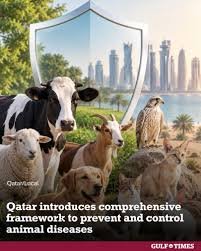
Qatar has enacted Law No. 12 of 2026 on Animal Health, replacing the country’s previous animal-health legislation from 1985 and establishing a substantially broader framework for preventing, detecting and controlling infectious, epidemic and zoonotic diseases in animals.
Published in Official Gazette Issue No. 17 of 2026, the legislation covers animal owners, veterinarians, animal facilities and animal products. It is scheduled to take effect six months after publication.
The new law is significant for Qatar’s livestock and food-security strategy because it links disease surveillance, mandatory reporting, vaccination, animal identification, isolation, movement control, veterinary intervention and compensation within a single regulatory framework.
Qatar strengthens animal-health governance
Under the new legislation, the Ministry of Municipality, in cooperation with relevant authorities, is responsible for epidemiological surveillance, diagnostic testing and implementation of animal-health measures. The law also provides for:
-
Animal disease awareness programmes
-
Vaccination programmes
-
A livestock identification and tagging database
-
Veterinary supervision of vaccination
-
Disease surveillance and diagnostic testing
-
Isolation of infected or suspected animals
-
Regulation of animal movement
-
Controls over infected animal products and waste
-
Veterinary intervention and sanitary measures
-
Compensation mechanisms for affected owners.
24-hour disease reporting requirement
One of the most important operational changes is the requirement for animal owners to notify the competent authority within 24 hours after suspecting or being informed that an animal is infected with a relevant disease. Owners must also arrange veterinary examination.
Veterinarians have corresponding obligations when infectious, epidemic or zoonotic disease is suspected or confirmed.
The approach is designed to shorten the interval between disease recognition and government intervention, an important principle in controlling diseases where early containment materially affects outbreak size.
Isolation and movement controls
Animals suspected or confirmed to be infected must be isolated at locations designated by the Ministry or competent authority. The legislation restricts the trade, disposal and movement of infected or suspected animals and controls their products, waste and carcasses.
Veterinarians may also take measures including seizure of animals and associated materials, testing, vaccination, facility-level health measures and verification of disinfection procedures.
This creates a regulatory chain extending from the individual animal to the farm, market, transport and animal-product level.
Disease list covers major transboundary threats
The law’s disease schedule is particularly relevant to the regional animal-health industry. It includes major diseases and zoonoses such as:
-
Foot-and-mouth disease
-
Lumpy skin disease
-
Bluetongue
-
Peste des petits ruminants
-
Rift Valley fever
-
Brucellosis
-
Rabies
-
Anthrax
-
Tuberculosis
-
Screwworm
-
Avian influenza
-
Newcastle disease
-
African horse sickness
-
West Nile fever
-
Q fever
-
Crimean-Congo haemorrhagic fever
-
Contagious bovine pleuropneumonia
-
Contagious caprine pleuropneumonia
-
Bovine viral diarrhoea
-
Infectious bovine rhinotracheitis
-
Sheep pox and goat pox.
The inclusion of livestock diseases alongside zoonotic and vector-borne diseases demonstrates the breadth of the regulatory framework.
Stronger vaccination obligations
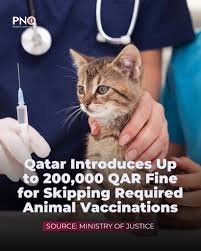
The legislation moves vaccination from a predominantly programme-based intervention toward a more explicitly enforceable animal-health obligation. Failure to vaccinate animals against diseases specified by the Minister can attract imprisonment of up to one year and/or a fine of up to QR200,000, according to reporting on the published law.
Other violations, including certain breaches concerning reporting, slaughter/disposal and disclosure of animal-health information, can attract fines of up to QR100,000. Repeat-offence penalties can be doubled.
The precise application of these provisions will depend on implementing decisions and the diseases subsequently designated under the law.
Compensation mechanism introduced
A notable feature is the establishment of an Animal Health Compensation Committee within the Ministry. The committee will review compensation requests from owners whose animals die or are disposed of following decisions by the competent authority.
This mechanism is important from a biosecurity perspective because compensation frameworks can reduce the economic disincentive associated with reporting suspected disease.
In outbreak control, delayed reporting can occur when owners fear the financial consequences of movement restrictions, slaughter or disposal. A defined compensation mechanism can therefore support earlier notification and government intervention, subject to the implementing rules.
Qatar’s livestock sector gives the law strategic importance
Qatar’s livestock industry has become increasingly relevant to its domestic food-security strategy. According to recent reporting, economically significant livestock stood at approximately 1.1 million head at the end of 2024, comprising approximately 60% sheep, 29% goats, 3% cattle and 8% camels.
The country has also expanded domestic production of dairy, poultry and other animal products.
Recent Ministry-reported figures cited by Gulf Times indicate approximately 202,000 tonnes of dairy products, 25,000 tonnes of fresh poultry meat, 16,000 tonnes of table eggs and 9,000 tonnes of red meat were produced domestically in 2025. Disease prevention therefore has direct implications for food availability, domestic production continuity and import-risk management.
Digital livestock identification becomes more important
The law specifically provides for a database dedicated to livestock identification and tagging. This creates an important foundation for traceability and digital animal-health surveillance.
A robust identification system can eventually link:
Animal ID → vaccination → diagnostic result → movement → treatment → farm → market → outbreak investigation
Such data architecture is increasingly becoming an essential component of modern animal-health systems.
Implications for animal-health companies
Qatar’s new legislation potentially creates demand across several segments:
Segment |
Potential impact |
|---|---|
Veterinary diagnostics |
Increased surveillance and testing |
Vaccines |
Stronger vaccination compliance |
Veterinary medicines |
Demand for disease treatment and prevention |
Identification technology |
Greater importance of animal tagging |
Digital animal health |
Opportunity for disease and livestock databases |
Biosecurity |
Increased farm-level compliance |
Veterinary services |
Greater examination and reporting requirements |
Laboratory infrastructure |
Greater diagnostic capacity requirements |
Animal-health consulting |
Regulatory and biosecurity implementation |
Traceability |
Potential expansion of digital livestock records |

