


The U.S. Food and Drug Administration (FDA) has substantially expanded the veterinary pharmaceutical toolkit available against New World screwworm (NWS), Cochliomyia hominivorax, with the agency reporting 15 Emergency Use Authorizations (EUAs) and three conditional approvals as of September 3, 2026.
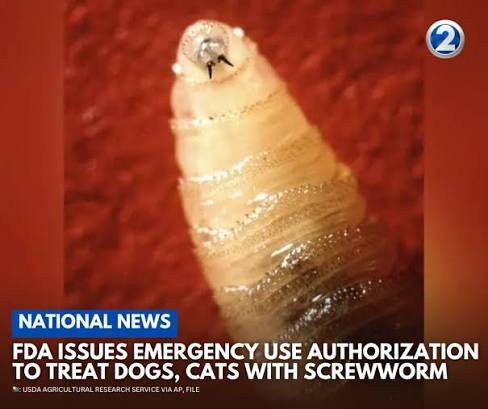
The regulatory acceleration reflects the scale and complexity of the emerging NWS threat, which extends beyond cattle to horses, swine, sheep, goats, deer, dogs, cats and other susceptible animals. NWS larvae invade wounds and mucous membranes and feed on living tissue, producing potentially severe and fatal myiasis.
The FDA’s latest action on September 3 authorized Capstar (nitenpyram) tablets and revised the authorization for generic nitenpyram tablets to permit both prevention and treatment of NWS infestations in eligible dogs, puppies, cats and kittens. The FDA described prevention in companion animals as a previously unmet need.
From emergency treatment to preventive animal health
The significance of the regulatory programme goes beyond the number of products authorized.
The initial response to NWS was predominantly focused on treating animals once infestation occurred. The regulatory trajectory in 2026 increasingly incorporates prophylaxis and short-term prevention, particularly where animals are exposed to wounds or travel through areas where NWS is present.
The FDA’s current NWS framework includes products spanning oral, injectable and topical delivery systems. The agency’s veterinarian information page lists authorized products for different species and circumstances, including nitenpyram for dogs and cats, ivermectin for horses, dicyclanil wound spray for multiple livestock species and ivermectin injection for cattle.
Current FDA NWS regulatory landscape
Regulatory category |
Current FDA position as of Sept. 18, 2026 |
|---|---|
Emergency Use Authorizations |
15 |
Conditional approvals |
3 |
Major target groups |
Livestock, horses, pets, wildlife |
Key species |
Cattle, sheep, goats, swine, horses, dogs, cats, deer and others |
Principal disease mechanism |
Larval myiasis |
Primary regulatory rationale |
Rapid access during an emerging public-health/animal-health emergency |
Source: FDA.
Companion-animal prevention is a notable development
The September 3 authorization allows Capstar and generic nitenpyram tablets to be used for prevention and treatment in dogs, puppies, cats and kittens weighing at least 2 lb and aged four weeks or older.
The FDA says its decision was based on the totality of available scientific evidence and concluded that the known and potential benefits outweighed the known and potential risks when the products are used according to the authorization. Both products are available over the counter in 11.4 mg and 57 mg tablet strengths, with dosing determined by body weight.
This is strategically important because companion animals can move between regions and countries, potentially creating an animal-health surveillance and biosecurity challenge in addition to the livestock problem.
The regulatory pipeline is now multispecies
The broader FDA programme demonstrates how rapidly the NWS product landscape has diversified. Among the products currently identified by FDA are:
-
Nitenpyram — prevention and treatment in dogs and cats.
-
Capstar/nitenpyram — prevention and treatment in dogs and cats.
-
Bimectin/ivermectin injection — prevention in certain cattle circumstances.
-
CLiK Extra/dicyclanil — wound-based prevention across multiple livestock and wildlife categories.
-
Ivermectin liquid for horses — short-term prevention under specified circumstances.
-
Simparica TRIO — treatment in dogs and puppies.
-
Other FDA-authorized and conditionally approved products covering cattle, companion animals and additional species.
The FDA has also maintained a dedicated pathway for companies seeking authorization or approval of additional NWS products.
Why NWS is different from a conventional parasite-control market
NWS creates a distinctive pharmaceutical-development environment because time-to-market, species coverage, wound management and geographic exposure all become critical.
Unlike conventional ectoparasite products, NWS involves larvae that penetrate living tissue. Consequently, treatment may require both pharmacological intervention and physical wound management.
The FDA’s veterinary guidance emphasizes rapid veterinary involvement when infestation is suspected. Visible maggots and abnormal odors associated with wounds or body openings can be warning signs requiring immediate veterinary attention.
The broader One Health dimension is also significant. NWS can infest livestock, companion animals and wildlife and, more rarely, humans.
Pharmaceutical companies gain a new emergency-response market
The NWS response is creating a rare regulatory environment in which existing antiparasitic molecules and formulations can potentially be evaluated for new emergency indications.
For animal-health companies, this creates several strategic opportunities:
-
Repurposing established molecules for emergency indications.
-
Developing rapid-acting oral products for companion animals.
-
Developing longer-duration injectable or topical protection for livestock.
-
Creating wound-management products with insecticidal activity.
-
Developing products for species that are poorly served by conventional parasite-control portfolios.
-
Supporting surveillance and diagnostic systems capable of identifying infestation early.
The FDA’s programme therefore has implications beyond NWS itself: it demonstrates how regulators can mobilize established veterinary pharmaceutical assets during an emerging transboundary animal-health emergency.
Regulatory acceleration does not eliminate evidence requirements
The emergency-use framework should not be interpreted as equivalent to conventional full approval.
The FDA explicitly describes the NWS products as operating under different regulatory mechanisms, including EUAs and conditional approvals. Product-specific authorization conditions, species restrictions, dosing requirements and withdrawal considerations therefore remain important.
For food-producing animals, this becomes particularly important because food safety, residues, withdrawal periods and species-specific use conditions must be addressed.
Implications for the global animal-health industry
The NWS episode is becoming a useful case study in emergency veterinary pharmaceutical innovation.
The progression from isolated treatment options toward a multispecies prevention-and-treatment portfolio demonstrates the value of maintaining regulatory flexibility and having established antiparasitic molecules that can potentially be rapidly evaluated against an emerging threat. For global animal-health companies, the episode also highlights the commercial value of:
-
Broad species portfolios
-
Emergency regulatory capability
-
Parasite-control R&D
-
Rapid formulation development
-
Veterinary education
-
Distribution readiness
-
Cross-border surveillance
-
Government-industry collaboration

