


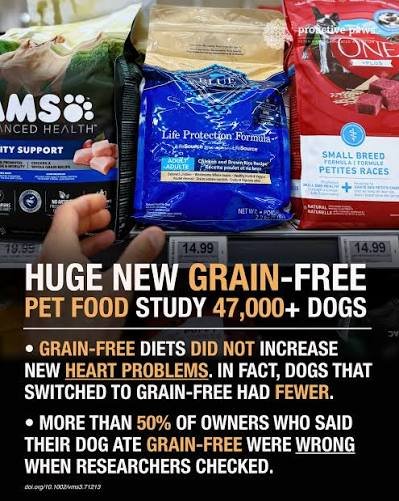
SEATTLE — In one of the largest real-world evaluations of companion dog nutrition and cardiovascular health to date, researchers analyzing data from the Dog Aging Project reported on September 18, 2026, that grain-free diet status was not predictive of newly diagnosed cardiac disease over a two-year observation period.
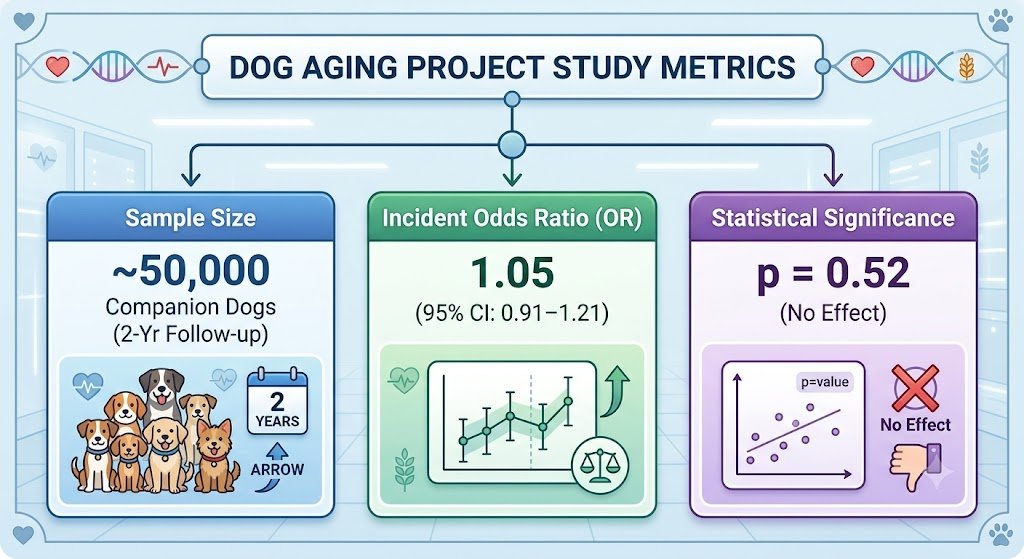
The study, published in Veterinary Medicine and Science, examined health outcomes across a cohort of nearly 50,000 companion dogs enrolled in the Dog Aging Project Consortium. The findings provide key observational context to the multi-year veterinary debate surrounding grain-free dog food formulations and canine dilated cardiomyopathy (DCM).
1. Core Findings & Statistical Modeling
To evaluate the long-term impacts of diet, researchers led by Janice O’Brien, Morgan Bishop, M. Katherine Tolbert, and Audrey Ruple applied statistical modeling techniques to control for confounding factors—including age, breed, body condition, and baseline health—using Directed Acyclic Graphs (DAGs).
-
No Incident Association: When evaluating new, incident-only cardiac diagnoses over the two-year period, the odds ratio (OR) for dogs fed grain-free diets was 1.05 (95% CI: 0.91–1.21, p = 0.52). This indicates no statistically significant elevation in cardiac risk compared to dogs fed grain-inclusive diets.
-
Diet Misclassification Error: The research team identified significant misclassification in owner-reported diet status. When comparing owner surveys against ingredient lists, many owners mislabeled their dog’s diet as grain-free or grain-inclusive. However, bias-analysis modeling demonstrated that this reporting error had a minimal impact on the overall risk estimates.
2. Historical Context: The Grain-Free & DCM Controversy
The study addresses concerns that emerged in 2018 when the U.S. Food and Drug Administration (FDA) issued a public alert regarding potential links between certain pet foods—specifically those marketed as “grain-free” containing high proportions of pulse ingredients (peas, lentils, chickpeas)—and non-hereditary canine dilated cardiomyopathy.
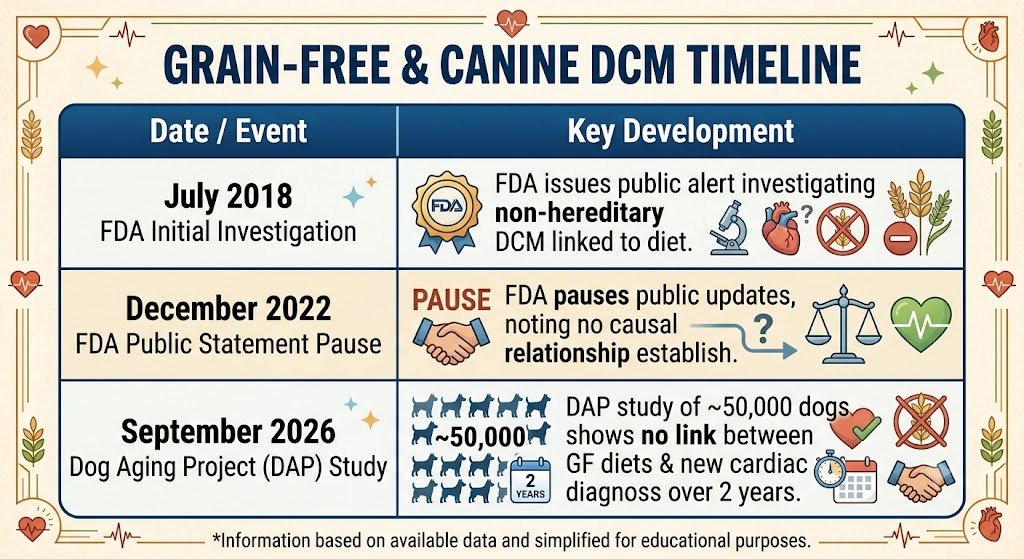
In late 2022, the FDA paused public case updates, maintaining that adverse event reports alone were insufficient to establish a direct causal relationship and stating that diet-associated DCM appears to be a complex, multifactorial issue.
3. Scientific Nuance & Critical Limitations
Veterinary nutritionists and cardiologists emphasize that while the Dog Aging Project findings offer reassurance regarding broad population-level trends, the results should not be interpreted as a blanket endorsement that all grain-free diets are nutritionally equivalent.
Key Caveats Highlighted by Researchers:
-
Broad Diagnostic Scope: The study evaluated overall owner-reported cardiac diagnoses rather than screening all ~50,000 dogs with systematic echocardiograms. Subclinical or early-stage cardiomyopathy that had not yet caused clinical signs or received a formal veterinary diagnosis would not be captured.
-
Formulation Variability: The term “grain-free” describes the absence of grains (wheat, corn, rice) rather than the presence of specific replacements. Formulations vary widely in their inclusion rates of pulses (peas, lentils), exotic proteins, fiber levels, and bioavailable taurine or precursor amino acids (methionine and cysteine).
-
Genetic Susceptibility: Individual dogs, as well as specific breeds (e.g., Golden Retrievers, Doberman Pinschers, Great Danes), may exhibit unique metabolic vulnerabilities or nutrient-interaction sensitivities that broad observational studies are not powered to isolate.
4. Practical Guidance for Dog Owners and Veterinarians
Veterinary consensus continues to focus on total diet formulation, quality control, and scientific testing over simple marketing labels.
-
Focus on Complete Nutrition: Pet owners considering or currently feeding grain-free diets—often chosen for management of food sensitivities or allergies—are encouraged to select formulas developed by certified veterinary nutritionists that meet World Small Animal Veterinary Association (WSAVA) guidelines.
-
Monitor for Early Symptoms: Owners should consult their primary veterinarian if a dog exhibits potential signs of cardiac disease, such as exercise intolerance, coughing, rapid resting breathing, or weakness, regardless of the diet being fed

