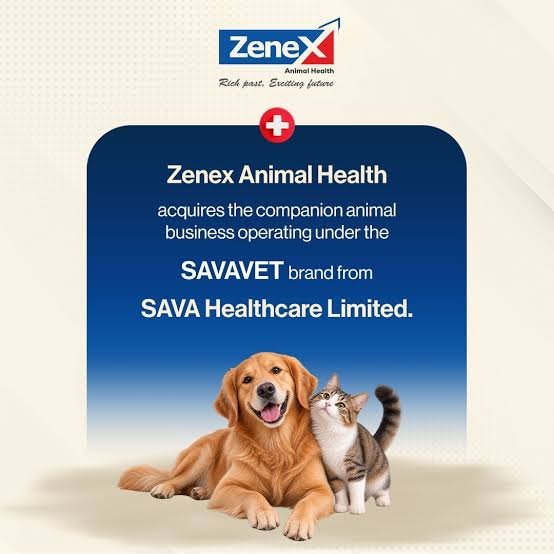
Zenex Animal Health, backed by Multiples Alternate Asset Management, has acquired the SAVAVET companion-animal business of SAVA Healthcare, adding approximately 70 brands, 165 stockists and relationships with more than 6,000 veterinarians to its animal-health platform.
Financial terms of the transaction were not disclosed. But our own, purely internal, guesstimate is that the Deal is Valued at around USD 30 Million and is significantly higher than USD 21 Million paid by Sun-Pharma Family Office for acquisition of much more attractive and highly valued asset, Vivaldis Animal Health in 2023, a current market leader in Companion Animals space in India.
The acquisition is Zenex’s third strategic acquisition since partnering with Multiples, following Ayurvet and Netherlands-based VievePharm. It materially strengthens Zenex’s companion-animal presence while adding another layer to a broader strategy of combining pharmaceuticals, preventive healthcare, herbal products, nutrition, international operations and veterinary distribution.
For SAVA Healthcare, the transaction represents a portfolio rationalisation: the company is retaining its farm-animal business while concentrating more heavily on human-health formulations, pharmaceutical R&D, contract development/manufacturing and international business. SAVA will also continue agreed contract-manufacturing relationships for Zenex and other veterinary companies.
The deal is therefore more than a straightforward pet-pharma acquisition. It is a platform-building transaction in which an established animal-health company is adding a scaled companion-animal commercial network while the seller sharpens its strategic focus.
What Has Been Acquired?
SAVAVET has developed over more than a decade as a specialist companion-animal healthcare business in India. The acquisition brings approximately:
Asset / capability
|
SAVAVET
|
Brands
|
~70
|
Stockists
|
~165
|
Veterinarian relationships
|
6,000+
|
Principal market
|
India
|
Core species
|
Dogs & cats / companion animals
|
Major therapeutic areas
|
Parasiticides, antibiotics, cardiac care, pain, dermatology, wellness
|
Business model
|
Veterinary-led pharmaceutical / healthcare
|
Transaction value
|
Not disclosed (Guesstimated to be ~ USD 30 Million)
|
Zenex and SAVA describe the acquired business as one of India’s leading companion-animal healthcare businesses.
SAVAVET’s own historical corporate material describes a broad small-animal portfolio addressing acute and chronic care, supported by a pan-India distribution network and a large trained field organisation. Earlier company material described 50+ brands and 100+ SKUs, illustrating that the business has expanded its portfolio over time. The company’s previous launches demonstrate its emphasis on differentiated companion-animal products. Examples include Felintra, an itraconazole antifungal for cats, Orapet probiotic dental drops for dogs and cats, and Earworks, an ear-cleansing product.
Why the Distribution Network Matters
The most strategically valuable element of the transaction may not be the 70 brands alone. It is the combination of:
Brands + veterinarian relationships + stockists + field force + market knowledge
SAVAVET has relationships with 6,000+ veterinarians and approximately 165 stockists. In veterinary pharmaceuticals, veterinarian recommendation remains an important component of product adoption, particularly for prescription and therapeutic categories.
Consequently, acquiring an established commercial organisation can provide a faster route to scale than building a companion-animal business organically.
Zenex Has Been Building Through Acquisitions
The SAVAVET transaction is not an isolated deal. It follows a clear acquisition sequence. Zenex platform-building timeline
Year
|
Strategic development
|
2021
|
Zenex established after acquiring the animal-health business of Zydus Animal Health
|
2023
|
Acquisition of Ayurvet
|
2026
|
Acquisition of Netherlands-based VievePharm
|
2026
|
Acquisition of SAVAVET companion-animal business
|
Zenex itself identifies SAVAVET as its third strategic acquisition since partnering with Multiples, following Ayurvet and VievePharm.
The original 2021 transaction was substantial: Zenex acquired Zydus Animal Health’s established animal-health undertaking for approximately ₹2,921 crore, according to contemporary reporting. The transaction provided the foundation on which the current Zenex platform was built.
Acquisition #1 — Ayurvet
Zenex acquired 100% of Ayurvet in December 2023. Ayurvet added:
-
Ayurvedic and herbal veterinary products
-
Feed supplements
-
Topical products
-
Farm-animal capabilities
-
Companion-animal products
-
R&D and product-development capabilities
-
Additional geographical reach, including Europe
The acquisition was explicitly described as complementary to Zenex’s existing business.
Acquisition #2 — VievePharm
In February 2026, Zenex acquired Netherlands-based VievePharm, an animal-nutrition specialist founded in 2006. VievePharm is particularly relevant because its portfolio is focused on boluses and complementary feed supplements for livestock, including products designed around animal health, fertility and productivity.
This expanded Zenex beyond conventional pharmaceuticals into specialised animal nutrition and preventive-health solutions.
Acquisition #3 — SAVAVET
SAVAVET adds the missing scale layer in companion-animal pharmaceuticals and veterinary relationships. The sequence therefore becomes strategically coherent:
Core animal pharmaceuticals
→ Herbal / natural health
→ Livestock nutrition / preventive health
→ Companion-animal pharmaceuticals
That is a classic platform-expansion pattern.
Zenex’s Current Platform Is Significantly Broader Than Its Original Business
Zenex’s current corporate profile reports:
-
60+ years of operational expertise
-
270+ brands
-
15 cGMP approvals
-
1,800+ employees
-
Manufacturing / operational footprint spanning India and international markets
-
Presence across Asia, Africa, CIS, EU, LATAM and MENA
The company describes its current portfolio as spanning livestock, poultry, companion animals and herbal healthcare, alongside international operations. Zenex’s product portfolio also includes therapeutics, nutrition, biologicals and herbal solutions, while its international footprint extends across several emerging and developed markets.
What SAVAVET adds
SAVAVET potentially strengthens one of the fastest-growing parts of that platform: Urban and semi-urban companion-animal healthcare. The strategic fit is therefore different from Ayurvet or VievePharm.
Acquisition
|
Primary strategic contribution
|
Ayurvet
|
Herbal / natural animal health
|
VievePharm
|
Livestock nutrition / bolus / preventive health
|
SAVAVET
|
Companion-animal therapeutics + veterinary network
|
This reduces dependence on a single animal segment and creates a broader multi-species platform.
India’s Companion-Animal Health Market Is Expanding
The timing of the acquisition is important. Independent market-research estimates point to strong structural growth in India’s companion-animal healthcare sector, although the estimates vary considerably depending on market definition.
Grand View Research estimates India’s companion-animal health market at:
-
US$452.4 million — 2025
-
US$514.0 million — 2026
-
US$1.286 billion — 2033
-
14.0% CAGR — 2026–2033
Grand View identifies dogs as the largest revenue-generating segment in 2025, while cats are projected to be the fastest-growing animal-type segment.
A separate IMARC estimate is materially higher, putting India’s companion-animal health market at approximately US$961.9 million in 2025, with a projection of US$1.773 billion by 2034, implying 6.82% CAGR during 2026–2034.
Pet Population Is Creating the Demand Base
India’s companion-animal opportunity is also supported by rising pet ownership. IMARC estimates approximately 32 million pets in Indian households, with the number projected to reach approximately 51 million by 2028. The important commercial shift is not simply more animals. It is increasing expenditure per animal. The market is moving progressively from:
Basic treatment
toward
Preventive healthcare
and increasingly toward:
Chronic disease management + diagnostics + nutrition + dermatology + dental care + wellness.
This is precisely where a broad SAVAVET portfolio becomes strategically relevant.
Why Chronic Companion-Animal Care Is Particularly Attractive
Companion-animal health differs structurally from many production-animal markets. A dairy farmer generally evaluates a veterinary intervention through:
-
productivity
-
milk yield
-
mortality
-
fertility
-
feed conversion
-
economic return
A pet owner may evaluate healthcare through:
-
longevity
-
quality of life
-
convenience
-
preventive care
-
chronic disease management
-
dermatology
-
dental health
-
nutrition
-
emotional attachment
This creates opportunities for higher-frequency and higher-value healthcare consumption. Cardiac care, dermatology, parasiticides and chronic disease management are particularly relevant because they can involve repeated veterinary consultations and recurring treatment.
SAVAVET’s portfolio includes several of these categories.
The Potential Synergy With Zenex
The transaction creates several potential synergy pools.
A. Commercial synergies – Zenex can potentially cross-sell SAVAVET products through its broader commercial infrastructure.
B. Product-development synergies – Zenex’s R&D infrastructure can potentially support new companion-animal formulations.
C. Manufacturing synergies – Zenex operates pharmaceutical manufacturing facilities and has experience across formulations including injectables, oral liquids, powders, tablets and boluses.
D. Internationalisation – Zenex already operates across Asia, Africa, CIS, Europe, LATAM and MENA. Selected SAVAVET products could potentially be evaluated for registration in international markets where regulatory and commercial requirements permit.
E. Portfolio leverage – A larger product portfolio can improve:
-
distributor productivity
-
veterinarian coverage
-
sales-force utilisation
-
customer acquisition economics
-
launch economics
-
bargaining power
-
marketing efficiency
These are potential synergies, not disclosed transaction synergies.
SAVA Healthcare Side Is Equally Important
The transaction should not be interpreted simply as SAVA exiting animal health.
SAVA retains its farm-animal business.
It will also continue agreed contract manufacturing for Zenex and other veterinary companies. The divestment therefore appears to be a portfolio refocusing exercise, rather than a complete withdrawal from veterinary healthcare. SAVA has historically operated across:
-
International pharmaceuticals
-
CDMO
-
SAVAVET
-
SAVA Herbals
-
Farm-animal healthcare
Its manufacturing infrastructure includes a WHO-GMP/PIC/s facility in Gujarat and R&D operations in Pune. This creates an interesting post-deal relationship:
SAVA retains manufacturing capability
while
Zenex acquires the companion-animal commercial platform.
That structure can potentially preserve manufacturing continuity while allowing both businesses to sharpen their strategic focus.
Competitive Landscape
The acquisition occurs within an increasingly competitive Indian companion-animal market involving multinational and domestic players. Major international animal-health companies active in India include:
-
Zoetis
-
Boehringer Ingelheim Animal Health
-
Elanco
-
MSD Animal Health
-
Virbac
-
Ceva
Indian players and emerging platforms are also expanding through pharmaceuticals, diagnostics, clinics, pet retail and digital veterinary services. The competitive battleground is consequently shifting from simply “who has the veterinary product?” toward:
Who controls the veterinarian relationship?
Who owns the distribution?
Who has differentiated products?
Who can launch fastest?
Who can combine pharmaceuticals, diagnostics, nutrition and services?
M&A Is Creating a New Type of Indian Animal-Health Company
The Zenex strategy illustrates a broader transition.
Earlier model – One company → one core segment
Examples:
-
poultry
-
dairy
-
livestock
-
companion animals
Emerging model
Multi-species platform → multiple therapeutic categories → multiple distribution channels → international markets
Zenex is increasingly moving toward the latter model. Its corporate portfolio currently spans:
Livestock + Poultry + Companion Animals + Herbal + Nutrition + International
and SAVAVET adds further depth to the companion-animal component.
Private Equity Perspective
From a private-equity platform-building perspective, the transaction has several characteristics of a buy-and-build strategy.
Platform – Zenex provides the initial scale, infrastructure and distribution platform.
Bolt-ons
-
Ayurvet
-
VievePharm
-
SAVAVET
Each adds a different capability.
Integration logic – The acquired companies are not identical businesses. Instead, they add complementary capabilities:
Herbal → Nutrition → Companion pharmaceuticals
This reduces the risk of simply buying revenue without adding strategic capability. Potential value-creation levers:
-
Revenue synergies
-
Cross-selling
-
Geographic expansion
-
New-product launches
-
Manufacturing optimisation
-
Distribution leverage
-
R&D utilisation
-
International registrations
-
Portfolio rationalisation
-
Further bolt-on acquisitions
Actual financial performance and synergy realisation will depend on integration and are not yet disclosed.
Key Numbers to Watch Post-Acquisition
For investors and industry observers, the most useful indicators will not simply be the number of acquired brands. The following KPIs will reveal whether the transaction creates genuine value:
KPI
|
Why it matters
|
SAVAVET revenue growth
|
Organic performance
|
Veterinarian coverage
|
Commercial reach
|
Stockist productivity
|
Distribution efficiency
|
Revenue per veterinarian
|
Sales-force productivity
|
New-product launches
|
Innovation pipeline
|
Gross margin
|
Portfolio quality
|
Chronic-care share
|
Recurring revenue potential
|
Parasiticide growth
|
Preventive-care penetration
|
Dermatology growth
|
Premiumisation
|
Cat portfolio growth
|
Emerging segment
|
Export registrations
|
International leverage
|
Cross-selling
|
Platform synergy
|
EBITDA contribution
|
Financial value creation
|
Key Risks and Integration Challenges
The transaction also carries several execution questions.
Portfolio overlap -Zenex already has companion-animal products. The key issue will be whether SAVAVET adds incremental therapeutic coverage or creates portfolio overlap.
Brand rationalisation – Approximately 70 acquired brands provide scale, but maintaining every brand may not necessarily maximise profitability.
Sales-force integration – Combining commercial teams can create duplication across territories and veterinarian accounts.
Channel economics – The profitability of the acquired portfolio will depend on stockist margins, veterinarian-driven demand, pricing and working capital.
Regulatory complexity – Veterinary pharmaceuticals require ongoing regulatory compliance, pharmacovigilance and product-quality management.
Talent retention – The veterinary commercial relationships embedded in the acquired organisation can be strategically valuable. Retaining key personnel may therefore be an important integration factor.
Strategic Conclusion
The Zenex–SAVAVET transaction is best understood as a platform-expansion deal rather than a simple pet-product acquisition. SAVAVET contributes three particularly valuable assets:
1. A ~70-brand companion-animal portfolio
2. ~165-stockist distribution
3. Relationships with 6,000+ veterinarians
For Zenex, these assets complement an increasingly diversified platform spanning livestock, poultry, companion animals, herbal products, nutrition and international markets.
The transaction also fits a clear acquisition sequence: Ayurvet → VievePharm → SAVAVET, with each transaction adding a different capability to the platform.
The broader market backdrop is supportive. Independent estimates point toward substantial growth in India’s companion-animal healthcare sector, although market-size estimates vary significantly depending on the definition used.
The strategic question now shifts from “Why acquire SAVAVET?” to:
Can Zenex convert SAVAVET’s veterinarian relationships, product portfolio and distribution footprint into a larger, more productive and more differentiated companion-animal platform?
The answer will ultimately be visible through organic growth, new-product launches, veterinarian productivity, margin expansion, cross-selling and internationalisation rather than the acquisition count alone.
DATA BOX — ZENEX × SAVAVET
Metric
|
Data
|
Transaction
|
Zenex acquires SAVAVET companion-animal business
|
Announcement
|
30 September 2026
|
Buyer
|
Zenex Animal Health
|
Financial sponsor
|
Multiples Alternate Asset Management
|
Seller
|
SAVA Healthcare
|
Brands acquired
|
~70
|
Stockists
|
~165
|
Veterinarian relationships
|
6,000+
|
Major categories
|
Parasiticides, antibiotics, cardiac, pain, dermatology, wellness
|
Deal value
|
Not disclosed
|
Zenex acquisition sequence
|
Ayurvet → VievePharm → SAVAVET
|
Zenex stated portfolio
|
270+ brands
|
Zenex stated employee strength
|
1,800+
|
Zenex stated cGMP approvals
|
15
|
India companion-health 2026 estimate
|
US$514m — Grand View Research
|
GVR forecast
|
US$1.286bn by 2033
|
GVR CAGR
|
14.0%
|
Alternative IMARC 2025 estimate
|
US$961.9m
|
IMARC 2034 forecast
|
US$1.773bn
|
IMARC CAGR
|
6.82%
|
Zenex’s corporate website currently reports 270+ brands, 15 cGMP approvals and 1,800+ employees. Market estimates are from separate commercial research methodologies and should not be directly combined.