



URBANA-CHAMPAIGN, Ill. — October 15, 2026 — In a milestone for precision livestock farming, researchers at the University of Illinois, working in coordination with North American swine integrators, have successfully validated a continuous airborne sensing platform capable of real-time detection of Porcine Reproductive and Respiratory Syndrome Virus (PRRSV).
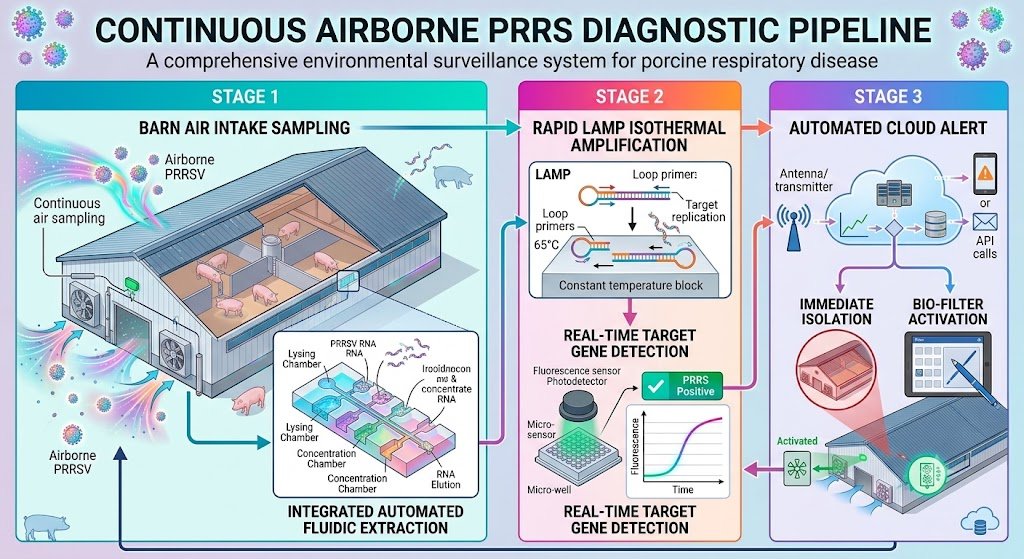
Utilizing Loop-Mediated Isothermal Amplification (LAMP) technology, the field-deployable unit identifies aerosolized viral particles directly within commercial swine housing units before clinical symptoms manifest across herds.
Mitigating Airborne Lineage 1C Spikes
The technology deployment coincides with heightened surveillance across U.S. and Canadian swine operations monitoring aggressive PRRSV Lineage 1C variants (including L1C.5 and L1C.5.32):
-
Sub-Clinical Aerosol Detection: The sensor captures airborne micro-droplets and executes rapid nucleic acid amplification in under 45 minutes, delivering sensitivity comparable to traditional oral-fluid PCR assays.
-
Automated Biosecurity Triggering: When aerosolized PRRSV thresholds are breached, the system sends immediate cloud alerts to farm managers, triggering automated positive-pressure ventilation adjustments and targeted pen isolation protocols.
-
Economic ROI: By reducing diagnostic lag times from days to under an hour, producers can halt farm-to-farm lateral transmission, mitigating multi-million dollar production losses tied to reproductive failure and respiratory mortality.

