


Veterinary Industry Faces Two More Years of Demand Pressure, Piper Sandler Warns
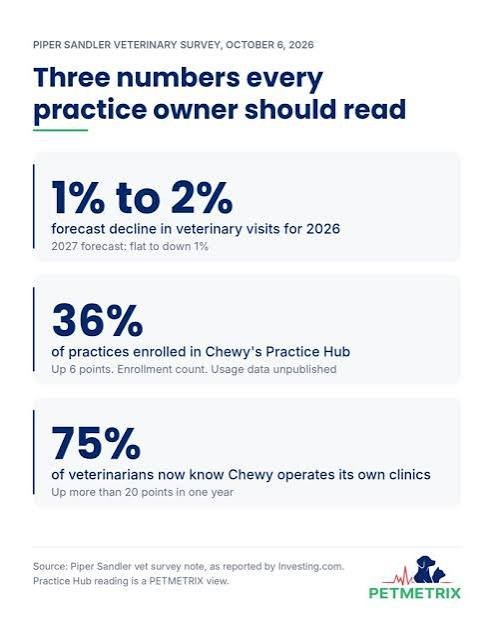
Veterinary visits are expected to decline by 1–2% in 2026 and remain flat to down 1% in 2027, according to Piper Sandler, highlighting the growing challenge of sustaining industry growth through price increases while underlying patient volumes remain weak.
The US veterinary sector may have to contend with subdued demand well into 2027, according to an industry outlook from investment bank Piper Sandler reported by Investing.com.
The forecast points to a difficult operating environment for veterinary practices, pet healthcare providers, animal-health manufacturers and distributors. Although pricing remains relatively resilient, the outlook suggests that underlying demand is struggling to keep pace with the industry’s growth expectations.
Piper Sandler expects veterinary visits to decline by 1–2% in 2026, followed by a broadly flat to 1% decline in 2027. Industry growth is projected to rely largely on price increases of 3–5%, with only limited contribution from greater service intensity.
The distinction matters: revenue growth supported primarily by higher prices is not equivalent to growth driven by more appointments, a larger patient base or greater utilisation of veterinary services.
Key findings: The numbers behind the forecast
Indicator |
Piper Sandler’s reported outlook |
Commercial implication |
|---|---|---|
Veterinary visits in 2026 |
Down 1–2% |
Fewer appointments may constrain organic growth |
Veterinary visits in 2027 |
Flat to down 1% |
A rapid volume-led recovery is not assumed |
Expected pricing increases |
3–5% |
Pricing becomes a primary revenue-growth lever |
Survey respondents attributing weak growth mainly to demand |
More than 50% |
Consumer demand is a central concern, not just staffing |
Veterinarians recommending pet insurance |
79% |
High stated recommendation does not eliminate affordability barriers |
Potential adoption of IDEXX’s upcoming MultiCue within one year |
25% of veterinarians surveyed |
An indicator of possible diagnostic adoption, not realised sales |
Source: Investing.com’s report on Piper Sandler’s veterinary-sector outlook. Figures reflect the reported analyst assessment and survey findings, not independently verified industry-wide outcomes.
Demand, Affordability and Inflation are Reshaping Veterinary Economics
A central finding in Piper Sandler’s assessment is the apparent shift in how industry participants explain weak growth. More than half of survey respondents reportedly attributed the slowdown primarily to demand rather than staffing constraints.
That distinction has important consequences. If appointment growth is being held back by clients delaying visits or declining recommended services, additional hiring or greater clinical capacity will not necessarily translate into higher revenue.
Three pressures deserve particular attention.
1. Veterinary inflation is affecting service utilisation
Cumulative veterinary inflation since 2022 has likely contributed to weaker visit volumes, according to the report. Higher consultation charges, diagnostic bills, treatment costs and other expenses can make pet owners more selective about when and how they seek care.
The commercial risk extends beyond elective procedures. When affordability becomes a concern, clients may postpone preventive appointments, diagnostics or follow-up consultations, potentially affecting both immediate practice revenue and longer-term health outcomes.
However, the reported figures do not establish that inflation alone caused the decline in visits. Household budgets, pet demographics and other demand factors may also contribute.
2. Slower puppy growth could limit future demand
Piper Sandler also identified lower puppy growth as a factor that could weigh on veterinary visits over several years.
New puppies typically generate an initial sequence of appointments for vaccinations, examinations, parasite control and other preventive services. A slower flow of new puppies can therefore affect the pipeline of future patients and the recurring demand generated by younger animals.
The impact may be felt unevenly across practices. Clinics with a strong existing client base, mature pets requiring chronic-disease management, or specialist services may experience a different demand profile from practices that depend heavily on new-pet registrations.
3. Price increases may sustain revenue without restoring volumes
With projected price increases of 3–5% against flat or declining visit volumes, veterinary businesses may continue to report nominal revenue growth without a comparable improvement in patient throughput.
That creates a strategic challenge for practice owners and investors: distinguish sustainable organic growth from growth driven primarily by pricing.
The key metrics to monitor are appointments per practice, new-client registrations, average transaction value, treatment acceptance, revenue per patient and client retention. Taken together, these measures can show whether higher prices are compensating for weaker volumes—or beginning to undermine future demand.
Implications for veterinary practices and corporate groups
A subdued market extending through 2027 would make disciplined operating decisions more important for both independent clinics and larger veterinary groups.
For independent practices, priorities include controlling labour and facility costs, improving appointment utilisation, strengthening client communication around treatment options, and measuring the conversion of clinical recommendations into accepted care.
For corporate veterinary groups, the outlook raises questions about acquisition underwriting, integration targets and the assumptions used in expansion plans. Growth models built on rapid appointment increases may need more conservative volume assumptions and greater scrutiny of same-clinic performance.
For lenders and investors, a prolonged period of weak volumes could affect cash-flow forecasts and the valuation multiples buyers are prepared to pay for veterinary businesses. The report does not establish that transaction activity or valuations will necessarily decline, but it supports testing acquisition models against slower organic growth and persistent cost pressures.
A useful planning approach is to model three scenarios: continued volume contraction, stabilisation in 2027, and a faster recovery. Each should incorporate pricing, staffing costs, client retention and capital expenditure rather than relying on a single headline revenue-growth assumption.
Animal-health manufacturers face a mixed demand environment
The outlook also matters beyond the veterinary clinic. Pharmaceutical manufacturers, diagnostic providers, distributors and pet-health businesses depend on different parts of veterinary spending, and their exposure to weaker visits will vary.
A decline in appointments does not automatically translate into an equivalent decline in medicine sales. Product demand can also be influenced by treatment mix, prescription fulfilment, preventive-care compliance, product launches, market-share changes and the severity of disease.
Nevertheless, persistent weakness in clinical activity may increase pressure on suppliers to demonstrate measurable clinical value, support treatment compliance and help practices deliver efficient care.
The Piper Sandler report highlighted several companies and product categories:
-
Elanco Animal Health: Piper Sandler identified Elanco as a preferred investment, citing its parasiticides, dermatology and farm-animal portfolios. The report noted adoption trends for Zenrelia and Credelio Quattro, as well as potential upside from Befrena in 2027 as supply constraints ease.
-
Zoetis: The firm viewed the company’s pipeline products favourably in its survey, while noting that they might not be sufficient to offset Apoquel market-share losses.
-
IDEXX Laboratories: Adoption of its inVue fine-needle aspiration platform was described as being at an early stage. Around 25% of surveyed veterinarians indicated they could adopt the upcoming MultiCue product within one year; this represents stated potential adoption, not a confirmed purchase commitment.
-
Trupanion: Veterinarians continued to show support for pet insurance, with 79% reportedly recommending coverage. Premiums, deductibles and out-of-pocket costs nevertheless remain barriers for consumers.
-
Chewy: Awareness of its veterinary clinics reportedly increased by more than 20 percentage points to 75%, while PracticeHub adoption rose by six percentage points to 36%. Piper Sandler also compared veterinary engagement with Chewy’s PracticeHub and Tractor Supply’s Allivet platforms.
These observations illustrate why the sector should not be treated as a single, uniform investment story. Weak appointment volumes may constrain some revenue streams while new products, diagnostics, insurance and distribution platforms create opportunities elsewhere.
The company-specific comments represent the analyst’s assessment and survey findings reported by Investing.com; they should not be interpreted as guaranteed commercial outcomes.
What veterinary businesses should monitor through 2027
The forecast provides a planning horizon rather than a definitive prediction of when the sector will recover. Actual performance will depend on consumer spending, pet ownership trends, inflation, clinical demand and individual companies’ execution.
Five indicators will be particularly important:
-
Appointment volumes: Whether year-on-year declines moderate, stabilise or accelerate.
-
New-pet registrations: Whether puppy growth and new-client acquisition improve.
-
Price versus volume growth: Whether higher fees continue to support revenue without materially weakening service uptake.
-
Treatment acceptance and preventive-care compliance: Whether clients proceed with recommended diagnostics, medications and follow-up visits.
-
Supplier performance: Whether product launches, market-share gains and diagnostic adoption can offset softer underlying clinical demand.

