


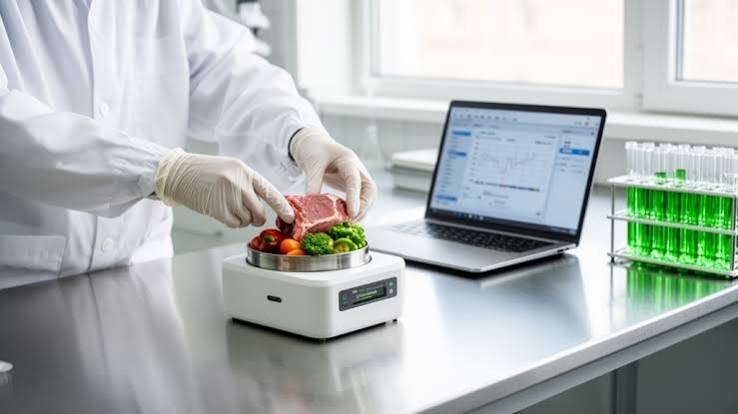
A comprehensive scientific review published by Bioengineer.org highlights a paradigm shift in veterinary public health and food safety monitoring. Titled “From Farm to Fork: AI, Biosensors and Green Chemistry Join Forces to Hunt Veterinary Drug Residues in Food,” the report outlines how machine learning algorithms, point-of-production biosensing tools, and sustainable extraction methods are converging into a unified, multi-layered detection ecosystem.
For food-animal practitioners, livestock integrators, and regulatory compliance officers, this technological shift expands residue avoidance beyond traditional withdrawal calendars and centralized laboratory chromatography, moving diagnostic oversight directly into field environments.
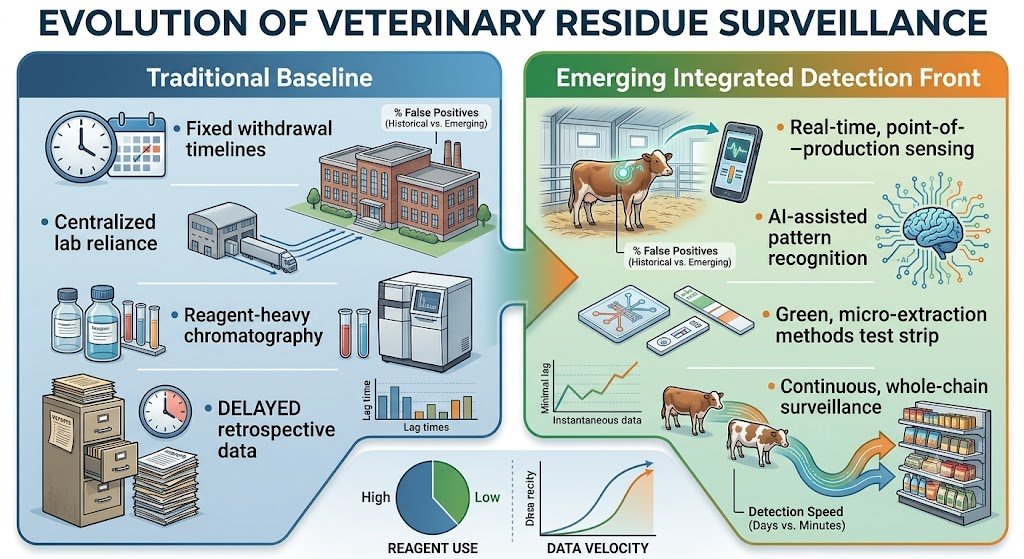
Three Pillars of Next-Generation Residue Control
Rather than functioning as competing diagnostic platforms, the review frames these three domains as complementary layers across the farm-to-fork supply chain:
1. Artificial Intelligence & Predictive Data Analytics
Advanced machine learning models are increasingly applied to raw analytical datasets to accelerate pattern recognition. By automating signal processing, AI systems enable faster identification of anomalous spectral or electrochemical signatures, flagging suspect samples for targeted laboratory confirmation significantly faster than manual review workflows.
2. Portable Biosensors at the Point of Production
Handheld and field-deployable biosensors bring diagnostic screening directly to farms, saleyards, and processing plants. Operating closer to the point of animal treatment, these rapid tools lower the threshold for on-site screening, enabling real-time verification before animals or milk shipments enter commercial processing streams.
3. Green Chemistry & Sustainable Sample Preparation
Modern analytical workflows are adopting green extraction methodologies that minimize organic solvent volumes, reduce hazardous waste streams, and lower overall reagent consumption. This environmental optimization streamlines sample processing while aligning regulatory monitoring with broader industrial sustainability mandates.
Practical Implications for Food-Animal Veterinarians
The decentralization and acceleration of residue testing carry direct operational consequences for veterinary practice management and livestock stewardship:
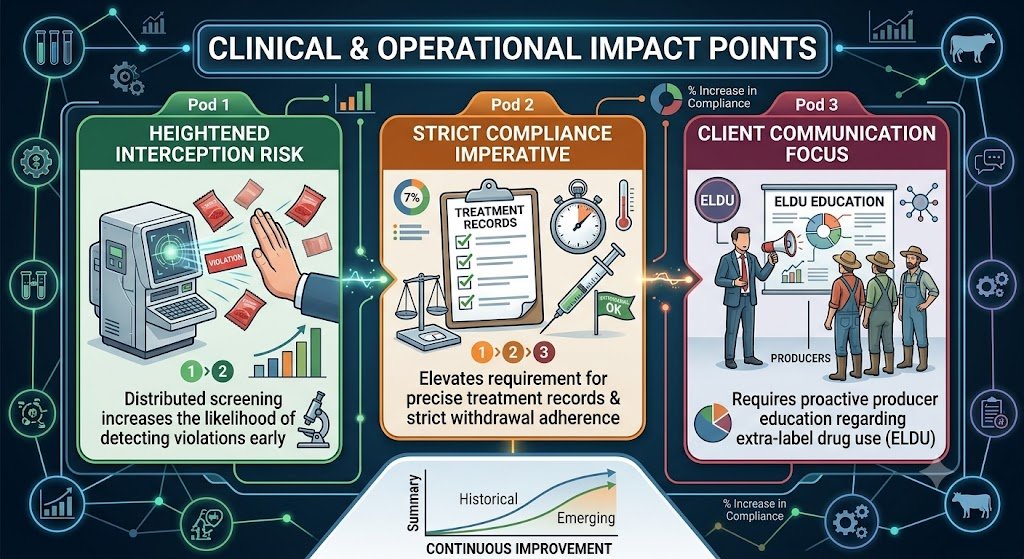
Because rapid, field-ready biosensors blur the traditional line between on-farm management and regulatory laboratory testing, the odds of catching a residue violation prior to retail distribution increase dramatically. Consequently, food-animal clinicians face heightened responsibility to ensure precise treatment logging, strict adherence to withdrawal periods, and clear communication with producers regarding extra-label drug administration.
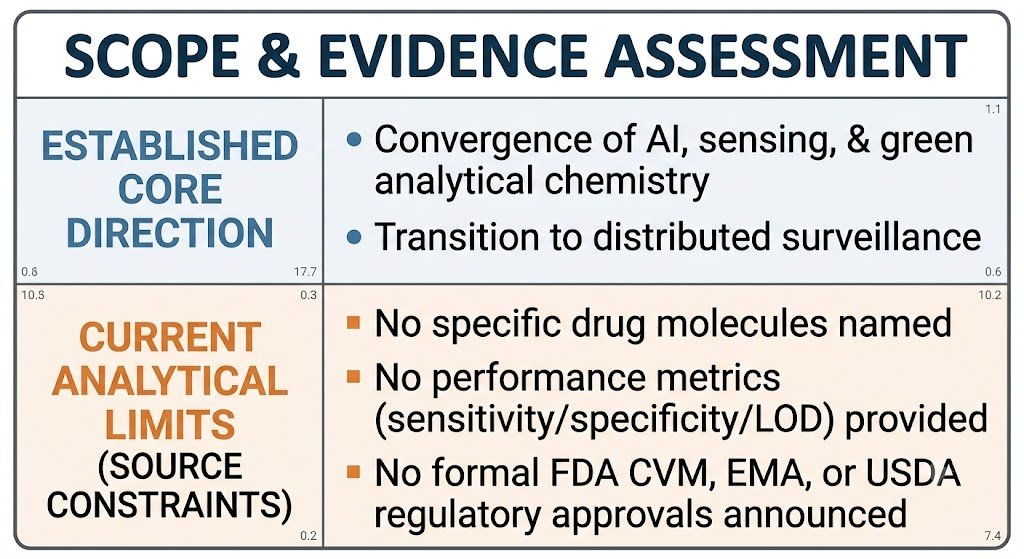
Scope & Analytical Boundary Evaluation
To maintain rigorous clinical and regulatory perspective, industry stakeholders must distinguish between conceptual review frameworks and fully validated commercial diagnostics:
-
Food Supply Focus: The review’s scope centers exclusively on animal-derived food products (e.g., meat, milk, eggs, honey) and livestock health; companion animal pharmaceuticals fall outside this surveillance model.
-
Validation Requirements: The cited literature represents a high-level review of technological trends. It does not report specific limit-of-detection (LOD) values, false-positive rates in complex tissue matrices (kidney, muscle, liver), or new regulatory clearances from agencies such as the FDA Center for Veterinary Medicine (CVM), the European Medicines Agency (EMA), or the USDA.

