


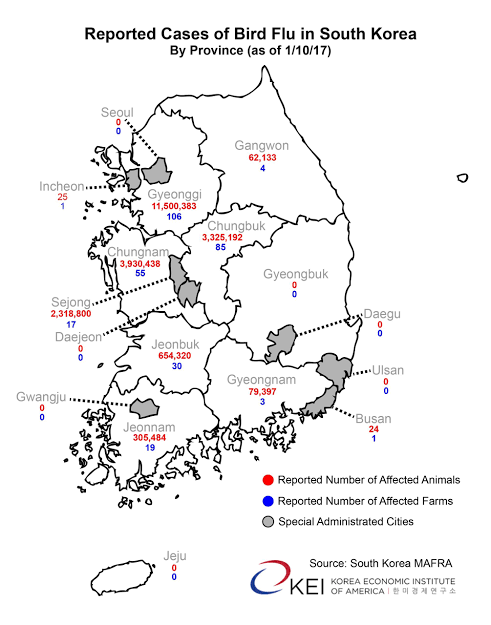
South Korea has expanded its highly pathogenic avian influenza response beyond veterinary agencies, involving disaster-management authorities and local governments after nine outbreaks were reported across five provinces. The government has allocated KRW 7 billion in special grants and is strengthening enforcement of poultry-farm vehicle disinfection.
Nine outbreaks reported across five provinces
South Korea’s Ministry of Agriculture, Food and Rural Affairs (MAFRA) and Ministry of the Interior and Safety held a joint meeting on 19 November to review the country’s response to highly pathogenic avian influenza (HPAI).
Reports described nine outbreaks since the first case was confirmed at a layer farm in Yeoncheon, Gyeonggi Province, on 3 November. The outbreaks have now been reported across five provinces and involved layer farms, duck farms and other poultry operations.
The Korean government’s briefing also identified multiple viral subtypes, including H5N1 and H5N9, underscoring the need for laboratory confirmation rather than assuming that every outbreak belongs to the same subtype.
Government expands response beyond veterinary departments
The joint meeting brought disaster-management departments into a response framework that had previously been led primarily by animal-disease control authorities. The objective is to coordinate animal-health measures with broader emergency-management capabilities. This includes reviewing:
-
Local disaster and safety headquarters
-
Culling and disinfection operations
-
Movement controls
-
Enforcement of farm biosecurity
-
Allocation and use of emergency funding
The government had released KRW 7 billion in special grants for local disease-control activities on 9 November. The allocation was reported to be KRW 2 billion higher than the previous year’s amount and released 15 days earlier. The earlier allocation is intended to support local authorities in implementing containment and disease-control measures.
Vehicle disinfection identified as a weakness
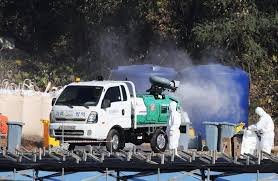
A particularly important issue emerging from the joint inspection process was non-compliance with the required two-stage disinfection of vehicles entering poultry farms. The reported shortcomings included vehicles failing to complete both stages:
-
Initial disinfection using fixed equipment.
-
Secondary disinfection using high-pressure spraying.

