


Antibiotic use in food-producing animals accounts for the majority of global antimicrobial consumption—estimated around 73%—and drives antimicrobial resistance (AMR) across animal, human, and environmental health.
Addressing this challenge requires tracking usage trends, curbing routine overuse, and adopting non-antibiotic alternatives. This news report extensively covers precisely these aspects in detail.
Global Trends
- High overall share: Food-producing animals consume a large proportion of antimicrobials worldwide, exceeding human use in many estimates
- Rising demand and intensification: Growing global demand for meat, milk, eggs, and fish has shifted farming toward intensive, high-density operations that historically relied on antibiotics for growth promotion and disease prevention
- Projected growth: Modeling across major food animal groups (such as cattle, pigs, poultry, and sheep) projects continued rises in total antimicrobial usage through 2030, especially in rapidly industrializing and middle-income economies
- Common classes: Tetracyclines and penicillins make up a large share of global veterinary use, while “shared” or critically important classes for human medicine (like fluoroquinolones and cephalosporins) represent smaller fractions and face stricter oversight in several regions
-
Regulatory shifts: Many jurisdictions and international bodies (such as the WHO, WOAH, and FAO) push for phasing out antibiotics for growth promotion and restricting medically important drugs to veterinary-supervised treatment
UK Veterinary Antibiotic Resistance and Sales Surveillance (UK-VARSS 2025) report (published November 2026 by the Veterinary Medicines Directorate) presents a comprehensive 12-year longitudinal view (2014–2025) of veterinary antibiotic sales, sector-specific usage, and antimicrobial resistance (AMR) in healthy and diseased animals.
-
Strengths of the Report: It combines statutory pharmaceutical sales data with high-coverage voluntary industry usage datasets (98% in pigs, 100% in salmon, ~90% in laying hens, trout, and gamebirds, and 83% in meat poultry). It distinguishes between passive clinical surveillance (biased toward sick animals/treatment failures) and active harmonised monitoring (randomised sampling of healthy animals at slaughter). Notably, the 2025 edition expands surveillance into companion animals via the Private Laboratories Initiative (PLI) and breaks down clinical resistance by animal age and Salmonella serovar
-
Key Limitations: Significant data gaps remain in the UK ruminant sector—beef cattle usage data were omitted entirely due to low coverage (~10%) and farm system diversity, while dairy coverage sits at 49% and sheep at 11%. Furthermore, sales data do not capture products imported under the Special Import Scheme (which rose to 10.6 tonnes in 2025 due to domestic product discontinuations/shortages) and can be skewed by wholesaler stockpiling
Trends in Antibiotic Usage in Food-Producing Animals (UK vs. Global)
1. United Kingdom Trends (UK-VARSS 2025)
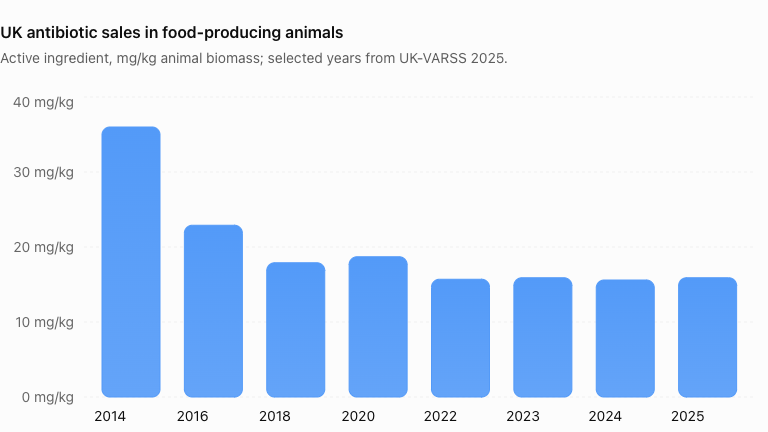
After a decade of steep reductions, UK livestock antibiotic sales have reached a stable plateau of “optimised use”:
The headline UK findings
Indicator |
2014 |
2025 |
Change |
|---|---|---|---|
Antibiotic sales in food-producing animals |
36.0 mg/kg |
15.9 mg/kg |
-56% |
Highest-priority critically important antibiotics |
0.38 mg/kg |
0.07 mg/kg |
-82% |
Total veterinary antibiotic sales, all animals |
452 tonnes |
195 tonnes |
-57% |
Colistin sales for animal use |
— |
Zero for fifth consecutive year |
— |
-
Overall Sales: Adjusted for animal biomass, sales stood at 15.9 mg/kg (195 tonnes total across all animals) in 2025—a 56% reduction since 2014 (36.0 mg/kg), though showing a minor 2% uptick from 2024 (15.6 mg/kg) driven largely by wholesaler stocking of tetracycline premixes.
-
Highest Priority Critically Important Antibiotics (HP-CIAs): Sales of last-resort human antibiotics (fluoroquinolones, 3rd/4th-generation cephalosporins, and colistin) dropped 82% since 2014 to 0.07 mg/kg, accounting for just 0.4% of total veterinary sales. Colistin has recorded zero sales for five consecutive years.
-
Shift in Administration Route: In-feed prophylactic/metaphylactic medication has fallen by 77% since 2014. In-water/milk administration now accounts for 50% of sales (exceeding in-feed at 32%), allowing faster, more targeted dosing when animals are sick. In pigs, in-water use (48%) surpassed in-feed use (47%) for the first time in 2025.
UK – Species Wise Antibiotics Usage 2025 vs 2024
UK Livestock Sector |
2025 Usage |
Change vs. 2024 |
Long-Term Change (vs. Baseline) |
HP-CIA Usage Status |
Pigs |
44.8 mg/kg |
-11% |
-72% (since 2015) |
0.007 mg/kg (-99% vs 2015); 0% colistin for 6 yrs |
Broilers (Meat Chicken) |
3.8 mg/kg |
-20% |
-81% (since 2014) |
Zero HP-CIA use for 2 consecutive years |
Turkeys |
18.1 mg/kg |
-8% |
-83% (since 2014) |
0.020 mg/kg (fluoroquinolones only) |
Ducks |
0.34 mg/kg |
+42% |
-95% (since 2014) |
Zero HP-CIA use across entire 11-yr period |
Laying Hens |
0.254% bird days |
-9% |
-62% (since 2016) |
0.0003% bird days (single breeder flock derogation) |
Gamebirds |
11.4 tonnes |
+3% |
-43% (since 2016) |
15.0 kg (-67% vs 2024; -77% vs 2016) |
Salmon |
12.4 mg/kg |
+52% |
-23% (since 2017) |
Zero HP-CIA use since 2021 |
Trout |
6.9 mg/kg |
+36% |
-64% (since 2017) |
4.0 mg/kg (oxolinic acid spike due to redmouth outbreaks) |
Dairy Cattle (49% cov.) |
6.8 mg/kg |
Flat |
Dry cow tubes -28% / Lactating -69% (vs 2014) |
0.003 mg/kg (0.04% of total use) |
Global Trends (WOAH ANIMUSE & International Data)
Globally, antimicrobial consumption in food animals presents a starkly bifurcated picture—sharp declines in high-income regulatory markets contrasted against rising or plateauing demand in rapidly intensifying agricultural economies:
-
Global Aggregate Baseline: According to the World Organisation for Animal Health (WOAH) ANIMUSE Global Report (Analysis of 2024 Data, published 2026) covering 74% of global animal biomass, the global biomass-adjusted indicator stands at 87–90 mg/kg—more than five times higher than the UK’s 15.9 mg/kg.
-
Uneven Trajectory: Among 80 consistent reporting countries, global usage edged down by 3% between 2019 and 2024, yet broader cohorts show a 9% increase since 2018, with early 2025–2026 indicators pointing to a ~4% uptick driven by livestock intensification in middle-income regions.
-
Europe & North America: The EU/EEA reduced veterinary antimicrobial sales by over 50% over the past decade under strict legislative bans. The US saw steep reductions following its 2017 Veterinary Feed Directive (banning growth promoters), followed by a plateau and renewed tightening in 2023–2025 under FDA GFI #263.
-
Asia & Latin America: Asia accounts for the largest share of global veterinary antibiotic volume. While China (the world’s largest consumer) achieved measurable drops after banning growth promoters in 2020 and rolling out its 2021–2025 National Action Plan, growth promoter use persists in nearly 20% of WOAH member countries globally, and rising meat/aquaculture demand in South/Southeast Asia and parts of South America continues to exert upward pressure on usage.
Global antibiotic consumption: the latest picture
Long-term reduction, but progress is slowing – The 2026 WOAH report provides the following findings:
Global indicator |
Finding |
|---|---|
Countries/participants reporting 2024 data |
119 |
Global animal biomass covered |
74% |
Estimated 2024 global use |
87 mg/kg biomass |
Coverage-adjusted estimate |
90 mg/kg |
Consistent 80-participant cohort, 2019–24 |
108 to 105 mg/kg |
Change in consistent cohort |
-3% |
Country-by-country assessment
The following table brings together the most recent comparable official datasets and country-specific surveillance. The figures are not all directly comparable because countries use different denominators, reporting periods and definitions.
Country / region |
Latest relevant findings |
Overall direction |
|---|---|---|
UK |
-56% food-animal sales since 2014 |
Down |
EU-27 |
-24.3% in 2024 versus 2018; 2024 rose 4.7% versus 2023 |
Down, recent reversal |
USA |
2024 medically important antimicrobial sales rose 16% versus 2023; 27% below 2015 peak |
Mixed |
Canada |
-19% biomass-adjusted sales since 2018; -5% in 2024 versus 2023 |
Down |
China |
Major reduction in antimicrobial growth-promoter use, but post-ban substitution and treatment-use challenges |
Mixed |
Japan |
Sales volume declined from 859 tonnes in 2017 to 745 tonnes in 2024 |
Down |
Australia |
National surveillance and stewardship, but less directly comparable public national use data |
Insufficient comparable trend |
India |
Important regulatory initiatives, but substantial gaps in national biomass-adjusted livestock usage data |
Insufficient comparable trend |
Brazil |
Regulatory controls and growth-promoter restrictions, but national trend requires more comparable use data |
Insufficient comparable trend |
Which antibiotics are being used most frequently?
The global WOAH 2026 report offers a useful overview of the distribution of antimicrobial classes.
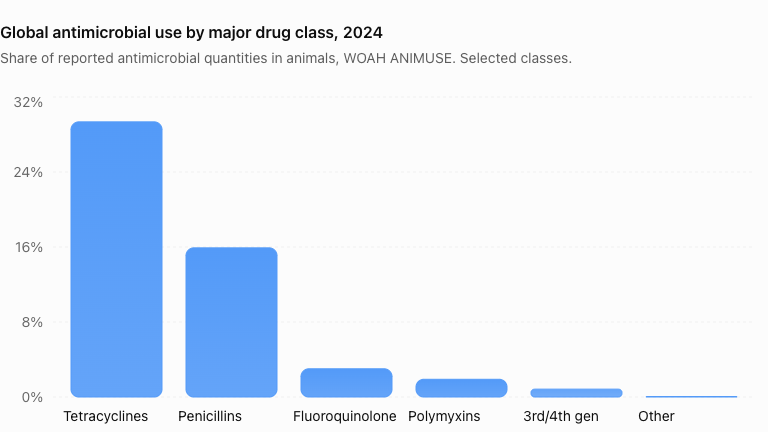
Tetracyclines and penicillins together account for approximately 45% of reported global use.
The highest-priority classes for human medicine account for much smaller proportions, but their use remains a major stewardship concern.
Aquaculture deserves special attention: fluoroquinolones accounted for 13.56% of reported antimicrobial quantities used in aquatic food-producing animals, according to the WOAH analysis.
Alternatives Used Instead of Antibiotics
Both the UK-VARSS sector statements and global veterinary science demonstrate that reducing antibiotics relies on replacing routine medication with multi-layered disease prevention rather than a single “silver bullet” drug:
-
Expanded Vaccination Programmes: Identified across UK pig, laying hen, salmon, and trout sectors as the primary driver reducing bacterial disease incidence. When vaccine supply falters—as seen with Enteric Redmouth vaccine shortages in UK trout—antibiotic usage spikes immediately. Globally, autogenous (farm-specific) vaccines and oral mucosal vaccines (e.g., against Lawsonia in pigs) have cut antibiotic use by up to 80% on adopting farms.
-
Gut Microbiome Modulators (Probiotics, Prebiotics, Synbiotics & Postbiotics): Highlighted in the UK poultry sector to prevent early-life E. coli colonisation, probiotics and prebiotics hold over 50% of the global antibiotic-alternative feed additive market. Postbiotics (non-living microbial metabolites) and faecal microbiota transplantation (FMT) are increasingly deployed in calves and piglets to prevent post-weaning diarrhoea following bans on medicinal zinc oxide (withdrawn in the UK/EU in 2022–2024).
-
Phytogenics, Organic Acids & Feed Enzymes: Plant-derived essential oils/bioactives (e.g., oregano, thyme, tannins), short- and medium-chain organic acids (which lower gut pH to inhibit Salmonella and E. coli), and feed enzymes (improving nutrient digestibility so undigested protein does not feed pathogenic gut bacteria) are standard replacements for antibiotic growth promoters globally.
-
Selective Dry Cow Therapy (SDCT) & Teat Sealants: In dairy farming, blanket prophylactic antibiotic infusions at drying-off are being replaced by internal bismuth subnitrate teat sealants alongside targeted antibiotic use only for cows with elevated somatic cell counts or confirmed infection.
-
Bacteriophages & Antimicrobial Peptides (AMPs): Lytic bacteriophages (viruses that selectively destroy specific bacteria like Salmonella or E. coli without harming commensal flora) and synthetic/natural AMPs are gaining commercial traction in poultry, swine, and aquaculture as targeted biotherapeutics.
-
Structural Biosecurity & Husbandry: All-in/all-out batch management, improved barn ventilation (reducing ammonia stress that triggers porcine/bovine respiratory disease), hatchery hygiene, water acidification, and farm-level benchmarking (such as the UK’s Persistently High User intervention schemes).
Alternative |
Principal biological action |
Most relevant applications |
Evidence maturity |
|---|---|---|---|
Probiotics |
Competitive exclusion, microbial balance, immune modulation |
Poultry, pigs, calves |
Moderate to strong for selected indications |
Prebiotics |
Selective stimulation of beneficial microbes |
Poultry, pigs, dairy calves |
Moderate |
Organic acids |
Gut pH modification, pathogen suppression |
Poultry, pigs, feed |
Moderate to strong for selected uses |
Phytogenics |
Antimicrobial and anti-inflammatory activity |
Poultry, pigs, ruminants |
Variable |
Enzymes |
Improved nutrient digestibility |
Poultry, pigs |
Strong for established applications |
Bacteriophages |
Targeted bacterial lysis |
Poultry, pigs, food safety |
Emerging |
Vaccines |
Prevention of specific infectious diseases |
All major livestock species |
Strong for established vaccines |
Postbiotics |
Microbial metabolites and cell components |
Poultry, pigs, calves |
Emerging |
Immunomodulators |
Modulation of host immune responses |
Multiple species |
Emerging |
Biosecurity |
Reduces pathogen introduction and transmission |
All species |
Strong |
Species-wise adoption
Animal sector |
Alternatives gaining importance |
|---|---|
Broilers |
Probiotics, organic acids, enzymes, coccidiosis vaccines, phytogenics |
Layers |
Probiotics, gut-health products, vaccination, biosecurity |
Swine |
Zinc-management strategies, organic acids, probiotics, postbiotics, vaccines |
Dairy cattle |
Calf probiotics, colostrum management, rumen modifiers, vaccination |
Beef cattle |
Vaccination, feedlot biosecurity, rumen management |
Aquaculture |
Vaccines, probiotics, immunostimulants, phages, water-quality management |
Sheep and goats |
Vaccination, parasite control, nutritional management, targeted treatment |
Antimicrobial Resistance (AMR): Is It Growing or Reducing?
The short answer: Over the long term (2014–2025), AMR in food-producing animals has substantially reduced in countries enforcing strict stewardship, but recent 2024–2025 data reveal a plateau and localized rebounds in specific multidrug-resistant (MDR) strains, while globally AMR remains an escalating threat.
1. Evidence of Long-Term Reduction (UK-VARSS 2025)
-
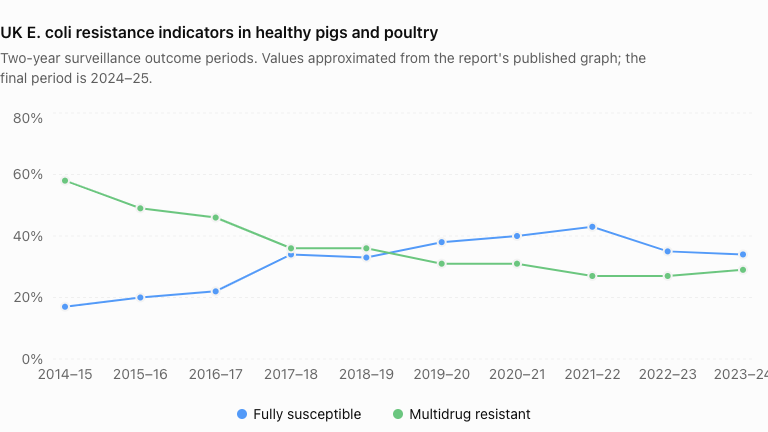
Healthy Livestock (Harmonised Monitoring): Since 2014/2015, the proportion of indicator E. coli from healthy pigs and poultry that are fully susceptible to all tested antibiotics nearly doubled (up 98%, from 17.2% to 34% in 2024/2025). Over the same period, MDR E. coli dropped by 58% (from 57.7% to 29%), and ciprofloxacin resistance halved (from 16.5% to 8.0%).
-
Zoonotic Salmonella: In healthy slaughter pigs, full susceptibility in Salmonella hit an all-time high of 57% in 2025 (up from 42% in 2023), with zero resistance detected to HP-CIAs or human-only antibiotics. Across clinical Salmonella submissions in Great Britain, full susceptibility improved to 76% (up from 69% in 2014).
-
Sick Livestock (Clinical Surveillance): Clinical E. coli isolates with “limited treatment options” (resistant to $\ge4$ antibiotics) fell by 68% since 2014 (from 57% to 18% in 2025), with sharp declines across young calves, piglets, and lambs.
2. Warning Signs: Where Resistance Is Plateauing or Growing
Despite falling antibiotic use, resistance is not declining linearly across all bugs:
-
Recent Plateau & Slight Rebound: In 2024/2025, full susceptibility in healthy pig/poultry E. coli dipped slightly to 34% (down from a peak of ~43% in 2022/2023), while MDR E. coli crept up by 2.4 percentage points (from 26.6% to 29%). In healthy pigs specifically, MDR E. coli rose from 26% (2023) to 34% (2025)—the first increase since 2015.
-
Rising ESBL/AmpC Carriage: Sensitive selective-media testing revealed that 32% of healthy UK pigs carried ESBL- and/or AmpC-producing E. coli in 2025 (up from 23% in 2023 and the highest since 2015), despite near-zero cephalosporin use in pigs. Over a third (38%) of these carried co-resistance to fluoroquinolones.
-
First-Time Detections of Human Last-Resort Resistance: Surveillance detected low-level vancomycin resistance (1.1%) and daptomycin resistance (2.8%) in porcine Enterococcus faecium for the first time, alongside trace carbapenemase-producing E. coli and mcr-1 colistin resistance (0.8% of pigs). Because carbapenems and glycopeptides are banned in food animals, these detections point to environmental spillover or human-to-animal transmission, and persistence via co-selection by older antibiotics (like tetracyclines and aminoglycosides).
-
Bovine Mastitis & Companion Animals: Clinical E. coli causing bovine mastitis showed rising ampicillin resistance (43% in government labs; 36% in private labs) despite falling intramammary antibiotic sales. Meanwhile, newly integrated private lab data for dogs and cats revealed high MDR rates in skin/soft tissue infections (68% in canine S. pseudintermedius, 100% in selected canine E. coli) and trace carbapenem resistance.
-
Global AMR Trajectory: Outside strict regulatory zones, WHO and global burden studies indicate that livestock-associated AMR remains high or rising in low- and middle-income countries (LMICs) where over-the-counter sales, sub-therapeutic dosing, and poor farm sanitation accelerate horizontal gene transfer.
Future of Antibiotics in Food-Producing Animals (UK & Major Countries)
The global trajectory is moving decisively away from mass medication toward strict veterinary prescription control, mandatory usage reporting, benchmarking of high-use farms, and total bans on human-critical drugs.
Country / Region |
Current Policy & Regulatory Framework (2025–2026) |
Future Direction & Targets (2026–2030+) |
United Kingdom |
Veterinary Medicines Regulations (updated 2024) ban routine prophylaxis and restrict metaphylaxis. Voluntary industry-led targets under RUMA Targets Task Force 3 (TTF3). |
• Sector Targets (to 2028/2029): Pigs (-20% from 2024); Gamebirds (-40% from 2019); Calves (-10% annual oral use); Dogs & Cats (-30% overall, -50% feline HP-CIAs).• Surveillance Expansion: Nationwide AMR survey in healthy prime beef cattle (2027), closing ruminant usage gaps via Medicine Hub, and scaling the Private Laboratories Initiative. |
European Union |
Regulation (EU) 2019/6 bans all routine use, growth promotion, and prophylactic group treatment. Regulation (EU) 2022/1255 reserves key antimicrobials strictly for humans. New veterinary GMP rules took effect in July 2026, and mandatory pathogen ID/susceptibility testing for cascade use began August 2026. |
• Farm-to-Fork Strategy: Target to reduce overall EU sales of antimicrobials for farmed animals and aquaculture by 50% by 2030 (vs. 2018 baseline).• Mandatory Data Collection: Phased legal requirement for member states to report species-level usage data across all livestock, extending to dogs and cats by 2030. |
United States |
Antibiotic growth promoters banned since 2017. FDA GFI #263 transitioned all remaining medically important over-the-counter (OTC) livestock antibiotics (e.g., injectable penicillin, oxytetracycline) to prescription-only status. |
• 5-Year Stewardship Plan (2024–2028): Focus on defined duration limits for medically important in-feed/in-water drugs (currently many lack duration caps), enhanced veterinary-client-patient relationship (VCPR) enforcement, and expanding biomass-adjusted usage tracking across swine, cattle, and poultry. |
China |
World’s largest livestock producer; banned all antibiotic growth promoters in feed in 2020. Executed the National Action Plan for Reducing the Use of Veterinary Antimicrobials (2021–2025). |
• Next-Phase Action Plan (2026–2030): Scaling “antibiotic-reduction demonstration farms” nationwide, enforcing strict prescription-only electronic traceability for veterinary drugs, restricting colistin and fluoroquinolones, and subsidising phytogenic/probiotic feed replacements. |
India |
Banned colistin in food animals and aquaculture (2019). Accelerated regulatory clampdown in 2025 with gazette notifications prohibiting chloramphenicol and nitrofurans (March 2025) and specified critical antimicrobials (September 2025) across milk, meat, egg, and aquaculture systems. |
• NAP-AMR 2.0 Enforcement: Transitioning from statutory notifications to ground-level enforcement across fragmented smallholder dairy and poultry networks, curbing OTC pharmacy/feed-mill sales, expanding FSSAI residue testing in milk/meat, and scaling ICMR/ICAR One Health surveillance. |
Brazil |
Major global poultry/beef exporter; phased out several growth promoters (including colistin, tylosin, lincomycin, and tiamulin) in recent years under MAPA regulations. |
• Export-Driven Alignment: Tightening alignment with EU and importing-market MRL (Maximum Residue Limit) and antimicrobial stewardship standards, expanding national sales/use monitoring systems, and phasing out remaining non-therapeutic feed antimicrobials. |
Key Strategic Takeaways for the Future
-
The “Floor” Effect: The UK experience proves that nations can cut veterinary antibiotic consumption by 50–80% without harming animal welfare, but once prophylactic and growth-promoter uses are eliminated, reductions level off. Further cuts require structural housing upgrades, next-generation vaccines, and genomic selection for disease resistance.
-
Co-Selection Means Total Volume Matters: Because resistance genes for human last-resort drugs (like cephalosporins and carbapenems) sit on mobile plasmids alongside genes for older farm antibiotics (tetracyclines, sulfonamides, aminoglycosides), simply swapping drug classes does not eliminate AMR—only lowering overall antibiotic exposure and improving farm biosecurity relieves evolutionary pressure.
-
One Health Convergence: Future regulation will no longer treat livestock in isolation. As seen in UK-VARSS 2025, companion animals (cats, dogs, horses), aquaculture, raw pet food, and environmental watercourses are being brought under the same quantitative targets and genomic surveillance frameworks.

