



Researchers from The Ohio State University analysed more than 2,000 urinary proteins and identified MMP-7 as a promising candidate for detecting feline kidney disease at an earlier stage.
Researchers investigating chronic kidney disease (CKD) in cats have identified urinary matrix metalloproteinase-7 (MMP-7) as a potential biomarker of early-stage disease.
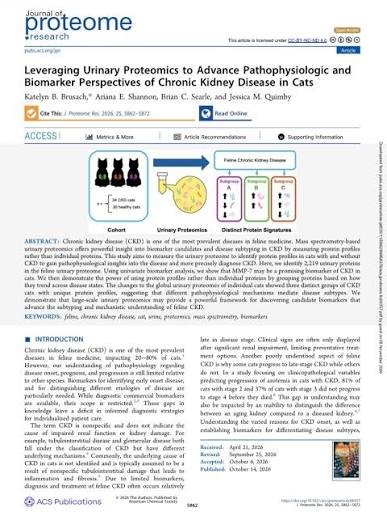
The research forms part of a feline CKD research programme led by Jessica Quimby at The Ohio State University College of Veterinary Medicine in the United States. The team examined urine samples from 30 healthy cats and 34 cats with CKD, using proteomic analysis to characterise differences in urinary proteins.
More than 2,000 proteins were profiled, with MMP-7 emerging as a particularly promising candidate marker for early-stage disease. Researchers also identified three protein-based clusters associated with late-stage CKD.
Why earlier diagnosis matters in cats
Chronic kidney disease is a major clinical problem in older cats. It is progressive and can remain clinically inconspicuous during its early stages. Traditional assessment relies on a combination of clinical history, physical examination, blood chemistry, urinalysis, urine concentration and other diagnostic measurements.
Serum creatinine is widely used to assess kidney function, but its interpretation can be affected by muscle mass and other factors. This can complicate assessment in older or muscle-wasted cats.
Symmetric dimethylarginine (SDMA), urine protein-to-creatinine ratio and other tests can provide additional information, but no single marker captures every aspect of kidney injury and disease progression.
A urinary biomarker such as MMP-7 could potentially add information about underlying renal pathology without requiring an invasive procedure.
What MMP-7 could mean for veterinary diagnostics
MMP-7 belongs to the matrix metalloproteinase family of enzymes, which are involved in extracellular matrix remodelling and tissue processes. Its identification in feline urine is scientifically interesting because it may help characterise biological changes associated with kidney disease.
The researchers also identified distinct protein clusters associated with late-stage disease. If validated in larger populations, such patterns could potentially help researchers understand why cats with CKD follow different clinical trajectories.
The reported work involved a relatively small sample of cats. A candidate biomarker is not the same as a validated clinical diagnostic test. Further research will be required to establish sensitivity, specificity, reference intervals, reproducibility and performance across different breeds, ages and disease stages.
It is also important to determine whether MMP-7 provides useful information beyond existing tests.
Commercial implications
The research reflects a broader shift in veterinary diagnostics towards earlier disease detection and biomarker-led monitoring.
Potential opportunities include veterinary reference laboratories, urine-based diagnostic platforms, proteomics companies and companion-animal chronic disease monitoring services. For veterinary practices, the value of a new biomarker will ultimately depend on whether it changes clinical decisions, improves monitoring or enables earlier intervention.

