



Dateline: North America | 9 October 2026
Category: Animal Protein Markets | Livestock Economics | Industry Analysis
North America’s beef, pork and poultry industries are entering the final quarter of 2026 with markedly different supply-and-demand dynamics. Beef producers continue to benefit from restricted cattle availability and firm prices, but the shortage is increasing procurement costs and leaving meatpacking capacity underutilised. Pork producers face uneven domestic demand and continued dependence on export markets, while the broiler industry is expanding production into a market where wholesale prices and consumer purchasing power will determine whether additional output translates into stronger margins.
In its 7th of October 2026 report, Animal Protein Markets Enter Q4 on Uneven Footing, CoBank identifies these differences as the principal drivers of fourth-quarter pricing and margin risk. The report draws on USDA data and CoBank’s own market calculations. Read the original CoBank analysis.
The report’s quantitative indicators reveal the scale of the challenge:
-
Beef: US cattle and calf inventories totalled 94.2 million head on 1 July 2026, up just 0.2% year over year. However, beef cows declined 1% to 28.5 million, while the projected calf crop fell 2% to 32.5 million.
-
Pork: US hog and pig inventories stood at 74.3 million head on 1 September 2026, down 1.5% year over year. Despite the smaller inventory, CoBank reports that pork production has been running above year-earlier levels, while domestic demand remains a concern.
-
Chicken: USDA data cited by CoBank show broiler harvest approximately 2% above year-earlier levels during the third quarter, with June and July monthly production reaching record levels.
-
Dairy-beef integration: Beef-on-dairy calf values reportedly declined from approximately US$2,000 in May to US$1,300, while remaining far above pre-2023 levels of around US$200.
The implications extend beyond meat prices. They affect livestock procurement, processing utilisation, feed economics, herd and flock management, export exposure and the commercial opportunities available to animal-health companies.
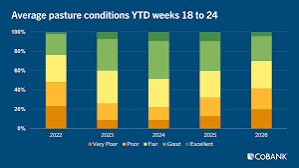
Beef: constrained cattle supplies sustain producer value but pressure processors
The US beef market remains structurally constrained by the availability of cattle for slaughter. Although the overall cattle inventory recorded a small annual increase in July, the number of beef cows continued to decline, indicating that a sustained expansion of the beef breeding herd has yet to become firmly established.
According to the US Department of Agriculture’s National Agricultural Statistics Service (USDA-NASS), the July 2026 inventory comprised:
US cattle indicator |
July 2026 |
Year-on-year change |
|---|---|---|
Total cattle and calves |
94.2 million head |
+0.2% |
Beef cows |
28.5 million head |
−1.0% |
Milk cows |
9.65 million head |
+2.0% |
Projected calf crop |
32.5 million head |
−2.0% |
Cattle on feed |
13.2 million head |
+2.0% |
Source: USDA-NASS, United States Cattle Inventory, 24 July 2026.
The headline increase in total cattle numbers therefore needs to be interpreted carefully. A larger total inventory does not necessarily mean more beef-producing cows or a rapid increase in animals available for slaughter. Dairy cattle, calves, replacement animals and cattle already in feedlots serve different roles in the production cycle.
The biological timetable also limits the speed of recovery. Producers must retain suitable heifers, breed them, manage gestation and raise calves before the additional animals can enter the beef supply chain. Retaining breeding stock also means foregoing the immediate revenue that could have been earned by selling those animals.
Drought and replacement costs complicate herd rebuilding
CoBank reported that 58% of the US cattle inventory remained exposed to moderate-to-exceptional drought conditions as of mid-September 2026. Drought can reduce pasture availability, increase supplementary feed costs and force producers to reconsider whether they can economically retain replacement heifers.
The USDA’s September market outlook also described historically low fed-cattle slaughter and lower beef-production forecasts for 2026 and 2027. Higher imports of lean beef were expected to help fill domestic supply gaps. These factors create a two-sided commercial outcome.
For cow-calf producers, scarce cattle can support selling prices and increase the value of productive breeding animals. For feedlots, packers and downstream buyers, however, expensive cattle can raise working-capital requirements and increase the risk that finished-product revenue will not adequately cover procurement and processing costs.
The impact on meatpackers is particularly important. A processor may have the physical capacity to slaughter and process more animals but be unable to operate at its preferred utilisation rate because cattle are unavailable or too expensive. Lower throughput can spread fixed costs across fewer animals, putting additional pressure on operating margins.
Commercial implication: Beef businesses are likely to place greater emphasis on securing cattle, improving yield and protecting the economic value of each animal. Reproductive efficiency, calf survival, disease prevention, parasite control, lameness management and feed efficiency may all contribute to better returns. Their value, however, must be assessed against the specific cost structure and production system of each operation.
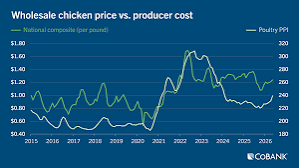
Pork: demand weakness and export exposure remain central risks
Pork has a different supply profile. CoBank reports that US pork production has been running modestly above year-earlier levels, while domestic demand has not kept pace sufficiently to support the usual seasonal price improvement.
A notable indicator was the retail pork-demand index, which CoBank said fell to its lowest level since 2020 ahead of the summer grilling season. The report also noted that the pork cutout value failed to achieve its typical seasonal rally.
These observations suggest that available supply is not automatically translating into stronger market prices. The challenge is to find sufficient domestic and international demand to absorb production without undermining producer or processor returns.
What the inventory figures show
USDA-NASS reported the following figures for 1 September 2026:
US hog indicator |
September 2026 |
Year-on-year change |
|---|---|---|
All hogs and pigs |
74.302 million head |
−1.5% |
Market hogs |
68.427 million head |
−1.5% |
Breeding hogs |
5.875 million head |
−1.0% |
June–August pig crop |
34.508 million pigs |
−1.5% |
Pigs per litter |
11.96 |
+1.2% |
Source: USDA-NASS, September Quarterly Hogs and Pigs, 24 September 2026.
The smaller inventory does not contradict CoBank’s observation that pork production has been running above year-earlier levels. Production reflects not just the number of animals in inventory, but also slaughter timing, carcass weights and productivity. Higher weights or changes in slaughter volumes can temporarily support output even when inventories decline.
CoBank also highlights the importance of exports. USDA’s Economic Research Service forecast cited in the report puts US pork exports for 2026 at approximately 7.2 billion pounds, up 2.9% from 2025. Mexico remains the leading destination and an important market for products such as hams.
This dependence creates opportunities as well as vulnerabilities. Strong export demand can help clear domestic supply, but trade restrictions, animal-disease-related market disruptions, logistics costs and changing demand in major destination countries can quickly alter the balance.
The report notes that prospects for sales to China have weakened as domestic production recovers and consumer demand softens. It also identifies restrictions affecting shipments from Iowa and Texas following pseudorabies-related concerns as a factor affecting trade flows to Mexico earlier in the summer.
Feed economics require a more nuanced assessment
Although lower feed costs had provided some support to producers, CoBank cautions that rising corn prices were increasing feed-cost pressure. Elevated fuel and operating expenses could further constrain expansion plans.
Consequently, pork profitability depends on several variables moving together: feed cost per kilogram of gain, pigs marketed per sow, mortality, carcass weight, realised selling price, export demand and processing efficiency.
Improving production efficiency can protect margins, but it cannot completely offset a prolonged gap between supply and consumer demand.
Commercial implication: Pork producers and integrators need to monitor export orders, domestic demand indicators, cold-storage inventories, feed prices and carcass values together. Animal-health programmes that demonstrate measurable improvements in survival, reproductive output, growth performance or feed conversion may be commercially attractive, provided the return on investment is established under farm-level conditions.
Chicken: production growth raises the importance of price competitiveness
Broiler production offers a third market dynamic. Chicken benefits from its relatively affordable price, convenience and flexibility across retail, food-service and processed-food channels. These characteristics can support demand when consumers face pressure on household budgets or trade down from more expensive proteins.
However, a favourable long-term demand position does not guarantee that every increase in output will improve producer margins.
CoBank reports that US broiler harvest was approximately 2% above year-earlier levels during the third quarter of 2026. Monthly USDA-NASS data also showed stronger June and July output, including record monthly production. The report cautions that the weekly and monthly series are not perfectly comparable, but both indicate renewed supply growth.
The immediate question is whether consumption, exports and food-service demand can absorb that additional production without creating excessive downward pressure on wholesale prices.
The importance of demand quality
CoBank identifies chicken as having a strong opportunity to gain share of consumer protein consumption. Nevertheless, wholesale values remained under pressure, and commodity broiler margins were described as compressed.
The report also highlights a distinction between restaurant sales growth and customer traffic. Chicken-chain sales increased 5.3% in 2025, outperforming broader growth among the top 500 restaurant chains, but CoBank notes that recent gains appeared to be driven more by pricing than by an increase in guest numbers.
For poultry companies, this distinction matters. Higher nominal sales do not necessarily indicate stronger underlying demand if the increase is largely price-driven.
The report also notes that lower year-on-year cold-storage holdings suggested the market had not yet become severely oversupplied. That is a useful counterpoint to production growth: higher output does not inevitably create a glut if inventories and demand remain balanced.
Operational execution will determine returns
Broiler margins depend on a combination of feed conversion, livability, mortality, flock uniformity, growth rate, processing yield, energy costs and plant utilisation. Disease outbreaks or inconsistent flock performance can quickly erode the benefit of efficient feed procurement and higher production volumes.
The commercial priority is therefore not simply to maximise output. It is to match production with customer demand while protecting cost per kilogram and maintaining predictable processing throughput.
Commercial implication: Poultry integrators and suppliers should monitor weekly slaughter and placements, wholesale prices, cold-storage stocks, export demand and restaurant traffic. Animal-health interventions should be assessed through measurable outcomes, including mortality, feed conversion, condemnations, uniformity and saleable yield—not solely through improvements in individual biological indicators.
Dairy expansion and beef-on-dairy economics reshape livestock incentives
The relationship between dairy and beef production is becoming increasingly important in the US protein economy.
CoBank reports that the US dairy herd expanded by approximately 200,000 cows over the preceding 12 months, with Texas, Idaho, Kansas and South Dakota contributing significantly to growth. The report describes US dairy-cow numbers as reaching a 34-year high.
An important factor is the economic value of beef-on-dairy calves. Dairy producers can use beef genetics on selected cows to produce crossbred calves with potential value in beef supply chains, while reserving dairy genetics for replacement animals where appropriate.
CoBank cited beef-on-dairy calf values of approximately US$1,300, down from a reported May peak of US$2,000 but still well above the approximately US$200 levels seen before 2023.
These are reported market values, not universal prices: actual returns depend on calf quality, genetics, location, sex, health status, buyer requirements and prevailing market conditions.
The economics also involve trade-offs. High calf values can encourage dairy producers to use more beef semen and sell crossbred calves, but aggressive diversion of dairy genetics can reduce the supply of future dairy replacements. Dairy herd expansion may increase milk output, while the value of beef-cross calves can provide an additional source of revenue.
CoBank’s June 2026 analysis of dairy replacements warned that US dairy replacement inventories had become exceptionally tight as producers responded to strong beef-on-dairy returns. That illustrates how incentives in one protein market can influence breeding decisions and production capacity in another.
The financial significance is not limited to calf sales. Additional dairy cows require feed, housing, labour, reproductive management and veterinary care. The overall return depends on milk revenue, feed costs, herd productivity, replacement availability and calf value.
Commercial implication: Animal-health companies serving dairy producers need to understand the combined economics of milk production, reproductive strategy, calf health and replacement management. Products that improve fertility or reduce calf morbidity may be valuable, but their commercial case should account for the producer’s breeding strategy and the opportunity cost of retaining or selling animals.
What the market divergence means for animal-health companies
CoBank’s analysis has implications for suppliers of vaccines, pharmaceuticals, diagnostics, feed additives, nutritional products, genetics and herd-management technologies.
Sector |
Principal market pressure |
Commercial priority for producers |
Potential animal-health value proposition |
|---|---|---|---|
Beef |
Limited cattle availability; high replacement costs; drought exposure |
Protect the value of breeding animals and maximise saleable output |
Reproductive performance, calf survival, disease prevention and feed efficiency |
Pork |
Uneven domestic demand; export dependence; feed-cost volatility |
Control cost per pig and preserve output efficiency |
Livability, sow productivity, biosecurity and feed conversion |
Broilers |
Rising output; pressured wholesale values; price-sensitive demand |
Produce consistently at competitive cost per kilogram |
Flock health, mortality control, uniformity and processing yield |
Dairy |
High calf values; replacement constraints; herd-expansion costs |
Balance milk revenue, calf returns and replacement requirements |
Reproductive management, calf health, transition-cow performance and disease prevention |
These are potential value propositions, not guarantees of commercial success. Their relevance varies with geography, farm scale, disease pressure, production system and customer economics.
For suppliers, the strategic lesson is to move beyond a generic productivity message. The same intervention can have different economic value across species and production systems. A reduction in mortality, for example, has to be assessed against the value of the animal, the cost of the intervention, the probability of achieving the result and the market conditions at the time the animal is sold.
Companies that can quantify these relationships are better positioned to demonstrate value to producers, integrators and investors.
Key indicators to monitor in Q4 2026
The following indicators provide a practical framework for tracking whether the current market dynamics are strengthening or easing.
Beef
-
Beef-cow inventory and replacement-heifer retention.
-
Cattle slaughter, carcass weights and packing-plant utilisation.
-
Drought conditions, feed availability and replacement-animal costs.
-
Lean-beef imports and export volumes.
Pork
-
Domestic pork demand and carcass cutout values.
-
Monthly production, slaughter weights and cold-storage stocks.
-
Corn prices and feed-cost margins.
-
Export volumes, particularly to Mexico, and trade-related disruptions.
Chicken
-
Weekly broiler slaughter and placement indicators.
-
Wholesale broiler prices and cold-storage inventories.
-
Feed costs, flock performance and processing yields.
-
Export demand and quick-service restaurant traffic.
Dairy-beef
-
Dairy-cow inventory and replacement-heifer availability.
-
Beef-on-dairy calf prices and breeding decisions.
-
Milk prices, feed costs and revenue per cow.
-
Calf health, survival and the economics of retaining replacements.
The direction of these indicators matters more than any single data point. A sustained improvement in domestic demand, for instance, could ease pork pricing pressure even without a major reduction in production. Similarly, a rise in beef replacement-heifer retention would be an early signal of rebuilding, but not proof that slaughter supplies will increase immediately.
Analyst view: species-specific economics will shape the next phase of animal protein
CoBank’s October assessment reinforces the importance of analysing beef, pork and poultry separately rather than treating animal protein as a single market.
Beef remains constrained by the slow biological process of herd rebuilding and exposure to drought. Pork faces a more immediate challenge in balancing production with domestic and export demand. Chicken has a clearer route to volume growth, but profitability depends on the market absorbing additional output at prices that cover production and processing costs.
Dairy expansion and beef-on-dairy economics add another layer of complexity by linking breeding decisions, calf values, milk production and replacement availability.
For animal-health companies, the commercial opportunity lies in matching solutions to these different economic conditions. Producers are likely to scrutinise costs closely and favour interventions with measurable, defensible effects on productivity, animal welfare and financial returns.
The central conclusion is that biological performance creates value only when it aligns with market economics. In the fourth quarter of 2026, the strongest commercial strategies will combine evidence of production benefit with a clear understanding of supply, demand, input costs and the value of the animal being produced.
References
-
CoBank. Animal protein markets enter Q4 on uneven footing. 7 October 2026. Original report.
-
USDA National Agricultural Statistics Service. United States Cattle Inventory Up Slightly. 24 July 2026. Official release.
-
USDA National Agricultural Statistics Service. September Quarterly Hogs and Pigs. 24 September 2026. Official report and data.
-
USDA Economic Research Service. Cattle & Beef — Market Outlook. Updated 18 September 2026. Official market outlook.
-
The Dairy Site. Beef, pork and chicken face different margin challenges — CoBank. 9 October 2026. Industry news report.
-
CoBank. Dairy replacements should begin a slow rebuild in 2027 and 2028. 18 June 2026. Related dairy and beef-on-dairy analysis.

