


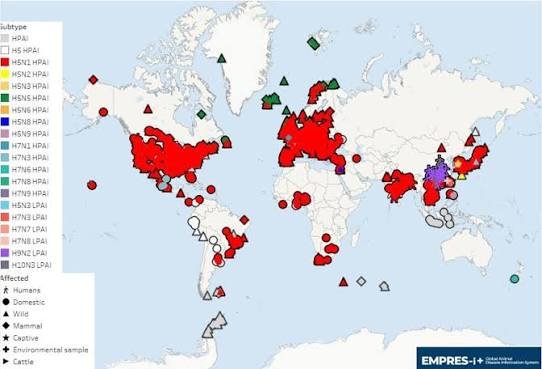
World Organisation for Animal Health (WOAH) has released Situation Report 87, detailing the global distribution, impact, and epidemiological trends of High Pathogenicity Avian Influenza (HPAI) through late September 2026.
A copy of the Report can be accessed here – hpai-situation-report-87
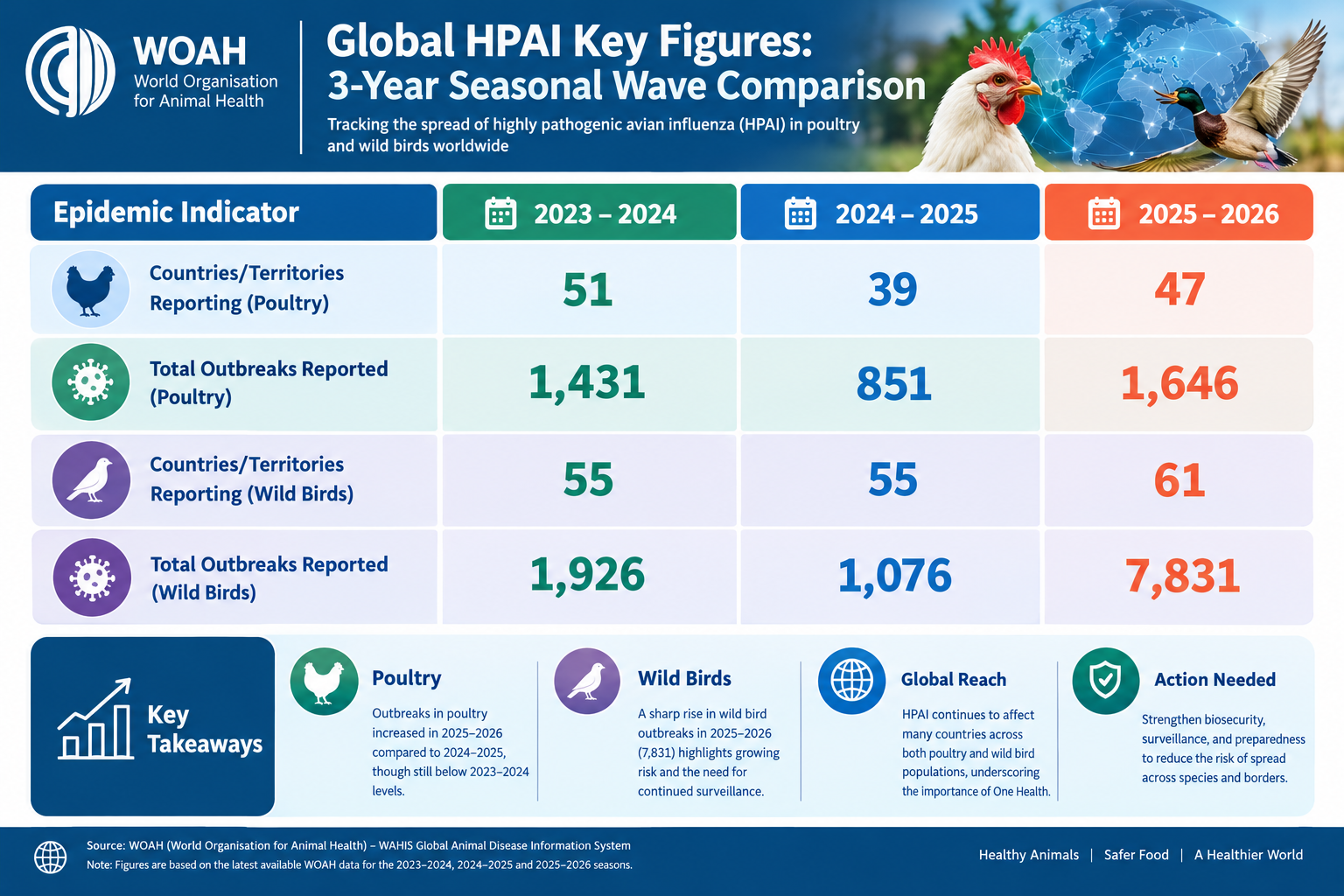
The current seasonal wave (October 2025 – September 2026) has demonstrated persistent cross-continental transmission, a massive surge in wild bird outbreaks, and continual mammalian spillover events. Although poultry outbreaks in the Northern Hemisphere have followed expected seasonal declines post-November 2025, wild bird surveillance figures reached historical highs—exceeding 7,800 outbreaks across 61 countries and territories.
Key Metrics & Comparative Epidemic Waves
September 2026 Monthly Breakdown
-
Poultry Outbreaks: 20 new outbreaks reported across 7 countries and territories (Bulgaria, Cambodia, Canada, France, Suriname, United Kingdom, United States).
-
Poultry Mortality & Culling: Approximately 467,458 birds were lost or culled globally during September alone. The Americas suffered the highest losses (459,312 birds).
-
Non-Poultry Birds: 30 new outbreaks across 13 countries and territories.
-
Mammalian Spillover: 1 new mammalian case confirmed in an Arctic fox in Norway.
-
Antarctica / Sub-Antarctic: No confirmed cases during September 2026, though unusual mortality was observed in Snow Petrels.
Regional Outbreak & Genotype Distribution
1. Americas
-
Suriname: Immediate notification of new poultry events in Paramaribo (started Sept 9, 2026).
-
United States & Canada: Ongoing H5N1 poultry outbreaks.
-
South America: Wild bird H5N1 detections in Chile (Araucanía), Uruguay (Colonia), Argentina (Buenos Aires), and Peru (Reassortant Eurasian/North American Clade 2.3.4.4b).
-
Disease Freedom: Peru officially self-declared recovery of HPAI freedom in poultry as of September 3, 2026, under Article 10.4.6 of the Terrestrial Code.
2. Europe
-
United Kingdom: New H5N5 event in Scottish poultry (Sept 21, 2026).
-
France: Ongoing H5N1 Clade 2.3.4.4b (Fully Eurasian Lineage) outbreaks in poultry.
-
Bulgaria: Ongoing H5N1 poultry outbreaks.
-
Wild Birds & Mammals: Detections across Belgium, Cyprus, Denmark, Germany, Iceland (H5N5), Netherlands, Norway, and Sweden.
3. Asia and the Pacific
-
Cambodia: New H5N1 event reported in Otdar Meanchey (Sept 21, 2026).
Key Technical Recommendations & One Health Action Points
WOAH stresses that because HPAI threatens livestock, wildlife conservation, and public health, a coordinated One Health framework is mandatory.
1. Farm-Level Biosecurity Protocols
-
Water & Vector Isolation: Restrict poultry and livestock access to surface water sources prone to contamination by migratory wild birds.
-
Structural Exclusion: Install netting and physical barriers to prevent wild bird entry into feed storage and housing facilities.
-
Sanitation: Enforce strict vehicle, boot, and equipment disinfection at farm perimeters.
2. Mammalian Diagnostic Protocols
-
Differential Diagnosis: Include HPAI in differential diagnostic panels for mammals showing neurological, respiratory, or unexplained mortality signs—especially in species exposed to wild birds or raw livestock products.
-
Livestock Worker Safety: Provide personal protective equipment (PPE) for workers handling sick livestock or unpasteurized dairy products.
3. Global Surveillance & Genomic Transparency
-
Database Sharing: Rapidly submit full-length viral genetic sequences and associated metadata to publicly accessible platforms (GISAID, GenBank).
-
Immediate Reporting: Notify WOAH via WAHIS of outbreaks in unusual hosts or non-poultry species without delay.
-
Trade Policy: Avoid applying unjustified, blanket trade restrictions on countries reporting wild bird or non-poultry cases.

. Details key outbreak metrics, regional wild bird surges)