


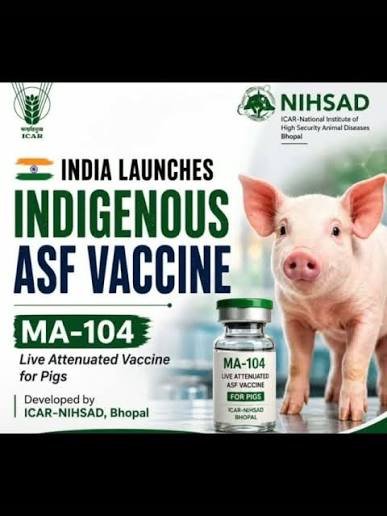
CAR-developed live-attenuated vaccine offers new hope to pig farmers after years of devastating ASF outbreaks.
India has reached a landmark milestone in veterinary science with the launch of its first indigenous live-attenuated African Swine Fever (ASF) vaccine, providing the country’s pig industry with its first domestically developed tool to combat one of the world’s most devastating swine diseases.
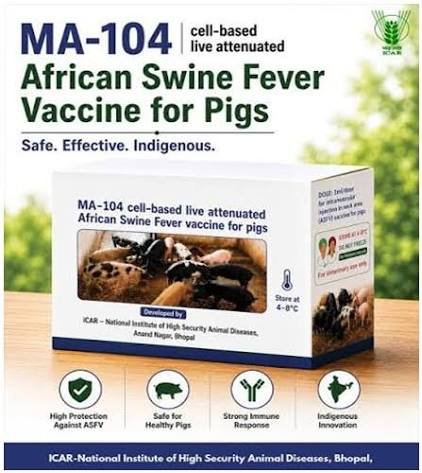
Developed by scientists at the ICAR-National Institute of High Security Animal Diseases (ICAR-NIHSAD), Bhopal, the vaccine uses the MA-104 cell line, making it suitable for large-scale production and commercial deployment. The breakthrough is expected to strengthen India’s preparedness against ASF, particularly in the Northeastern states, where repeated outbreaks since 2020 have caused massive pig losses, disrupted rural livelihoods and inflicted heavy economic damage.
The vaccine represents a major achievement for India’s animal health research ecosystem and is expected to play an important role in protecting the country’s rapidly growing pig sector.
A Breakthrough Against One of the World’s Deadliest Livestock Diseases
African Swine Fever is regarded as one of the most feared diseases affecting domestic pigs and wild boar. The virus causes:
-
High fever
-
Severe internal bleeding
-
Loss of appetite
-
Weakness
-
Respiratory distress
-
Sudden death
Depending on the viral strain, mortality can approach 100%, making ASF one of the most economically destructive diseases in global pig production. Unlike Classical Swine Fever (CSF), ASF has no approved treatment, and until recently, effective vaccines were unavailable in most parts of the world.
India’s Long Battle with African Swine Fever
India confirmed its first ASF outbreak in 2020, primarily affecting pig populations in Assam and Arunachal Pradesh. Since then, the disease has spread to several states, including:
-
Assam
-
Meghalaya
-
Mizoram
-
Nagaland
-
Manipur
-
Arunachal Pradesh
-
Tripura
-
Sikkim
-
Bihar
-
Jharkhand
-
Uttar Pradesh
-
Kerala
The Northeastern region, home to nearly half of India’s pig population, has been particularly vulnerable because pig farming forms an essential component of rural livelihoods and food security. Thousands of pigs have been culled over the past few years to contain outbreaks, resulting in losses running into hundreds of crores of rupees.
Developed Entirely in India
The newly launched vaccine has been developed by researchers at ICAR-NIHSAD, India’s premier high-containment laboratory for transboundary animal diseases.
A major scientific advancement is the successful adaptation of the vaccine virus to the MA-104 continuous cell line. This offers several advantages over earlier production methods:
-
Easier large-scale manufacturing
-
Better production consistency
-
Improved scalability
-
Reduced manufacturing costs
-
Greater commercial feasibility
The availability of a stable cell-line production platform is considered an important step toward ensuring reliable vaccine supply for India’s pig industry.
Why the MA-104 Cell Line Matters
Historically, producing ASF vaccines has been technically challenging because the virus grows efficiently only in primary macrophage cell cultures, which are difficult and expensive to prepare. Using the MA-104 cell line offers several practical advantages:
-
Continuous cell availability
-
Standardized manufacturing
-
Better quality control
-
Simplified industrial production
-
Greater scalability for commercial vaccine manufacturers
This innovation significantly improves the prospects for wider vaccine availability across India.
Protecting India’s Pig Farmers
Pig farming supports millions of rural households, particularly in:
-
Assam
-
Meghalaya
-
Nagaland
-
Mizoram
-
Arunachal Pradesh
-
Manipur
-
Tripura
In these states, pigs provide:
-
Household income
-
Nutritional security
-
Employment
-
Livelihood diversification
Repeated ASF outbreaks have forced authorities to implement extensive culling programmes, leaving many smallholder farmers without income for months. A safe and effective vaccine could dramatically reduce future losses and improve resilience within the sector.
Economic Importance of India’s Pig Sector
Although pig production represents a smaller share of India’s livestock industry than dairy or poultry, it remains economically significant.
India is home to approximately 9 million pigs, with the majority concentrated in the Northeast. The sector contributes to:
-
Rural employment
-
Tribal livelihoods
-
Smallholder income generation
-
Meat production
-
Nutritional security
Improved disease control is expected to enhance productivity, encourage investment and strengthen domestic pork production.
ASF Remains a Global Challenge
African Swine Fever continues to threaten pig industries across:
-
Europe
-
Asia
-
Africa
-
Parts of the Caribbean
Since its rapid global spread beginning in 2018, ASF has caused the loss of millions of pigs worldwide, severely disrupting pork production and international trade.
China—the world’s largest pork producer—experienced unprecedented losses following ASF outbreaks, reshaping global meat markets and accelerating vaccine research worldwide.
Despite significant progress, only a limited number of ASF vaccines have received regulatory approval internationally. India’s indigenous vaccine therefore represents an important addition to global ASF control efforts.
Vaccination Will Complement Existing Biosecurity
Veterinary experts emphasize that vaccination should be viewed as one component of integrated ASF control, not a replacement for biosecurity. Pig farmers should continue to implement:
-
Strict farm hygiene
-
Controlled animal movement
-
Visitor restrictions
-
Proper disposal of carcasses
-
Feed biosecurity
-
Rapid reporting of suspected cases
-
Veterinary surveillance
Combining vaccination with strong biosecurity offers the best opportunity to reduce future outbreaks.
Benefits for the Indian Animal Health Industry
The successful development of an indigenous ASF vaccine demonstrates India’s growing capabilities in veterinary biotechnology. Potential long-term benefits include:
-
Reduced dependence on imported technologies
-
Strengthened domestic vaccine manufacturing
-
Faster outbreak response
-
Improved food security
-
Greater confidence among pig producers
-
Opportunities for future technology transfer and exports, subject to regulatory approvals
The achievement also reinforces the role of ICAR institutions in developing innovative solutions for transboundary animal diseases.
Looking Ahead
The launch of India’s first indigenous African Swine Fever vaccine represents a significant milestone for veterinary science, livestock health and rural development.
As commercial production expands and vaccination programmes are implemented, the vaccine has the potential to substantially reduce disease losses, protect farmer livelihoods and strengthen the resilience of India’s pig industry against one of its greatest biological threats.
Continued surveillance, responsible vaccine deployment and robust biosecurity will remain essential to achieving sustainable long-term control of African Swine Fever.
Key Highlights
-
India has launched its first indigenous live-attenuated African Swine Fever vaccine.
-
The vaccine was developed by ICAR-NIHSAD, Bhopal using the MA-104 cell line, facilitating scalable production.
-
The innovation is expected to provide major benefits to pig farmers, especially in India’s Northeastern states.
-
ASF remains one of the world’s deadliest swine diseases, with mortality approaching 100% in susceptible pigs.
-
Vaccination, combined with biosecurity and surveillance, offers a powerful new strategy to reduce future outbreaks and economic losses.

