


Isoxazolines are the most successful molecules in the history of animal healthcare industry, by far. As happens with any new class of parasiticide compunds – after the successful commercialization of 1 molecule, incumebents try and launch additional molecules from the same class of compounds to benefit from this new class of compounds. Animal Health as well as larger, Human Pharma industry is testament to this phenomenon virtually on a regular basis.
However, difference with Isoxazoline molecules is that – probably for the first time, each and every single molecule commercialized so far under Isoxazolines has scaled Annual Sales in excess of USD 1 Billion for respective brands, what with excellent product life cycle management practices.
As Isoxazoline molecules start coming off-patent – its time companies look at newer and certainly safer molecules as there are stray concerns on neurological effects of some isoxazoline compounds. This review covers a few, new molecules under R&D and may get commercialized over the next few years.
New Parasiticides Under Development
While current isoxazolines—fluralaner (Bravecto), afoxolaner/esafoxolaner (NexGard), sarolaner (Simparica), and lotilaner (Credelio)—dominate the pet ectoparasiticide market, animal health R&D is actively exploring next-generation molecules and chemical classes.
This push for replacements and next-generation iterations is driven by three main factors:
-
Safety & Tolerability: Reducing potential central nervous system (CNS) adverse effects (such as muscle tremors, ataxia, and seizures) in pets with underlying neurological conditions or $MDR1$ gene mutations.
-
Resistance Management: Preventing insect and tick target-site mutations in GABA-gated chloride channels ($GABACls$) caused by long-term selection pressure.
-
Ecotoxicological Impact: Addressing environmental persistence and prolonged fecal/urinary elimination of current isoxazolines that harm non-target terrestrial and aquatic arthropods.
Primary Next-Generation Chemical Classes & Candidates
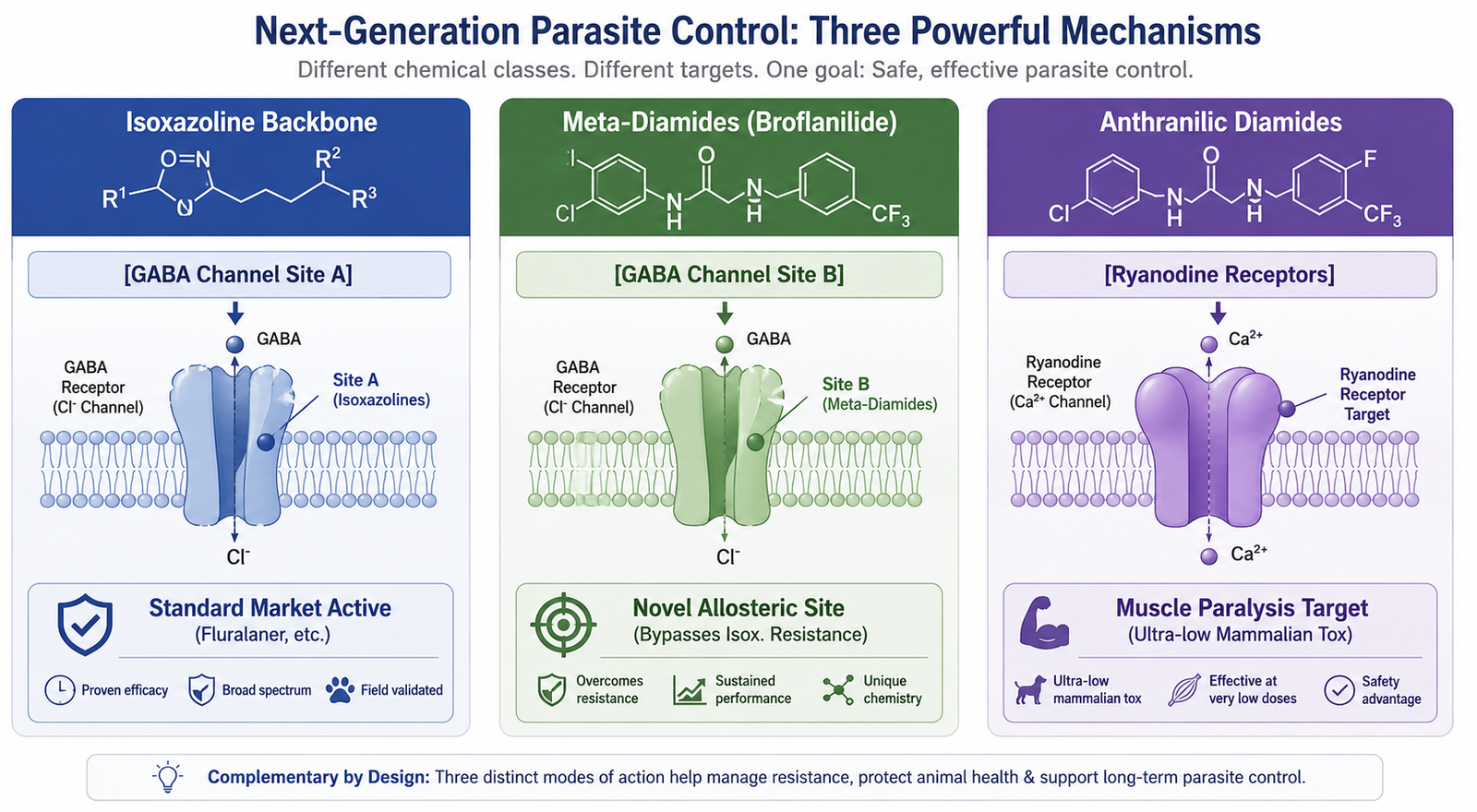
A. Meta-Diamides (e.g., Broflanilide)
Meta-diamides represent the most prominent novel chemical class being targeted as next-generation antiparasitics.
-
Mechanism of Action: Like isoxazolines, meta-diamides act as non-competitive antagonists at invertebrate gamma-aminobutyric acid (GABA)-gated chloride channels. However, structural modeling shows they bind to a distinct inter-subunit pocket (near the G336 residue in the M3-transmembrane domain of RDL receptors)
-
Key Advantages: Because they bind to a different target site than fipronil, dieldrin, or first-generation isoxazolines, they exhibit no cross-resistance.
-
Safety & Selectivity: High selectivity for arthropod receptors over mammalian GABA_A receptors gives them a favorable safety window. While originally developed for agricultural pest control (such as broflanilide), derivative molecules are being investigated for companion animal formulations.
B. Single-Enantiomer Isoxazolines (e.g., Esafoxolaner)
Rather than abandoning the isoxazoline scaffold, animal health companies are refining the chemistry through stereoisomeric purification.
-
Mechanism: Traditional isoxazolines are synthesized as racemic mixtures containing active and inactive enantiomers.
-
Key Advantage: Esafoxolaner represents the isolated S-enantiomer of afoxolaner. Using only the biologically active isomer cuts the required chemical dosage, reducing the total metabolic burden on the pet’s liver and kidneys while maintaining tick and flea control.
C. Ryanodine Receptor (RyR) Modulators / Anthranilic Diamides
-
Molecules: Compounds derived from the anthranilic diamide family (e.g., Chlorantraniliprole, Cyantraniliprole).
-
Mechanism of Action: Selectively target invertebrate ryanodine receptors in cardiac and skeletal muscle cells. This causes uncontrolled release of intracellular calcium ions (Ca2), leading to muscle paralysis and rapid parasite death.
-
Key Advantage: Ryanodine receptors in mammals have a completely different structure, resulting in negligible toxicity in dogs and cats. Research focuses on modified derivatives that offer systemic bioavailability for oral or topical delivery in pets.
D. Mesoionic Insecticides & Novel Nicotinic Modulators
-
Molecules: Triflumezopyrim derivatives and novel nicotinic acetylcholine receptor (nAChR) allosteric modulators
-
Mechanism of Action: Bind to distinct orthosteric or allosteric sites on nAChRs in parasite nervous systems
-
Key Advantage: Provides rapid flea knock-down without relying on GABA channels, making them candidates for combination products or standalone alternatives where central nervous system safety is a priority.
2. Structural Comparison of Parasiticidal Classes
Chemical Class |
Example Active Ingredients |
Primary Molecular Target |
Cross-Resistance Risk with Isoxazolines |
Key Development Goal |
Isoxazolines (1st Gen) |
Fluralaner, Sarolaner, Afoxolaner, Lotilaner |
GABACl & GluCl channels (Site A) |
N/A (Current Standard) |
Broad-spectrum monthly/quarterly protection |
Purified Isoxazolines |
Esafoxolaner |
GABACl channels (Active S-enantiomer) |
Moderate |
Lower active dose, reduced metabolic load |
Meta-Diamides |
Broflanilide derivatives |
GABACl channels (M3 region / Site B) |
Very Low |
Bypass target-site mutations, improved eco-profile |
Anthranilic Diamides |
Cyantraniliprole analogues |
Invertebrate Ryanodine Receptors (RyR) |
None |
High mammalian safety margin, rapid paralysis |
Mesoionics |
Triflumezopyrim analogues |
nAChR Receptors (Novel binding site) |
None |
Non-systemic/Fast flea knock-down |
3. Alternative R&D Directions Beyond New Molecules
Major animal health companies (Zoetis, Merck, Boehringer Ingelheim, Elanco) are pursuing delivery and formulation strategies alongside brand-new chemical entities:
-
Ultra-Long-Acting Injectable Formulations:
-
Products like Bravecto Quantum (injectable fluralaner suspension) extend protection up to 12 months with a single veterinary injection. Future pipeline molecules are being synthesized specifically for sustained-release polymer or microparticle delivery systems.
-
-
Next-Gen “Endectocide” Combinations:
-
Instead of standalone molecules, R&D emphasizes multi-action molecules or optimized co-formulations (e.g., pairing optimized isoxazolines with praziquantel, moxidectin, or eprinomectin like Credelio Quattro or NexGard Combo) to treat internal endoparasites (tapeworms, heartworms, roundworms) and ectoparasites in a single dose.
-
-
Eco-Friendly & Rapidly Degraded Metabolites:
-
Current research focuses on designing active molecules that clear rapidly from animal tissue and break down quickly in soil/water to prevent accumulation in livestock and wildlife ecosystems.
-

