


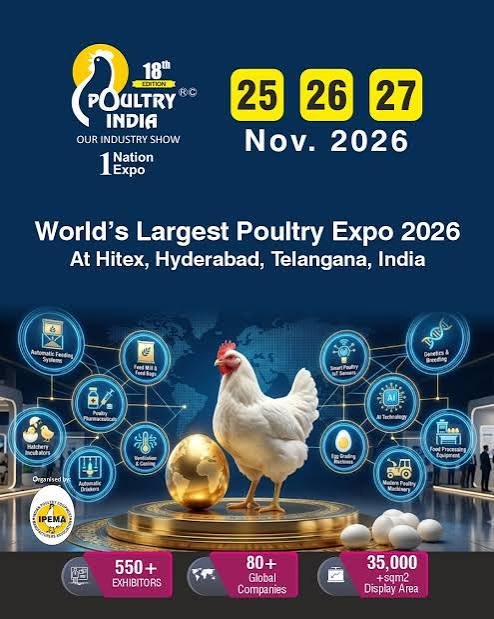
The 18th edition of Poultry India Expo 2026 opens today at the HITEX Exhibition Centre in Hyderabad, bringing together India’s poultry industry and international stakeholders for three days of technology demonstrations, business networking and knowledge exchange.
Organised by the Indian Poultry Equipment Manufacturers’ Association (IPEMA), the exhibition will run from November 25–27 under the broader theme of advancing India’s poultry industry through innovation, collaboration and technology.
The organisers expect participation from more than 51,000 industry professionals and business delegates, with over 550 exhibitors and international representation from more than 125 countries. The exhibition will cover seven air-conditioned halls, providing a platform for equipment manufacturers, poultry integrators, breeders, feed companies, veterinary pharmaceutical businesses, nutrition specialists, technology providers and entrepreneurs.
The event follows Poultry Knowledge Day, held yesterday, November 24, at HICC–Novotel, Hitech City, Hyderabad. The technical conference brought together leading Indian and international voices to discuss some of the most important challenges facing modern poultry production.
Together, the Knowledge Day and exhibition represent an important meeting point for an industry that is increasingly being shaped by productivity pressures, disease threats, feed economics, automation, food safety and changing consumer expectations.
Knowledge Day 2026: Science, innovation and trust take centre stage
Held on November 24, the Knowledge Day conference carried the theme “Empowering Poultry Excellence through Science, Innovation & Trust.”
The programme brought together expertise spanning poultry science, veterinary medicine, nutrition, engineering, artificial intelligence and business strategy. Its agenda reflected an important shift: the future competitiveness of poultry production will depend not simply on increasing bird numbers, but on improving biological efficiency, disease prevention, environmental control and consumer confidence. Some of the key sessions and their industry significance were:
1. Poultry vaccination technologies
Dr Sandeep Bhatia, Principal Scientist and In-charge of the PME Cell at ICAR–National Institute of High Security Animal Diseases (NIHSAD), was scheduled to address advancements in poultry vaccination technologies.
Vaccination remains a cornerstone of commercial poultry production. With the continuing threat of infectious diseases, including avian influenza and Newcastle disease, the industry needs increasingly effective vaccination programmes, improved delivery systems, appropriate vaccine selection and better monitoring of immune responses.
For Indian producers, the challenge is particularly significant because of the diversity of production systems, ranging from highly integrated commercial operations to smaller farms with variable biosecurity standards.
2. Precision poultry health management using AI and sensors
One of the most forward-looking topics was the application of artificial intelligence and sensor technologies to poultry health management. Dr Suresh Raja Neethirajan, Associate Professor and Research Chair in Canada, was scheduled to discuss how AI and sensors can support precision poultry health management. The potential applications extend across several aspects of production:
-
Continuous monitoring of temperature, humidity and ventilation.
-
Detection of changes in bird movement, activity and behaviour.
-
Early identification of possible disease outbreaks.
-
Monitoring of feed and water consumption.
-
Detection of abnormal mortality patterns.
-
Automated alerts for environmental and management deviations.
The significance is substantial. Traditional poultry management often depends on periodic farm inspections and the experience of individual farm managers. Sensor-based systems can provide continuous information, helping identify problems before they become visible as substantial production losses.
However, the commercial value of AI will depend on reliable data, affordable equipment, integration with existing farm systems and the ability to convert alerts into practical management decisions.
3. Advancements in breeder nutrition – Dr Doug Korver
Dr Doug Korver, President of Alpine Poultry Nutrition Inc. and Professor Emeritus at the University of Alberta, Canada, was scheduled to discuss advancements in breeder nutrition. Breeder nutrition has implications extending well beyond the individual bird. Nutritional management influences reproductive performance, egg quality, hatchability, chick quality and the subsequent productive potential of commercial flocks.
The industry increasingly recognises that breeder nutrition needs to be managed across different production stages rather than through a uniform feeding strategy. Energy and protein balance, amino acid availability, minerals, vitamins, body-weight management and reproductive development all contribute to breeder performance.
4. Beyond fans and cooling pads
Itzhak Stolak, Business Consultant at Speria, part of Munters, was scheduled to explore overlooked factors in automated poultry housing systems. Environmental control is particularly important in India, where high ambient temperatures, humidity variations and seasonal climatic extremes can place substantial stress on commercial poultry flocks.
While fans, cooling pads and ventilation equipment remain essential, successful environmental management also depends on air distribution, building design, stocking density, equipment maintenance, insulation and the interaction between temperature and humidity.
The industry needs to look beyond simply installing more powerful fans or cooling systems. The objective should be to create consistent and appropriate environmental conditions throughout the poultry house. This has direct implications for bird welfare, feed conversion, mortality and production efficiency.
5. Building consumer confidence in eggs and chicken
An equally important business-oriented discussion was the session by brand and business strategy expert Harish Bijoor, Founder of Harish Bijoor Consults Inc.
His topic, How to Enhance Consumer Confidence on Poultry Products – Eggs & Chicken, addressed a critical issue for the Indian poultry industry. India has built substantial production capacity, but long-term demand growth also depends on consumer trust.
Clear communication around food safety, traceability, quality assurance, responsible production and nutritional value is essential. The industry must also be better equipped to address consumer concerns and misinformation through credible, transparent communication.
6. Industry inspiration
Actor, filmmaker, sports administrator and President of Rugby India Rahul Bose was included as the motivational speaker, bringing a leadership and performance perspective to the gathering. The official programme also listed former senior agriculture policymaker Siraj Hussain, IAS (Retd.), as a keynote speaker.
The breadth of the Knowledge Day programme illustrates how poultry has evolved into a multidisciplinary business, where animal science, engineering, data analytics, economics and consumer behaviour increasingly intersect.
The three-day exhibition at HITEX will cover several important segments of the poultry value chain.
Exhibition segment |
Technologies and business opportunities |
|---|---|
Breeding and genetics |
Genetic improvement, breeder management and hatchery performance |
Feed and nutrition |
Feed milling, nutritional formulations, feed additives and raw-material efficiency |
Farm automation |
Automated feeding, drinking, monitoring and production management |
Poultry housing |
Environmental control, ventilation, cooling and housing infrastructure |
Veterinary healthcare |
Vaccines, pharmaceuticals, diagnostics and biosecurity |
Egg processing |
Grading, sorting, packaging and processing technologies |
Waste management |
Poultry litter utilisation, manure management and sustainability |
The exhibition is expected to provide opportunities for international suppliers and Indian manufacturers to explore partnerships, distribution arrangements, technology transfers and domestic manufacturing possibilities.
For Indian companies, the event also offers an opportunity to demonstrate home-grown engineering and equipment solutions to international buyers. IPEMA has highlighted its partnerships with more than 20 international poultry associations and over 40 national-level poultry organisations, reinforcing the event’s international networking ambitions.
India’s poultry industry: The scale of the opportunity
The timing of the exhibition is significant given India’s growing importance in global poultry production. According to the figures highlighted by IPEMA, India produced 142.77 billion eggs in 2023–24, making it the world’s second-largest egg-producing country. India is also among the world’s four largest broiler-producing nations.
The poultry sector contributes to:
-
Affordable animal-protein availability and national nutrition security
-
Employment across farming, feed manufacturing, veterinary services, logistics and processing
-
Rural entrepreneurship and small-business development
-
Demand for maize, soybean meal and other agricultural commodities
-
Growth of India’s animal-health, biotechnology and equipment manufacturing industries

