


Establishing a New Federal Benchmark After More Than a Decade
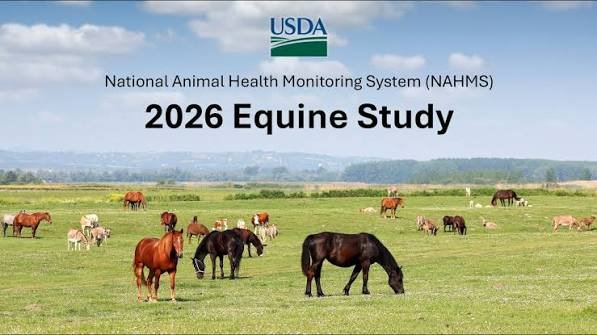
The U.S. Department of Agriculture (USDA)—through a joint initiative by the Animal and Plant Health Inspection Service (APHIS) and the National Agricultural Statistics Service (NASS)—has officially initiated the 2026 National Animal Health Monitoring System (NAHMS) Equine Study.
This comprehensive surveillance effort serves as the first major nationwide baseline for equine health and management practices since the previous NAHMS equine study in 2015. Prior assessments were conducted in 1998 and 2005.
By gathering statistically representative, science-based data directly from horse owners, ranch managers, and facility administrators, the 2026 study addresses emerging shifts in biosecurity, veterinary workforce shortages, emergency preparedness, and equine welfare.
National Scope and Survey Methodology (Phase I)
The 2026 NAHMS Equine Study is national in scope, covering randomly selected operations across all 50 U.S. states.
Eligibility and Selection Criteria
-
Target Operations: The sample pool targets equine operations housing five or more equids (including horses, ponies, donkeys, and mules) that satisfy the USDA Agricultural Census definition of a farm or holding.
-
Diverse Disciplines: Sampling encompasses breeding facilities, boarding barns, working ranches, riding academies, vocational facilities, and private holdings.
-
Participation Modalities: Selected participants receive questionnaires distributed by NASS enumerators. To maximize response rates and preserve data integrity, owners can complete the survey online via secure portal, by mail, over the phone, or through in-person interviews.
Under Federal Law (Title 7, U.S. Code), all individual operation responses are strictly confidential and protected from public disclosure. Data is published exclusively in aggregated statistical formats.
Core Data Objectives and Strategic Priorities
Stakeholder input—including consultation with veterinary researchers, state animal health officials, and organizations like the American Association of Equine Practitioners (AAEP)—established six core research pillars for the 2026 survey.
Key Analytical Focus Areas
Focus Area |
Operational Objective |
Industry Significance |
Disease Occurrence & Trends |
Benchmark rates of equine infectious anemia (EIA), EHV-1, vector-borne viruses, and respiratory illnesses. |
Evaluates long-term vaccine efficacy and disease control measures. |
Veterinary Access |
Quantify owner utilization of practitioner services and identify regional access constraints. |
Informs policy solutions for the nationwide shortage of rural equine veterinarians. |
At-Risk & Transitioning Equids |
Study management strategies for horses moving between vocational roles, ownership, retirement, or rescue pipeline. |
Directs welfare resources to populations vulnerable to neglect or abandonment. |
Biosecurity Practices |
Evaluate farm-level isolation, sanitation, vector management, and transport biosecurity protocols. |
Reduces multi-state outbreak risks associated with transient horse populations. |
Impact on Veterinary Policy and Resource Allocation
Data generated by the 2026 NAHMS study will influence federal, state, and academic veterinary agendas for the coming decade:
-
Targeted Research Funding: Federal agencies (including USDA APHIS) and private research foundations use NAHMS statistical baselines to allocate grants toward priority equine diseases.
-
Disaster and Emergency Response: Baseline counts and biosecurity profiles enable state veterinarians to model evacuation capacity during extreme weather events and wildfires.
-
Educational Outreach: Extension services and veterinary associations leverage survey findings to develop practical, evidence-based biosecurity toolkits for horse owners.

