HomeCorporateVeterinary AI Adoption More Than Doubles to 83.7%, Digitail–AAHA Study Finds

Veterinary AI Adoption More Than Doubles to 83.7%, Digitail–AAHA Study Finds

Veterinary clinics are moving from AI experimentation to routine use, but the study finds that governance, workflow integration and staff readiness remain uneven.

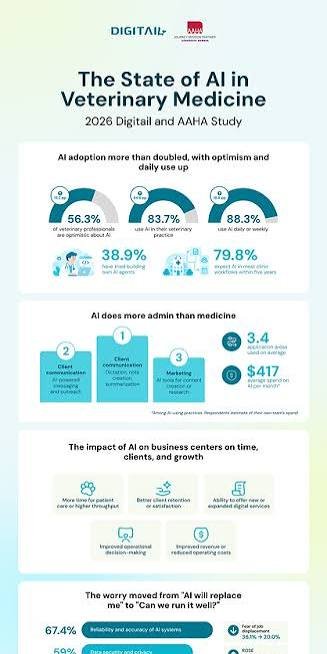
Artificial intelligence adoption among veterinary professionals in the United States and Canada has more than doubled in two years, reaching 83.7% in 2026, compared with 39.2% in 2024, according to a new study by veterinary software provider Digitail in collaboration with the American Animal Hospital Association (AAHA).

Released on 1 October 2026, the 2026 Veterinary AI Study draws on responses from 1,730 veterinary professionals. It finds that AI is increasingly embedded in everyday practice operations, with 88.3% of AI users reporting daily or weekly use.

veterinary AI adoption 2026

Clinical documentation leads AI adoption

Clinical documentation is the most common application. 62.8% of AI users reported using AI for documentation tasks, including AI scribes and SOAP-note generation. Client communication, outreach and marketing are other prominent use cases.

Adoption is spreading beyond veterinarians and practice managers to technicians, assistants and client-service teams. The study also found that 38.9% of AI users had experimented with building their own AI agents, while a further 29.9% were considering doing so.

The findings point to a shift in veterinary AI from occasional experimentation toward routine administrative and communication support. However, they do not establish that AI tools have replaced professional clinical judgment or improved clinical outcomes.

Governance gap separates adoption from business outcomes

The report’s central finding is that AI maturity—not simply tool adoption—is associated with stronger reported business outcomes.

Practices with the highest AI maturity reported an average of 4.05 positive business outcomes, compared with 0.64 among the least mature practices. This represents approximately six times as many reported outcomes.

The study’s maturity framework evaluates six dimensions: strategy and intent, governance and oversight, vendor evaluation, workflow and technology integration, adoption depth, and capability and readiness.

Yet implementation structures have lagged adoption. 65.2% of respondents said their practices had introduced AI without meaningfully changing workflows. Nearly half lacked an AI strategy or designated owner, while close to one-third had no AI governance arrangements.

The results suggest that practices may need documented usage policies, staff training, vendor evaluation, data-security safeguards and defined accountability to translate AI availability into consistent operational value.

Business benefits and risks

Respondents most frequently associated AI with the ability to see more patients or increase throughput (44.3%), improved client retention or satisfaction (32%), and the introduction or expansion of digital services (29.2%). The survey also recorded reported benefits involving operational decisions, revenue or costs, and staff wellbeing.

At the same time, concerns about reliability and accuracy, data security, privacy and training remain material. Fear of job displacement declined from 37.2% in 2024 to 20% in 2026, indicating a changing pattern of professional concern in the survey.

These are self-reported associations. The study does not demonstrate that governance alone caused the difference in outcomes, nor does it provide an independently audited financial return for AI investment.

Implications for the veterinary industry

The findings have implications for veterinary software providers, hospital groups, independent clinics and investors. Demand is likely to extend beyond AI note-taking into workflow integration, staff enablement, data management and client engagement.

For practice operators, the practical question is increasingly how to evaluate AI tools, protect client and patient information, maintain veterinary oversight and measure whether time savings translate into improved capacity or financial performance.

The study provides a useful snapshot of a rapidly changing market. Its next value will depend on longitudinal evidence showing whether reported benefits persist, how outcomes differ by practice type and size, and whether AI integration produces measurable improvements in care delivery and business performance.

Source and methodology: Digitail and AAHA’s 2026 study collected self-reported responses from 1,730 veterinary professionals in the United States and Canada between 27 July and 12 August 2026. The comparison uses core measures from the 2024 survey, which had 4,031 respondents.

Animal Health India Editorial Team
Animal Health India Editorial Teamhttps://animalhealthindia.com
Animal Health India (AHI) is an independent news and intelligence platform covering the global animal health, veterinary, livestock, poultry, companion animal and pet food sectors. Our editorial team comprises veterinary journalists, animal health professionals, regulatory affairs specialists and industry analysts with over 30 years of combined experience covering India, Asia, Europe and North America. AHI publishes news, regulatory updates, market intelligence and company news drawn from primary sources including DAHD, EMA, USDA, AVMA and leading veterinary publications worldwide.

RELATED ARTICLES