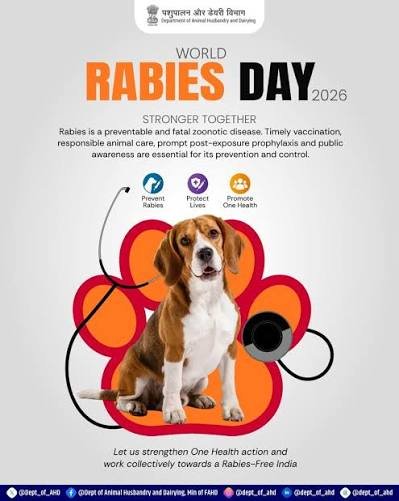
As the world observes World Rabies Day 2026, the global animal-health community is again focusing attention on one of the clearest examples of a disease that requires coordinated animal, human-health and community interventions.
This year’s theme, “Stronger Together,” highlights the need for veterinary services, public-health authorities, communities and animal owners to work together to prevent rabies transmission.

According to the World Organisation for Animal Health (WOAH), rabies remains almost 100% fatal once clinical signs appear, while approximately 59,000 people die from rabies every year, with dogs responsible for the majority of human infections.
Why Rabies Remains an Animal-Health Priority
Rabies is preventable through vaccination, yet elimination remains challenging in areas where dog vaccination coverage, veterinary infrastructure, surveillance and access to post-exposure treatment remain uneven.
The principal control model is therefore straightforward:
Dog vaccination → surveillance → responsible dog population management → rapid diagnosis → human post-exposure prophylaxis
This makes veterinary vaccination the critical upstream intervention.
The Business and Industry Dimension
Rabies control creates a continuing requirement for:
-
Canine rabies vaccines
-
Veterinary diagnostics
-
Mass-vaccination programmes
-
Animal identification and surveillance
-
Animal population-management services
-
Cold-chain infrastructure
-
One Health data platforms
For governments, the economics are also significant because preventing animal transmission can reduce the need for expensive human post-exposure interventions.