


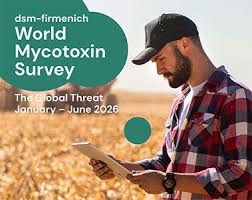
dsm-firmenich’s Global Survey Highlights Why Co-Contamination Has Become One of the Biggest Hidden Challenges in Animal Nutrition
For livestock producers, feed manufacturers and veterinarians, mycotoxins remain one of the most costly and difficult challenges in modern animal production. Invisible to the naked eye and often impossible to detect without laboratory analysis, these toxic compounds produced by moulds can reduce growth, impair immunity, affect reproduction and increase disease susceptibility across multiple animal species.
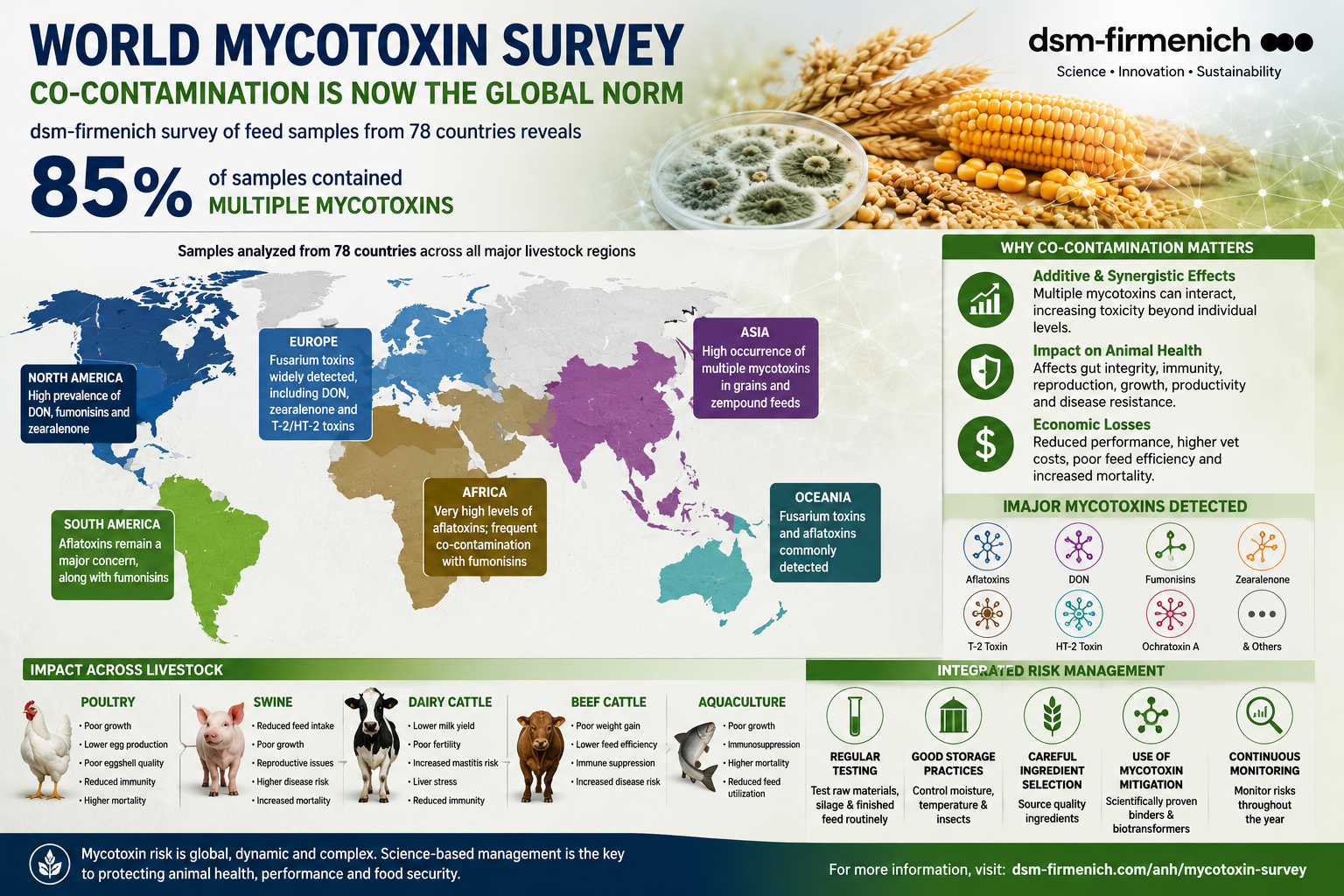
The latest World Mycotoxin Survey from dsm-firmenich paints a clear picture of the scale of the problem. Drawing on feed and raw material samples collected from 78 countries, the survey found that 85% of analysed samples contained two or more mycotoxins, confirming that co-contamination has become the global norm rather than the exception.
The findings reinforce a growing scientific consensus: livestock are rarely exposed to a single mycotoxin. Instead, animals are increasingly consuming complex mixtures of toxins that may interact to produce greater health and production losses than individual contaminants alone.
World’s Largest Feed Surveillance Programmes
The dsm-firmenich World Mycotoxin Survey is among the largest continuous surveillance programmes of its kind. Every year, thousands of samples of grains, silage, compound feed and feed ingredients are analysed using advanced laboratory techniques to identify naturally occurring mycotoxins.
The survey provides valuable insights into regional contamination patterns, emerging risks and changing climatic influences that affect fungal growth.
The latest report analysed samples originating from 78 countries, offering one of the most comprehensive snapshots of global feed safety available to the livestock industry.
What Are Mycotoxins?
Mycotoxins are toxic chemicals naturally produced by certain fungi, mainly species belonging to the Aspergillus, Fusarium and Penicillium genera.
These fungi may infect crops: Before harvest, During harvesting, During storage, During transportation and During feed processing.
Unlike mould growth, which may sometimes be visible, mycotoxins themselves cannot be seen, smelled or tasted. Importantly, they are also remarkably stable and often survive feed processing, pelleting and storage.
Co-Contamination Is Now the Rule
One of the survey’s most important findings is that 85% of samples contained multiple mycotoxins. Rather than containing only aflatoxin or only fumonisin, many feed samples simultaneously contained combinations such as:
- Aflatoxins
- Deoxynivalenol (DON)
- Fumonisins
- Zearalenone (ZEN)
- T-2 toxin
- HT-2 toxin
- Ochratoxin A
This matters because animals are exposed to these toxins together—not individually. Modern analytical methods have shown that feed ingredients frequently contain three, four or even more mycotoxins in the same batch.
Why Multiple Mycotoxins Are More Dangerous
For many years, researchers assessed individual mycotoxins separately. However, recent studies have demonstrated that combinations of toxins may produce:
Additive effects
Synergistic effects
Cumulative toxicity
This means two moderate toxin concentrations may cause greater biological damage than either toxin alone. Even when each individual mycotoxin is below regulatory guidance values, the combined exposure may still reduce animal performance.
This is one of the reasons why veterinarians and nutritionists increasingly evaluate overall mycotoxin risk rather than focusing on a single contaminant.
Impact on Poultry
Poultry are particularly vulnerable because of their rapid growth rates and high feed consumption. Multiple mycotoxins may contribute to: Poor feed conversion ratio, Reduced weight gain and Lower egg production
The poultry industry has increasingly recognised that chronic, low-level exposure may cause significant economic losses even when birds do not show obvious clinical signs.
Impact on Swine
Among livestock species, pigs are especially sensitive to several Fusarium toxins. Potential effects include: Reduced feed intake, Slower daily weight gain, Poor reproductive performance, Increased stillbirths, Reduced fertility and Impaired immune function.
Young piglets and breeding animals are generally the most vulnerable.
Impact on Dairy and Beef Cattle
Ruminants possess some ability to detoxify certain mycotoxins through rumen microorganisms. However, this protection is incomplete. High-producing dairy cows may experience: Lower milk yield, Poor fertility, Increased mastitis risk, Liver stress and Transition disorders
Silage contamination remains an important concern in many dairy systems worldwide.
Climate Change Is Increasing the Risk
Changing weather patterns are altering fungal ecology around the world. Warmer temperatures, prolonged droughts followed by heavy rainfall and changing humidity levels create favourable conditions for fungal growth.
Scientists are increasingly observing:
Expansion of aflatoxin-producing fungi into new regions
Changes in Fusarium distribution
Greater year-to-year variation in contamination
Increased unpredictability of mycotoxin occurrence
Emerging and Masked Mycotoxins
Another challenge highlighted by modern surveillance is the growing recognition of masked and emerging mycotoxins. Masked mycotoxins are modified forms produced by plants during natural defence responses. Although they may escape routine testing, digestion within the animal can convert them back into toxic compounds.
Emerging mycotoxins, meanwhile, are fungal metabolites that are not yet routinely monitored but may still affect animal health. As laboratory technologies improve, researchers continue to identify additional compounds that could contribute to overall toxin burden.
Risk Management Requires Multiple Strategies
Experts agree that no single intervention can eliminate mycotoxin risk. Successful management combines several approaches.
1. Regular Feed Testing – Routine laboratory analysis remains the foundation of mycotoxin management. Testing should include:
Raw materials
Silage
Finished feed
High-risk ingredients
2. Good Storage Practices – Reducing moisture, controlling insects and maintaining clean storage conditions help minimise fungal growth after harvest.
3. Careful Ingredient Selection – Nutritionists increasingly evaluate supplier quality, harvest conditions and historical contamination patterns when purchasing raw materials.
4. Mycotoxin Mitigation Technologies – Feed additives designed to bind or biologically transform mycotoxins are widely used in commercial livestock production.
Modern products may combine:
- Clay-based binders
- Yeast cell wall components
- Enzymes
- Biotransformation technologies
- Functional ingredients that support liver and immune health
Selection should be based on the mycotoxins present and supported by scientific evidence.
What the Survey Means for the Industry
The latest dsm-firmenich survey sends a clear message to the global livestock sector. Mycotoxins are no longer isolated contamination events affecting individual crops. Instead, they represent a persistent feed quality challenge that requires integrated risk management. The high prevalence of co-contamination means veterinarians, nutritionists and feed manufacturers must consider the combined effects of multiple toxins when evaluating animal health and production performance.
The latest World Mycotoxin Survey demonstrates that understanding co-contamination, rather than focusing on individual toxins alone, is becoming the cornerstone of modern feed safety programmes. For producers, feed manufacturers and veterinarians, recognising this shift will be critical to maintaining healthy, productive and resilient livestock systems in the years ahead.
Key Takeaways
-
85% of feed samples analysed from 78 countries contained multiple mycotoxins
-
Co-contamination is now more common than single-toxin contamination
-
Multiple mycotoxins can have additive or synergistic effects, increasing health and production risks
-
Poultry, pigs and high-producing dairy cattle are particularly vulnerable
-
Climate change is altering fungal growth patterns and increasing contamination risk
-
Regular testing, good storage, careful ingredient selection and evidence-based mitigation strategies are central to effective mycotoxin management
References
- dsm-firmenich. World Mycotoxin Survey (January–December 2025)
- dsm-firmenich. World Mycotoxin Survey Quarterly Reports
- FAO. Mycotoxins in Food and Feed: Global Challenges and Risk Management
- World Organisation for Animal Health (WOAH). Feed Safety and Animal Health Resources
- Bryden WL. Mycotoxin contamination of the feed supply chain: implications for animal productivity and feed security. Animal Feed Science and Technology
- Grenier B, Oswald IP. Effects of mycotoxin co-contamination on livestock health and performance. Toxins

