


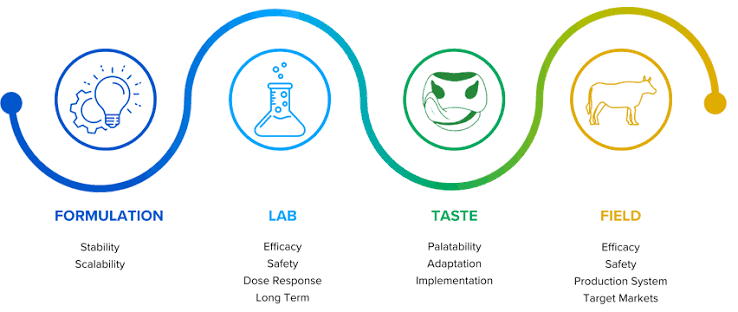
For decades, livestock scientists have searched for a practical way to reduce methane emissions from cattle without compromising animal health or farm productivity. Enteric methane—the gas produced naturally during rumen fermentation—is responsible for nearly one-third of agriculture’s greenhouse gas emissions worldwide and represents a significant loss of dietary energy that could otherwise be used for growth or milk production.
Among the emerging technologies attracting global attention is Rumin8, an Australian biotechnology company developing synthetic bromoform-based feed additives designed to suppress methane formation inside the rumen. Early studies have produced striking results, with some investigational formulations reducing methane emissions by more than 90% under controlled conditions. However, the science is still evolving, and several important questions remain.
This article reviews the scientific basis of Rumin8 technology, how it works, and what published research tells us so far.
Why Methane Matters
Unlike carbon dioxide, methane remains in the atmosphere for a much shorter period, but it has a far greater warming effect over the first two decades after release.
Cattle, buffalo, sheep and goats produce methane as a normal consequence of digestion. Inside the rumen, billions of microorganisms ferment plant fibre to produce volatile fatty acids that supply energy to the animal. During this process, hydrogen accumulates. If hydrogen were allowed to build up, fermentation would slow dramatically.
Nature solves this problem through specialised microorganisms known as methanogenic archaea. These microbes combine hydrogen with carbon dioxide to form methane, which the animal releases mainly by eructation (belching).
Although this process supports efficient rumen fermentation, it also represents an energy loss of approximately 2–12% of dietary gross energy, depending on diet and production system. Reducing methane therefore offers two potential benefits:
- Lower greenhouse gas emissions
- Improved feed-energy utilisation
This “win-win” concept has driven intense global research into methane-mitigating feed additives.
Current Strategies for Methane Reduction
Scientists have evaluated numerous approaches over the past two decades, including:
- Improved forage quality
- High-concentrate diets
- Lipid supplementation
- Nitrate supplementation
- Essential oils
- Tannins
- Probiotics
- Vaccines targeting methanogens
- Seaweed-based feed additives
- Synthetic methane inhibitors
Among these, two technologies have consistently demonstrated the largest methane reductions: 3-Nitrooxypropanol (3-NOP), commercialised as Bovaer®.
and Bromoform-based technologies, including Asparagopsis seaweed and synthetic bromoform.
From Seaweed to Synthetic Chemistry
The remarkable methane-reducing properties of the red seaweed Asparagopsis taxiformis generated worldwide interest after studies reported methane reductions exceeding 80% under some feeding conditions.
Researchers identified bromoform (CHBr₃) as the principal bioactive compound responsible for inhibiting methane production. However, commercial adoption of seaweed has faced several practical challenges:
- Seasonal variation in bromoform concentration
- Difficulties in large-scale cultivation
- Variable product quality
- Supply constraints
- Storage and stability issues
- High production costs.
Rumin8’s approach is different. Instead of harvesting seaweed, the company produces synthetic bromoform, aiming to deliver a consistent concentration of the active compound while avoiding many of the supply-chain limitations associated with marine biomass. This allows greater control over formulation, dosing and manufacturing.
How Does Synthetic Bromoform Work?
Methane production in the rumen depends on a series of biochemical reactions carried out by methanogenic archaea. The final step is catalysed by an enzyme called methyl-coenzyme M reductase (MCR).
This enzyme is essential. Without it, methanogens cannot complete methane formation. Bromoform interferes with this final reaction by disrupting the enzyme system required for methanogenesis. As methane formation declines, hydrogen accumulates in the rumen instead of being converted into methane.
The process can be summarised as:
Normal rumen
Hydrogen + Carbon dioxide → Methane
After bromoform supplementation
Hydrogen accumulates → Methane production falls dramatically
Published studies consistently report increased hydrogen emissions alongside reduced methane output, confirming that methanogenesis has been effectively inhibited.
Why Formulation Matters
One of the most important lessons from recent research is that not all Rumin8 formulations perform equally. This distinction is often overlooked. The company has investigated several formulations, including:
Oil-based formulations.
Powder formulations.
Granular formulations.
Prodrug technologies under development.
The formulation influences:
Stability, Delivery within the rumen, Release rate, Effective bromoform concentration, Animal acceptance and Manufacturing feasibility.
Consequently, results obtained with one formulation cannot automatically be applied to another.
The First Peer-Reviewed Animal Study
A landmark study published in Translational Animal Science in 2025 evaluated two investigational Rumin8 products in 24 Angus beef steers fed a total mixed ration under feedlot conditions. The animals were assigned to:
Control.
Oil formulation.
Powder formulation.
The findings were striking. The oil-based formulation reduced:
Methane production by 95%
Methane yield by 95%
Methane intensity by 96.1%
At the same time, hydrogen emissions increased substantially, confirming inhibition of methanogenesis. Importantly, researchers reported no significant adverse effects on: Feed intake, Average daily gain, Feed efficiency, Rumen fermentation characteristics and Animal health observations.
These results represent some of the largest methane reductions yet reported for a synthetic feed additive under controlled experimental conditions.
Powder Formulations Produced Different Results
The same study also highlighted why caution is necessary. The powder formulation tested did not achieve comparable methane reductions, despite increasing hydrogen production in some phases of the experiment.
Researchers suggested that the lower concentration or delivery of active bromoform in the powder formulation may explain the weaker performance.
This finding demonstrates that efficacy depends not simply on the active ingredient but also on how it is formulated and delivered to the rumen.
Beyond Feedlots
One common criticism of methane-reducing technologies is that many perform well in feedlots but are more difficult to use in grazing systems. Recognising this challenge, researchers have begun evaluating synthetic bromoform under pasture conditions.
A 2025 study involving pasture-fed heifers reported a clear dose-dependent reduction in methane emissions, with methane yield falling by up to 24% over the measurement period and no detectable bromoform residues in muscle or fat. While reductions were smaller than those reported in intensive feedlot studies, the findings suggest that synthetic bromoform can also be effective in grazing systems when delivered appropriately.
A Promising Technology—But Not the Final Answer
The scientific evidence published so far is encouraging. Synthetic bromoform has demonstrated the ability to suppress methane production dramatically under controlled conditions without measurable effects on growth performance or rumen function in the short term.
At the same time, the evidence also shows that performance depends heavily on formulation, dose and production system. Results from oil-based products should not be assumed to apply to powders, granules or newer prodrug technologies until they have been independently validated.
In Part 2 of our Series on Methane Gas Reducers, we will critically examine every published Rumin8 animal trial, compare the technology with Bovaer® and Asparagopsis, review the latest safety and residue data, and assess whether synthetic bromoform could become one of the most important innovations in climate-smart livestock production.
Select References
-
Kelly L. et al. The effect of Rumin8 Investigational Veterinary Product on enteric methane emissions, animal production parameters, and the rumen environment in feedlot cattle. Translational Animal Science (2025)
-
Gyeltshen T. et al. Feeding a bromoform-based feed additive for methane mitigation in beef cattle. Animal Feed Science and Technology (2025)
-
Pacheco D. et al. Dose-dependent inhibitory effects of an investigational feed additive containing bromoform on methane emissions from cattle fed fresh pasture. Animal Nutrition (2025)

