


This is Part 1 of a 2-Part Series on Injectable Peptides under development for applications in animal health.
From Hormone Injections to Next-Generation of Precision Medicines for animal species
Global animal health industry is entering a new era of biologic innovation. While vaccines, monoclonal antibodies and gene-based technologies have received much of the attention in recent years, another class of medicines is quietly gaining momentum—injectable peptide therapeutics.
Peptides have been used successfully in veterinary medicine for decades. Products such as oxytocin, gonadorelin, buserelin, deslorelin, ACTH analogues and insulin have become indispensable tools in livestock production and companion animal practice. Yet these familiar medicines represent only the beginning of what peptide science may offer veterinary medicine.
Today, research laboratories, biotechnology companies and animal health manufacturers around the world are developing a new generation of injectable peptides designed to combat infectious diseases, improve wound healing, regenerate damaged tissues, modulate immune responses and manage chronic diseases in animals. Many remain in preclinical or early clinical development, but together they signal a significant shift toward precision therapeutics that target specific biological pathways rather than relying solely on conventional small-molecule drugs.
As pressure grows to reduce antibiotic use in food-producing animals, improve companion animal longevity and address emerging diseases, injectable peptides are attracting increasing attention as a promising platform for future veterinary medicines.
What Are Peptides?
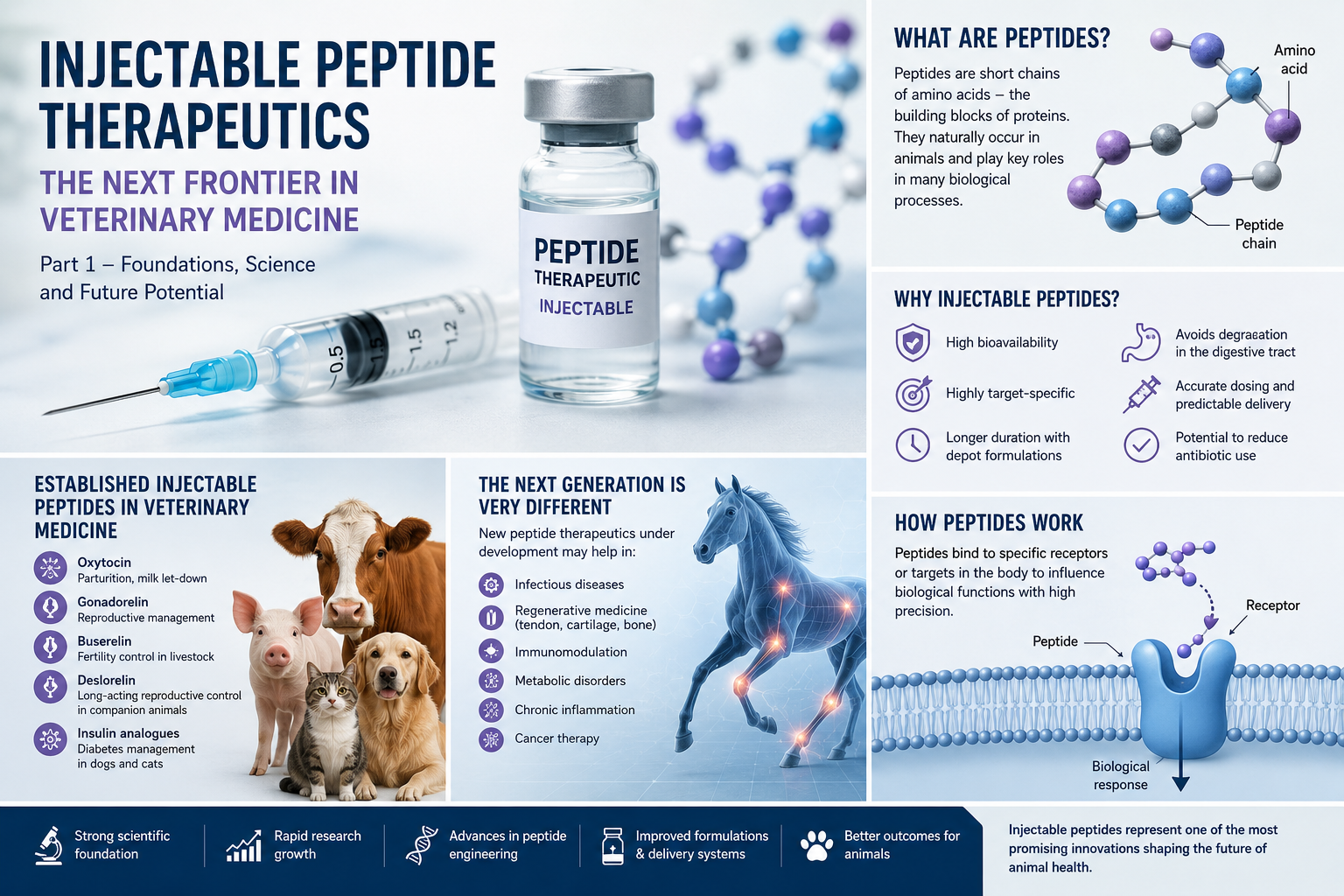
Peptides are short chains of amino acids, the same building blocks that form proteins. Most therapeutic peptides contain between 2 and 50 amino acids, making them much smaller than proteins but often highly selective in how they interact with biological targets.
Because peptides closely resemble molecules naturally produced by the body, they can bind with remarkable precision to receptors, enzymes and signalling pathways. This specificity allows them to influence biological functions while often reducing unwanted effects on unrelated tissues.
Many hormones naturally found in animals—including oxytocin, vasopressin and glucagon-like peptide-1 (GLP-1)—are themselves peptides. Modern drug discovery builds on these naturally occurring molecules, modifying them to improve stability, extend duration of action and enhance therapeutic effectiveness.
Why Injectable Peptides?
One of the biggest challenges in peptide drug development is that peptides are easily broken down in the digestive system.
If swallowed, many peptide molecules are rapidly degraded by stomach acid and digestive enzymes before they can reach the bloodstream. Consequently, injectable delivery remains the preferred route for most peptide therapeutics, ensuring high bioavailability and predictable dosing. Injectable formulations offer several advantages:
-
Rapid absorption into the bloodstream.
-
High therapeutic concentrations.
-
Accurate dosing.
-
Avoidance of gastrointestinal degradation.
-
Compatibility with sustained-release depot technologies.
Researchers are also developing long-acting injectable formulations capable of maintaining therapeutic concentrations for weeks or even months after a single administration, reducing handling stress in animals and improving treatment compliance.
Why Are Animal Health Companies Investing in Injectable Peptides?
The veterinary pharmaceutical industry faces several major challenges:
-
Antimicrobial resistance (AMR).
-
Increasing restrictions on antibiotic use.
-
Rising demand for precision medicine.
-
Longer lifespans in companion animals.
-
Higher expectations for animal welfare.
-
Growing prevalence of chronic diseases.
Traditional antibiotics remain highly effective for many bacterial infections, but growing concern about antimicrobial resistance has accelerated the search for alternative therapies.
Injectable peptides could provide targeted treatments that either kill pathogens directly or strengthen the animal’s own immune response, reducing reliance on conventional antibiotics in some settings.
At the same time, companion animal medicine increasingly resembles human healthcare, with greater emphasis on managing chronic conditions such as osteoarthritis, obesity, endocrine disorders and age-related muscle loss. Peptide therapeutics may offer new options for these complex diseases.
How Peptides Differ from Conventional Drugs
Most veterinary medicines today are small-molecule drugs. These compounds are chemically synthesized and often interact with multiple biological targets. Peptides work differently.
Instead of broadly influencing multiple systems, they generally bind to highly specific receptors involved in defined physiological processes.
This precision may provide several advantages:
Small-Molecule Drugs |
Injectable Peptides |
|---|---|
Often affect multiple pathways |
Highly target-specific |
Usually chemically synthesized |
Built from amino acids |
May require frequent dosing |
Long-acting formulations under development |
Greater potential for off-target effects |
Often designed for precise biological signalling |
Well-established manufacturing |
Increasing advances in peptide synthesis and formulation |
While peptides are not a replacement for conventional medicines, they represent an important complementary technology capable of addressing diseases where traditional drugs have limitations.
Commercial Foundation Already Exists
Injectable peptides are not entirely new to veterinary medicine. Several peptide medicines have been used successfully for many years. Examples include:
Oxytocin – Widely used in cattle, sheep, goats, pigs and horses to assist with parturition, uterine contractions and milk let-down.
Gonadorelin – Commonly administered during reproductive management programmes to improve fertility and synchronise ovulation.
Buserelin – A synthetic analogue of gonadotropin-releasing hormone (GnRH) used extensively in cattle breeding programmes.
Deslorelin – A long-acting GnRH agonist used for reproductive management and temporary fertility control in companion animals.
Insulin Analogues – Dogs and cats with diabetes mellitus routinely receive injectable insulin formulations to maintain blood glucose control.
These established therapies demonstrate that peptide medicines are already trusted components of veterinary practice. The current wave of innovation aims to extend peptide technology far beyond endocrinology and reproduction.
Next Generation Is Very Different
Historically, most injectable veterinary peptides functioned as hormones. The newest generation is far more diverse. Scientists are now investigating injectable peptides capable of:
-
Killing multidrug-resistant bacteria.
-
Stimulating tissue regeneration.
-
Accelerating wound healing.
-
Reducing inflammation.
-
Enhancing immune function.
-
Supporting cartilage repair.
-
Improving muscle preservation.
-
Delivering highly targeted biological therapies.
Rather than simply replacing deficient hormones, these next-generation peptides are designed to influence complex cellular pathways involved in disease progression and recovery.
Growing Scientific Pipeline
Published veterinary research over the past decade shows rapid growth in peptide-related investigations. Areas attracting significant attention include:
Antimicrobial peptides (AMPs): Naturally occurring defence molecules that may help combat bacterial infections while reducing antibiotic use.
Regenerative peptides: Candidates designed to promote healing of tendons, ligaments, cartilage and other musculoskeletal tissues, particularly in horses and dogs.
Immunomodulatory peptides: Molecules capable of enhancing or regulating immune responses, with potential applications in infectious diseases and vaccine support.
Metabolic peptides: Injectable therapies targeting obesity, diabetes, muscle preservation and healthy ageing in companion animals.
Anti-inflammatory peptides: Experimental treatments aimed at reducing chronic inflammation while preserving normal immune function.
Most remain investigational, but together they represent one of the most active areas of veterinary biologics research.
Why This Matters for the Animal Health Industry
The global animal health market is evolving rapidly. Veterinarians increasingly seek therapies that are:
-
More precise.
-
Longer acting.
-
Easier to administer.
-
Less likely to contribute to antimicrobial resistance.
-
Supported by strong scientific evidence.

