


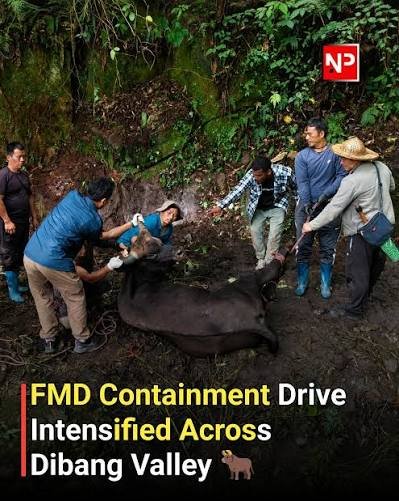
State veterinary authorities have confirmed Foot-and-Mouth Disease (FMD) in Arunachal Pradesh, with Dibang Valley among the worst-affected districts and more than 200 reported cases there. Mithun mortality has been particularly significant.
A central veterinary team has since collected additional samples from Mithuns, pigs and goats for advanced laboratory examination, but as of 20 August 2026, no officially available laboratory report has identified the circulating FMD virus serotype or genotype from this latest investigation.
The Foot-and-Mouth Disease (FMD) situation in Arunachal Pradesh has entered a more closely monitored phase after state authorities confirmed the outbreak and intensified surveillance, sample collection, vaccination and field containment measures.
The Arunachal Pradesh Animal Husbandry, Veterinary and Dairy Development Department (AHV&DD) officially confirmed the FMD outbreak on 8 August 2026, identifying Dibang Valley, East Kameng, Pakke-Kessang and Papum Pare among the affected districts. The department reported more than 200 cases in Dibang Valley, with substantial Mithun mortality in Acheso, Angrim Valley, Aropo and Gipulin.
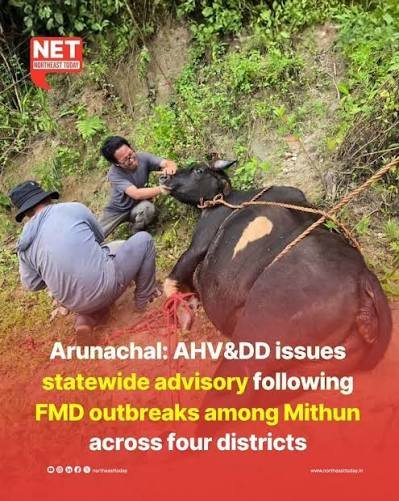
The latest development is particularly important for animal-health surveillance: authorities have collected additional samples from affected animals, including Mithuns, pigs and goats, and sent them for laboratory examination.
The outbreak itself has been officially confirmed by the state veterinary department. What remains outstanding publicly is the detailed laboratory characterization of the virus associated with the latest field investigation.
What the Arunachal Government Has Confirmed
The state AHV&DD’s 8th of August communication provides the clearest primary-source picture currently available.
It says FMD has affected multiple districts, with Dibang Valley particularly affected. More than 200 cases were reported there, alongside significant Mithun mortality. Sporadic cases were also reported in East Kameng, Pakke-Kessang and Papum Pare, although mortality in those districts was described as limited.
The department also highlighted a potentially important epidemiological issue: Dibang Valley shares an international border, prompting authorities to investigate the source of infection and assess the possibility of transboundary introduction. That makes laboratory characterization particularly important.
Most Important Laboratory Question: Which FMD Virus Is Circulating?
FMD is caused by Foot-and-Mouth Disease Virus (FMDV), which exists in multiple serotypes. Identifying the circulating serotype is critical because immunity is serotype-specific, meaning vaccination strategies need to match the virus strains circulating in the field.
Arunachal Pradesh government explicitly stated that it had sought a multidisciplinary team from the ICAR–National Institute on Foot and Mouth Disease (ICAR-NIFMD), Bhubaneswar, for:
-
detailed epidemiological investigation;
-
field assessment;
-
sample testing;
-
identification of the circulating FMD virus strain;
-
identification of the virus serotype.
This is therefore not a speculative laboratory question.
The state itself has identified strain and serotype determination as a priority.
Vaccination History Provides an Important Clue
The preliminary field observations indicated that the affected Mithuns had not been vaccinated during the seventh round of FMD vaccination, conducted from 1 May to 19 June 2026. The state reported overall vaccination coverage of 89% during that round and said that, based on observations at the time, vaccinated animals had remained free from disease.
Four Districts Have Reported FMD — But That Does Not Yet Prove Regional Expansion
The current geographic picture requires careful interpretation. The state department has identified:
Dibang Valley – More than 200 reported cases, with significant Mithun mortality.
East Kameng – Sporadic cases.
Pakke-Kessang – A few reported cases.
Papum Pare – Cases reported in Banderdewa and Sagalee circles.
The government said cases in the latter three districts were currently under control following field intervention and supportive treatment, with mortality limited. The presence of cases in four districts means the outbreak is not geographically confined to Dibang Valley.
But the available evidence does not yet establish that the disease is currently expanding outward from Dibang Valley.
Why the Border Location Matters
Dibang Valley’s international-border location adds another layer of concern. The state government explicitly said it was investigating the source of infection and assessing the possibility of a transboundary introduction. This is exactly where laboratory epidemiology becomes important.
Why We Should Not Assume the Serotype
There is historical evidence of FMD virus serotype O in Arunachal Pradesh. A published retrospective study of FMD in Northeast India reported isolation and identification of serotype O, with molecular analysis showing relationships among type-O viruses.
There is also historical reporting of FMD affecting Mithuns in Arunachal Pradesh in 2021, where the World Reference Laboratory/ProMED noted the importance of determining the serotype and genotype.
But neither source establishes the serotype of the 2026 Dibang Valley outbreak.
Therefore: It would be scientifically inappropriate to label the current 2026 virus as serotype O until the current outbreak’s laboratory results are officially reported.

Five Indicators We Should Now Watch
The next phase of the outbreak can be followed through five indicators.
1. Laboratory results – The first priority is the release of results from the samples collected during the latest central investigation.
Watch for:
-
FMDV confirmation;
-
serotype; genotype/lineage;
-
species-specific results; sequencing information;
-
relationship to previously circulating Indian strains.
2. New cases – The second question is whether new infections continue. A falling number of new cases would support containment. New clusters, particularly outside currently affected areas, would increase concern.
3. Vaccination coverage – The 89% state-level coverage reported for the May–June 2026 round is encouraging, but the affected Mithun population reportedly included animals that had not been vaccinated during that round.
The crucial metric now is therefore coverage among the susceptible animals in the affected and neighbouring areas, rather than the state-wide percentage alone.
4. Geographic spread – The four-district footprint needs continued monitoring.
The key question is whether the number of affected administrative areas remains stable or increases. A disease map updated every few days could provide much greater epidemiological clarity than cumulative case numbers alone.
5. Animal movement – Finally, authorities need to monitor movement of susceptible animals between villages, herds and districts. This becomes especially important around livestock populations that are managed under less intensive systems. Movement restrictions, surveillance and vaccination need to operate together.
India’s National FMD Programme Adds Context
The outbreak is occurring against the backdrop of India’s national Livestock Health & Disease Control Programme (LHDCP). The programme includes FMD control and vaccination as major components, with the broader objective of controlling and ultimately eliminating important livestock diseases. (Department of Animal Husbandry & Dairying)
The Government of India has also established a laboratory network for FMD confirmation. A March 2026 parliamentary response stated that suspected FMD samples are confirmed through 32 identified laboratories, including ICAR-NIFMD. (Press Information Bureau)
That infrastructure is particularly important now because the Arunachal outbreak requires not only clinical control but molecular and epidemiological characterization.
Current Evidence Status — 20 August 2026
Question |
Current evidence |
|---|---|
Is FMD officially confirmed in Arunachal Pradesh? |
Yes — state AHV&DD confirmed the outbreak on 8 August |
Is Dibang Valley affected? |
Yes |
Are Mithuns heavily affected? |
Yes; substantial mortality reported |
More than 200 cases in Dibang Valley? |
Reported by state authorities |
Other affected districts? |
East Kameng, Pakke-Kessang and Papum Pare |
Latest samples collected? |
Yes — Mithuns, pigs and goats |
Latest detailed laboratory report publicly available? |
Not available as of 20 August |
2026 FMD serotype publicly confirmed? |
Not as yet |
2026 genotype/sequence publicly reported? |
Not as yet |
Source of infection established? |
No — investigation ongoing |
Transboundary introduction confirmed? |
No — being investigated |
Vaccination gap identified among affected Mithuns? |
Yes — preliminary field observations |
What Comes Next
The most important forthcoming evidence will be the laboratory characterization of the virus. If the government releases:
serotype → genotype → sequence → geographic comparison
That could help determine whether the current outbreak represents a localized resurgence, a new introduction or a broader transmission event.
For now, the evidence supports a cautious conclusion:
Arunachal Pradesh has an officially confirmed FMD outbreak, with Dibang Valley and Mithuns particularly affected. Additional samples have been collected for advanced laboratory examination, but the detailed results and current virus serotype have not yet been publicly reported.
Primary References & Sources
-
Arunachal Pradesh AHV&DD — official outbreak confirmation, 8 August 2026. This is the most important primary source currently available; it documents the affected districts, Mithun mortality, vaccination history, sampling, RRT response and request for ICAR-NIFMD investigation.
-
ICAR-NIFMD / national FMD laboratory framework — India’s FMD diagnostic and surveillance infrastructure. The government has identified 32 laboratories for confirmation of suspected FMD samples.
-
Government of India, DAHD — LHDCP — national framework for FMD vaccination, surveillance and disease control. DAHD — Livestock Health & Disease Control Programme
-
Government of India / PIB — FMD surveillance and laboratory confirmation — national programme and laboratory network. PIB — FMD surveillance and control information
-
Times of India, 16 August 2026 — reported the central/state containment operation and more than 200 Mithun deaths by 8 August.
-
Published scientific evidence on FMD in Northeast India — previous work identified FMDV serotype O in the region, but this does not establish the serotype of the 2026 outbreak.
-
World Reference Laboratory for FMD / ProMED historical Arunachal Mithun report — demonstrates the historical importance of serotype/genotype investigation in Arunachal Mithun outbreaks.

