


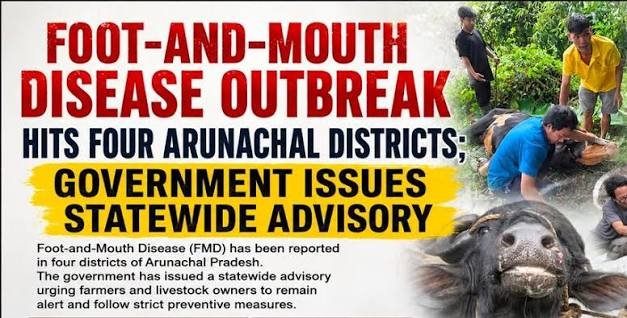
Government of India team and Rapid Response Teams continue treatment, surveillance and sample collection in Anini and surrounding areas as authorities respond to a serious Foot-and-Mouth Disease outbreak affecting Mithuns.
Containment operations against Foot-and-Mouth Disease (FMD) are continuing in Arunachal Pradesh’s Dibang Valley, with state veterinary authorities, Rapid Response Teams (RRTs), district administration and a Government of India expert team carrying out field treatment, surveillance, epidemiological assessment and diagnostic sampling.
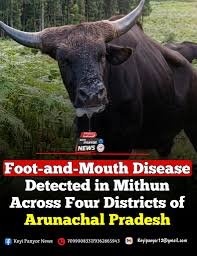
The latest field operation has focused particularly on Mithuns, the semi-domesticated bovine that is economically and culturally important to communities in Arunachal Pradesh. The central team, led by Joint Commissioner Dr V. K. Teotia, arrived in the district on August 13 and conducted field assessments on August 14 and 15 across several affected locations.
More Than 200 Mithuns Reported Dead
The outbreak emerged as a significant livestock-health concern earlier in August. Officials reported that more than 200 Mithuns had died in Dibang Valley by August 8, with the highest reported mortality in Acheso and Angrim villages. The disease had also been detected in Aropo, Gipulin and other villages.
Dibang Valley has an estimated 3,925 Mithuns, according to the 21st Livestock Census cited in the August 8 reporting. The reported mortality therefore represents a serious local animal-health and livelihood concern, although the reported death figure should not be interpreted as the prevalence of infection across the entire Mithun population.
The outbreak has also prompted heightened surveillance elsewhere in Arunachal Pradesh. Reports have identified East Kameng, Pakke-Kessang and Papum Pare among districts affected by confirmed FMD outbreaks, while additional suspected or reported cases have been noted in other areas.
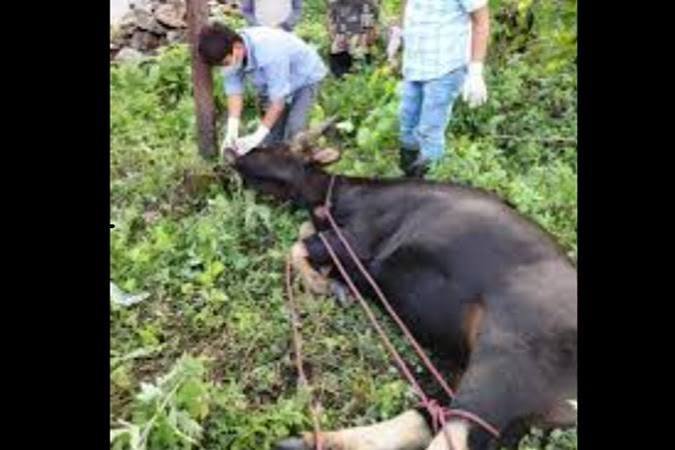
Government of India Team Conducts Field Assessments
The central veterinary team reached Dibang Valley on August 13. During field visits on August 14–15, specialists covered:
-
Acheso
-
Angrim Valley
-
Aropo up to Chegu Camp
-
Mipi Circle
-
Maro
-
9 Kilo
-
Matu Camp
The team met Mithun owners, village leaders and Panchayati Raj representatives while veterinary personnel treated infected animals, distributed medicines and collected diagnostic samples. Samples were obtained from Mithuns, pigs and goats, and post-mortem examinations were also conducted.
The central team also visited the Indo-Tibetan Border Police camp at Acheso, where blood samples were collected from goats and personnel were briefed on FMD epidemiology, biosecurity and public-health safeguards.
The collected samples and specimens were taken for further laboratory examination after the central team departed Anini on August 16. This is an important distinction: field reports document sampling and laboratory examination, but the currently available reports do not provide a final laboratory characterization of the outbreak strain in the public domain.
Three Rapid Response Teams Deployed
The state response began with an RRT from Itanagar reaching Anini on August 8 with medicines and supplies. Three dedicated RRTs were subsequently constituted and deployed across affected areas.
A District Informatics Officer from Tezu arrived on August 11 to support field visits, epidemiological assessment and sample collection. The RRTs are expected to remain stationed in the district until the outbreak is brought under control, with additional teams available if required.
The response therefore combines several layers of disease control:
Clinical treatment → surveillance → epidemiological investigation → diagnostic sampling → biosecurity → vaccination → community reporting
That integrated approach is consistent with the broader principles used internationally for FMD control.
Vaccination Remains the Main Preventive Tool
The Arunachal Pradesh Animal Husbandry and Veterinary Department has reiterated that FMD vaccination is conducted twice a year and remains a central preventive measure.
Livestock and Mithun owners have been urged to participate in vaccination campaigns, report suspected cases promptly and follow recommended biosecurity and animal-waste disposal practices.
Earlier reporting from the state indicated that several affected Mithuns had not received vaccination during the previous campaign. However, this should be regarded as an officially reported observation rather than evidence that vaccination status alone explains the outbreak; transmission dynamics, animal movement, immunity levels, virus characteristics and biosecurity all require consideration.
Why FMD Is a Major Livestock-Health Threat
FMD is one of the world’s most contagious livestock diseases. It affects cattle, pigs, sheep, goats, buffalo and other cloven-hoofed animals and can cause substantial production losses and disruption to livestock trade. The World Organisation for Animal Health (WOAH) identifies FMD as a transboundary animal disease with major economic consequences.
The disease can spread through infected animals and contaminated materials, including vehicles, equipment, clothing, footwear, feed and other fomites. Infected animals can also release large quantities of virus through respiratory secretions.
Typical clinical signs include fever, vesicles and erosions around the mouth and feet, lameness, loss of appetite, weight loss and reduced milk production. Mortality is generally low among adult animals but can be substantially higher in young susceptible animals.
FMD is different from human hand, foot and mouth disease
The terminology can cause confusion. Livestock FMD is not the same disease as human hand, foot and mouth disease. WOAH states that FMD is not readily transmissible to humans and is not considered a public-health risk.
The immediate concern in Arunachal Pradesh is therefore animal health, livestock productivity, livelihoods, disease spread and movement/trade risk, rather than a human FMD epidemic.
India Is Working Toward Stronger FMD Control
The Dibang Valley outbreak comes against the backdrop of India’s wider national effort to reduce FMD incidence.
According to the Government of India’s Department of Animal Husbandry and Dairying, the number of reported FMD outbreaks in India declined from 132 in 2019 to 32 in 2025. Government data also reported average FMD post-vaccination seroconversion of about 70%, while average NSP-antibody prevalence declined from 16% during 2021–23 to 7.8% in the latest assessment cited by the government.
The government has been implementing FMD control through the Livestock Health and Disease Control Programme (LHDCP), including vaccination, surveillance and laboratory confirmation of suspected outbreaks.
In July 2026, the Centre also held a national workshop covering differentiated FMD-control strategies, FMD-free zones and compartments, negative-marker vaccines and emerging threats from SAT serotypes. The broader objective is to strengthen India’s disease-control framework and advance the country’s goal of achieving FMD-free status by 2030.
Why the Dibang Valley Outbreak Matters
The current situation has significance beyond the immediate affected villages.
Mithun production is closely linked to rural livelihoods in Northeast India, while Arunachal Pradesh is one of the country’s most important Mithun-rearing states. A substantial FMD outbreak can therefore affect:
Animal health → household assets → livestock productivity → rural income → local trade → regional disease-control costs
The geography of Dibang Valley also makes sustained field surveillance particularly important. The current operation’s emphasis on village-level engagement, sample collection, treatment and continued deployment of RRTs reflects the need to identify and contain transmission rather than rely solely on clinical treatment.
What Happens Next?
The immediate priorities are expected to remain:
-
Laboratory examination of collected samples
-
Continued clinical surveillance
-
Rapid identification and reporting of new cases
-
Vaccination of eligible susceptible livestock
-
Movement and biosecurity controls
-
Safe disposal of infected animals and animal waste
-
Continued community engagement with Mithun owners
-
Additional RRT deployment if required

