


BiomEdit has acquired the technology platform and pipeline assets of Folium Science, adding a CRISPR-Cas precision microbiome technology and an approved poultry feed additive to its animal-health portfolio. The transaction strengthens BiomEdit’s position at the intersection of synthetic biology, microbiome science and veterinary biologics.
BiomEdit expands precision microbiome capabilities
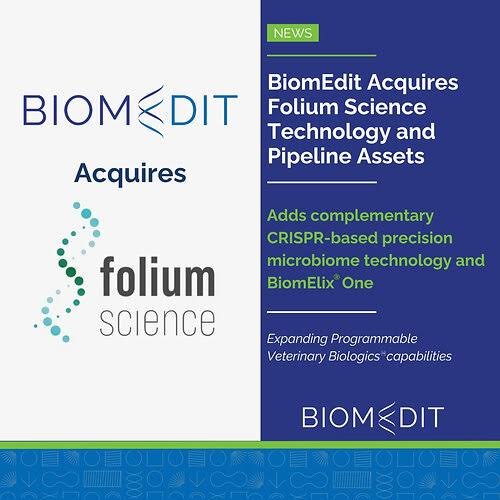
BiomEdit, an animal-health biotechnology company, announced on August 25, 2026, that it had acquired Folium Science’s technology platform and pipeline assets.
The transaction includes Guided Biotics®, Folium Science’s CRISPR-Cas technology, as well as BiomElix® One, a poultry feed additive that has received approval from Brazil’s Ministry of Agriculture and Livestock (MAPA). Financial terms were not disclosed. The deal gives BiomEdit two complementary approaches to manipulating the animal microbiome.
BiomEdit’s existing technology focuses on engineering beneficial bacteria to perform defined biological functions. Folium’s technology is designed to selectively target particular bacterial populations within the microbiome, while seeking to preserve the wider microbial community.
From an industry perspective, that combination is significant because it moves beyond conventional probiotics toward more targeted microbiome engineering.
Two different approaches to the microbiome
The strategic logic of the acquisition can be simplified into two technological functions.
Technology approach |
Primary concept |
Potential application |
|---|---|---|
BiomEdit |
Engineer beneficial microbes |
Deliver specific biological functions |
Folium Guided Biotics |
Selectively target bacterial populations |
Reshape microbial communities |
Combined platform |
Add, modify and selectively target microbes |
Precision veterinary biologics |
BiomEdit describes its technology as Programmable Veterinary Biologics™, a class of genetically engineered bacterial biologics intended to perform targeted biological functions in animals. Folium’s Guided Biotics platform provides a complementary strategy based on CRISPR-Cas technology.
The company therefore gains a broader technological toolkit rather than simply adding another conventional feed additive or probiotic product.
BE-101 remains BiomEdit’s lead veterinary biologic
The acquisition also needs to be viewed against BiomEdit’s existing lead program, BE-101. BE-101 is being developed for the prevention of mortality associated with necrotic enteritis in broiler chickens, a disease associated with Clostridium perfringens. BiomEdit says the product is in the final stages of the conditional licensure process with the USDA Center for Veterinary Biologics (CVB).
Earlier in 2026, BiomEdit said its foundational patent portfolio directly supported BE-101 and described the product as a probiotic-vectored antibody biologic designed to neutralize C. perfringens toxins.
That development is strategically important for poultry producers because necrotic enteritis remains a major challenge in intensive broiler production and has historically been managed through combinations of vaccination, husbandry, nutrition and antimicrobial strategies.
BiomEdit’s approach is positioned as a non-antibiotic biological intervention, although regulatory approval and real-world performance remain the appropriate benchmarks for assessing its commercial value.
Why precision microbiome technology matters in poultry
The animal microbiome is not simply a collection of individual bacterial species. It is a complex ecosystem involving interactions between:
Feed → intestinal microbiota → metabolites → intestinal barrier → immune system → pathogen pressure → animal performance
Broad-spectrum interventions can affect multiple components of that ecosystem. Precision approaches attempt to produce a more defined biological effect. This is where the BiomEdit-Folium combination becomes scientifically interesting.
Analyst view: the strategic value is greater than the product count
The acquisition is best understood as a technology-platform transaction rather than simply a product acquisition. There are three strategic benefits.
1. Expanded biological toolbox – BiomEdit can potentially combine microbial engineering with selective microbiome targeting.
2. Commercial and pipeline diversification – BiomElix One provides an approved feed-additive asset in Brazil, while the CRISPR platform creates additional development possibilities.
3. Poultry provides an initial commercial beachhead – Both companies’ technologies have clear relevance to poultry production, giving BiomEdit an opportunity to build development and regulatory expertise around a large, commercially important livestock segment.
Brazil could become an important test market
The Brazilian asset is strategically noteworthy. Brazil is one of the world’s largest poultry-producing and exporting countries, making the market particularly relevant for technologies aimed at poultry health, productivity and feed efficiency.
BiomElix One’s MAPA approval therefore provides BiomEdit with something that many early-stage biotechnology companies lack:
an asset with an existing regulatory pathway and market relevance.
However, regulatory approval in Brazil does not imply approval in the United States, European Union or other jurisdictions. Each market has its own regulatory requirements, and commercial performance still needs to be demonstrated under local production conditions.
Bottom Line
BiomEdit’s acquisition of Folium Science’s technology and pipeline assets represents a strategically important move toward precision microbiome engineering in animal health.
The transaction adds CRISPR-Cas-based bacterial targeting, an approved Brazilian poultry feed additive, and additional scientific capabilities to a company already developing engineered microbial biologics.
The most important development is therefore not simply BiomElix One or the Guided Biotics platform individually. It is the possibility of combining microbial engineering and selective microbiome modification within a single veterinary biotechnology platform.
For the animal-health sector, that signals a broader transition from conventional probiotics and feed additives toward programmable, mechanism-specific biological interventions.
The science is promising, but the commercial test remains straightforward: regulatory approval, reproducible field efficacy, manufacturing economics and farmer adoption.

