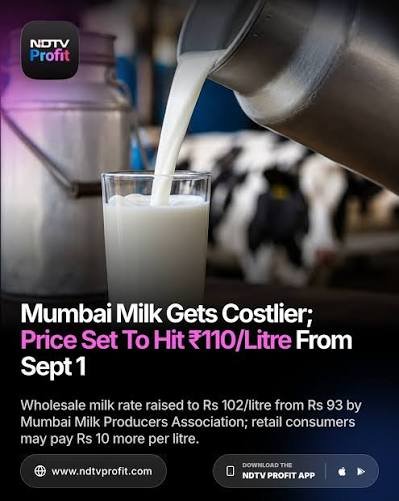
India’s dairy economy is entering another period of price pressure as rising feed, animal-maintenance and operating costs squeeze producers and push milk prices higher. In Haryana, buffalo-milk producers in Julana have collectively resolved to sell milk at INR 100 per litre from September 1, with a reported INR 5,100 penalty for farmers selling below the agreed rate. At the same time, Mumbai’s buffalo/tabela milk wholesale price is scheduled to rise from INR 93 to INR 102 per litre, a INR 9 or 9.7% increase, from September 1. ( 1 USD = INR 96)
The developments are important because they expose a central tension in India’s dairy economy: India is producing more milk than ever, yet the economics of producing and distributing that milk are becoming increasingly difficult for farmers, processors and consumers.
india-milk-price-rise-2026-dairy-inflation
India produces record volumes—but milk is becoming more expensive
According to the Department of Animal Husbandry & Dairying (DAHD), India produced 247.87 million tonnes of milk in 2024–25, up 3.58% from 239.30 million tonnes in 2023–24. Per-capita milk availability increased from 471 grams/day to 485 grams/day.
The longer-term expansion is even more substantial:
Indicator
2018–19
2024–25
Change
Milk production
187.74 MT
247.87 MT
+32.0%
Per-capita availability
390 g/day
485 g/day
+24.4%
Annual production increase, 2024–25
—
3.58% YoY
—
This is therefore not simply a story of a national milk shortage. It is increasingly a story about the cost of converting feed, labour, land, water, veterinary care and capital into marketable milk.
Haryana’s INR 100 milk decision: a farmer-margin story
The decision reported from Sirsa Khedi in Julana, Haryana, is particularly revealing.
Farmers have reportedly agreed to charge ₹100/kg/litre for buffalo milk from September 1, while imposing a ₹5,100 penalty on members who sell below the collectively determined price. A similar decision has reportedly been taken by dairy farmers in Dhanauri village in Kaithal district. Farmers cited increasing prices of khal and binola, important livestock-feed inputs, as a reason for seeking higher milk prices.
The significance goes beyond one village. The action represents an attempt by producers to restore bargaining power at the farm gate when input costs rise faster than the price they receive for milk.
But there is an important analytical caveat: a village-level collective price is not equivalent to an official Haryana-wide milk price or a regulated market price. It should therefore be interpreted as a signal of producer cost pressure rather than evidence that all Haryana milk will sell for ₹100/L.
india-milk-price-rise-2026-dairy-inflation
Mumbai provides a much larger market signal
The Mumbai development has a substantially broader consumer impact. The Bombay Milk Producers Association has announced that the wholesale price of buffalo/tabela milk will rise from ₹93/L to ₹102/L from September 1, with the revised price scheduled to remain in place through February 28, 2027.
That represents: ₹9/L increase ÷ ₹93/L = 9.68% or approximately 9.7%. If the entire wholesale increase were passed through to households, a family buying:
1 litre/day would spend about ₹270 more per month
1.5 litres/day → about ₹405 more/month
2 litres/day → about ₹540 more/month
These are simple arithmetic illustrations, not forecasts of actual retail prices. Reports indicate that retail prices could move toward approximately ₹110/L, depending on distribution and retailer margins.
INR 100 milk threshold is becoming psychologically important
Haryana’s producer target of ₹100/L and Mumbai’s ₹102/L wholesale price are occurring almost simultaneously. That matters because ₹100/L is becoming a visible psychological price threshold for fresh buffalo milk in parts of India’s urban and rural dairy economy.
Why are milk prices rising if production is also rising?
This is the most important question. India’s milk output is expanding, but milk prices are determined by marginal production costs, procurement economics, demand, logistics and processing/distribution margins, not simply by national production volumes.
Several cost channels matter.
1. Feed – Feed is one of the largest variable costs in dairy production. A typical dairy ration contains some combination of:
compound/concentrate feed;
oilseed cakes;
bran;
maize;
fodder;
crop residues;
mineral mixtures.
The National Dairy Development Board’s Dairy Knowledge Portal provides an illustrative Murrah buffalo ration requiring approximately 6.2 kg of concentrate feed, 20.5 kg of green fodder and 4.5 kg of wheat straw per day, alongside mineral supplementation.
That makes the economics straightforward: When feed prices rise, the cost of producing every litre of milk rises—even if the animal’s milk yield does not change.
2. Fodder availability remains a structural vulnerability- India’s dairy system is unusually dependent on a combination of crop residues, green fodder and purchased concentrates. This creates exposure to:
monsoon variability / drought/ crop-price movements / competing demand for maize and oilseeds / transportation costs and seasonal fodder shortages.
For small dairy farmers, the impact can be especially severe because they often have limited ability to hedge feed costs or lock in long-term procurement contracts.
3. Animal maintenance costs – Feed is not the only expense. Farmers also face costs associated with:
veterinary medicines;
vaccinations;
breeding;
artificial insemination;
labour;
electricity;
water;
housing;
transportation;
animal replacement;
reproductive-health management.
These expenses become particularly important when milk yield per animal is low. DAHD data show large productivity differences among animal categories. In 2024–25, average daily productivity was approximately 8.95 kg for crossbred cattle, 6.48 kg for indigenous/non-descript buffaloes and 3.86 kg for indigenous/non-descript cattle in the reported productivity series. Higher productivity can spread fixed costs across more litres of milk.
India’s inflation backdrop makes the milk increase more painful
The milk-price developments are arriving against a broader food-inflation environment. India’s July 2026 retail inflation was 4.45%, according to Reuters’ reporting of official data, while food inflation reached 5.52%.
The Ministry of Statistics and Programme Implementation’s CPI dashboard also reports 5.52% year-on-year All-India Consumer Food Price Index inflation for July 2026. This distinction matters.
A household may experience relatively moderate headline CPI inflation while experiencing considerably higher pressure in its food basket. And milk is not an optional food for many Indian families.
The paradox: India has more milk, but affordability remains a problem
India’s dairy story is remarkable. Milk production increased from 187.74 million tonnes in 2018–19 to 247.87 million tonnes in 2024–25, while per-capita availability increased from 390 g/day to 485 g/day.
India now accounts for approximately one-quarter of global milk production, according to DAHD. Yet higher production does not automatically mean cheaper milk. The reason is that supply growth and cost growth can occur simultaneously.
A farmer can produce more milk nationally while still facing: higher feed cost + higher labour cost + higher veterinary cost + higher transport cost + higher capital cost = pressure for a higher milk price.
Buffalo milk is particularly relevant
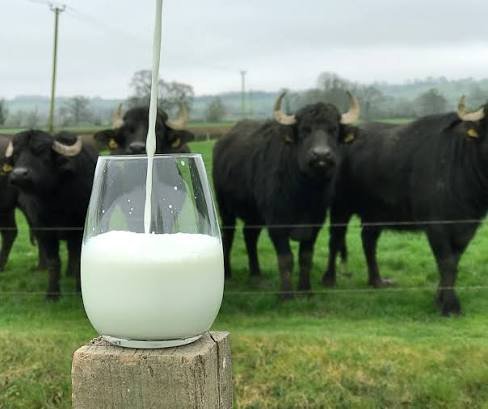
The current price developments are heavily associated with buffalo milk. That is significant for India because buffaloes are central to the country’s dairy economy.
DAHD’s 2024–25 data show indigenous buffaloes contributing 31.18% of national milk production, while crossbred cattle contributed 30.80%. Indigenous cattle contributed 11.20%, non-descript cattle 9.64%, non-descript buffalo 11.97%, and goats 3.32%.
Together, indigenous and non-descript buffaloes therefore account for more than 43% of India’s milk output in the reported classification. That makes buffalo economics highly relevant to India’s overall dairy-price trajectory.
What does this mean for Indian consumers?
The immediate concern is not that milk will suddenly become unaffordable nationwide. The more realistic risk is cumulative food-budget pressure.
For a household already dealing with rising prices of vegetables, cereals, cooking inputs and other essentials, another ₹200–₹500 per month on milk can be meaningful. The effect is potentially greater for:
large families;
households with young children;
elderly consumers;
families consuming substantial quantities of curd/paneer;
households dependent on milk for daily tea/coffee;
lower-income urban households.
And because milk is frequently purchased every day, consumers feel the increase immediately rather than at the end of a monthly billing cycle.
Real opportunity: produce more milk Per animal, not simply By more animals
India’s long-term dairy strategy should increasingly focus on milk produced per animal at the lowest sustainable cost. The economic levers include:
Better feed conversion – Balanced rations can improve milk yield without proportionally increasing feed consumption.
Fodder security – More silage, perennial fodder, crop-residue treatment and drought-resilient fodder systems could reduce exposure to volatile purchased feed.
Better genetics – India has already invested heavily in breeding improvement. DAHD’s current programmes include artificial insemination, IVF and sex-sorted semen technologies.
Preventive animal healthcare – Mastitis, reproductive disorders, parasitic disease and metabolic disorders can quietly reduce the economic output of dairy animals.
Cold-chain efficiency – Reducing spoilage and improving collection logistics can increase the proportion of the consumer rupee reaching the productive end of the chain.
AHI Analyst View: India’s dairy sector is moving from a volume challenge to a cost-efficiency challenge
India has largely solved the question of whether it can produce enormous quantities of milk. The next challenge is more difficult:
Can India produce 300+ million tonnes of milk in the future without making milk progressively less affordable for Indian households?
The answer will depend less on simply increasing herd numbers and more on: feed efficiency + animal productivity + fodder security + disease prevention + breeding + cold-chain efficiency + fair producer pricing.
The current ₹100/L developments in Haryana and ₹102/L Mumbai wholesale price are therefore more than isolated local price announcements. They are signals from different ends of India’s dairy economy that the cost of producing milk is becoming an increasingly important determinant of food affordability.
Key Data Snapshot
Indicator
Latest data
India’s milk production, 2024–25
247.87 million tonnes
YoY milk-production growth
3.58%
Per-capita milk availability
485 g/day
Milk production, 2018–19
187.74 million tonnes
Production growth since 2018–19
~32%
July 2026 food inflation
5.52%
July 2026 headline CPI inflation
4.45%
Mumbai tabela/buffalo milk wholesale price
₹93 → ₹102/L
Mumbai increase
₹9/L / ~9.7%
New Mumbai price effective
1 September 2026
Haryana producer target reported in Julana
₹100/L
Reported undercutting penalty
₹5,100
Editorial conclusion
India does not currently have a simple “not enough milk” problem. It has a dairy-cost problem.
Record production and rising per-capita availability coexist with increasing pressure on feed, animal maintenance and distribution economics. For consumers, that creates a particularly difficult form of inflation: the price of an everyday nutritional staple rises while households have limited ability to reduce consumption without changing dietary habits.
For policymakers, the priority should therefore be to improve milk productivity and feed efficiency per animal, strengthen fodder systems and reduce supply-chain losses—while ensuring that higher producer costs do not translate disproportionately into higher consumer prices.
Animal Health India (AHI) is an independent news and intelligence
platform covering the global animal health, veterinary, livestock,
poultry, companion animal and pet food sectors. Our editorial team
comprises veterinary journalists, animal health professionals,
regulatory affairs specialists and industry analysts with over 30
years of combined experience covering India, Asia, Europe and North
America. AHI publishes news, regulatory updates, market intelligence
and company news drawn from primary sources including DAHD, EMA,
USDA, AVMA and leading veterinary publications worldwide.