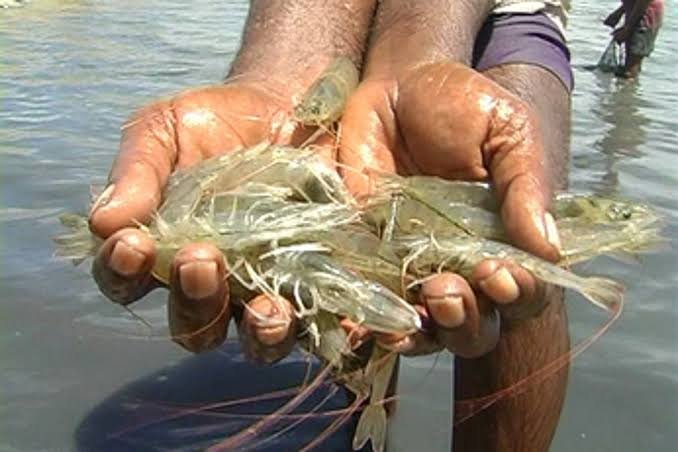
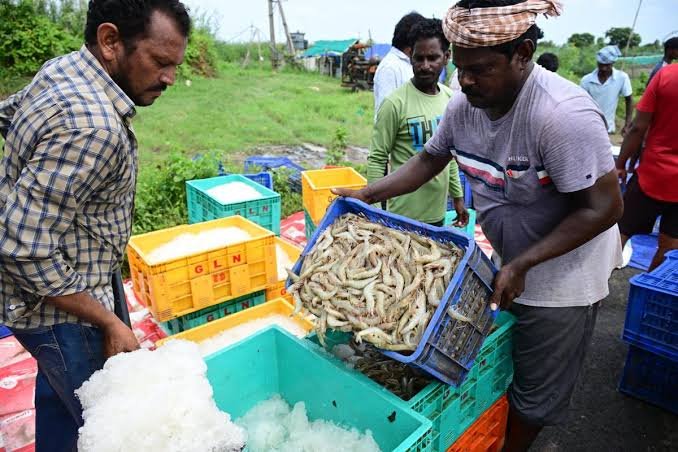
Andhra Pradesh Shrimp Farmers Face Feed Cost Squeeze
Andhra Pradesh’s shrimp-farming industry is facing a renewed margin squeeze as aquaculture feed prices, production costs and market-price weakness put pressure on farmers, while a political dispute has emerged over the role and effectiveness of the state’s aquaculture regulatory framework.
The issue is significant beyond Andhra Pradesh. The state is India’s dominant shrimp-producing and exporting region, and any sustained deterioration in farmer economics could affect shrimp production, farm investment, feed demand and India’s seafood export competitiveness.
Recent government data indicate that approximately 2.16 lakh aquaculture farmers operate across about 5.79 lakh acres in Andhra Pradesh. The state government has acknowledged that farmers are dealing with declining market prices and higher fish-feed costs.
Andhra Pradesh Shrimp Farmers Face Feed Cost Squeeze
Feed has become the immediate pressure point
The sharpest dispute concerns aqua-feed pricing. In May 2026, the Andhra Pradesh government objected to increases reported at approximately ₹8/kg for vannamei feed and ₹10/kg for tiger-shrimp feed. Farmers and government representatives questioned whether feed manufacturers should be able to revise prices without adequate consultation with farmer organisations.
The pressure intensified in June, when industry reports indicated that some feed manufacturers raised prices by approximately ₹12–16/kg.
Feed manufacturers attributed the increases to higher raw-material, fuel and transportation costs, while farmers argued that the additional burden was arriving when shrimp prices were already under pressure and disease-management expenses were elevated.
Feed economics are critical because feed dominates production cost
NABARD’s Andhra Pradesh State Focus Paper notes that feed accounts for about 60% of operational aquaculture costs and identifies the AP Feed (Quality Control) Act, 2020 as part of the state’s regulatory architecture.
This means even relatively modest changes in feed price can materially alter farm-level profitability. For example, if a farm uses 1 tonne of feed, a ₹12/kg increase represents an additional:
1,000 kg × ₹12 = ₹12,000 per tonne
At ₹16/kg, the additional cost becomes:
1,000 kg × ₹16 = ₹16,000 per tonne.
For farms consuming several tonnes during a production cycle, the impact quickly becomes substantial.
Government data confirm the cost problem
The issue has moved beyond farmer associations and political statements. In August, the Union government reported that Andhra Pradesh had informed the Centre that aqua farmers were facing increased feed costs alongside declining market prices. The state also reported measures aimed at reducing feed costs.
Importantly, feed manufacturers subsequently agreed to reduce shrimp-feed prices by ₹4/kg following government intervention. This provides an important qualification to the current debate:
The feed-price problem is documented by government, but the exact magnitude of the financial stress varies by farm, species, feed conversion, stocking density, survival rate and market price.
Raw-material inflation is feeding through to shrimp feed
A May government review provides unusually useful data on the upstream economics. According to the Andhra Pradesh government’s assessment, prices of major feed raw materials increased sharply between January and May 2026.
Feed input
Earlier price
Reported later price
Approx. increase
Fish meal
₹1.50 lakh/t
₹2.40 lakh/t
+60%
Fish oil
₹2.80 lakh/t
₹4.40 lakh/t
+57%
Soy lecithin
₹68,000/t
₹1.10 lakh/t
+62%
Feed manufacturers told the government that key raw materials had risen by more than 20% between January and April 2026, while officials estimated that raw-material inflation had increased manufacturing costs by approximately ₹31.03/kg.
Manufacturers reportedly sought feed-price increases of approximately ₹25–31/kg, while farmers opposed the increases and asked that existing prices be maintained at least through the summer crop.
Andhra Pradesh’s shrimp industry is too important for this to remain a local dispute
The economic importance of Andhra Pradesh aquaculture is substantial. MPEDA’s latest state-level data show that Andhra Pradesh’s export-oriented aquaculture includes L. vannamei, P. monodon and other shrimp species, with vannamei overwhelmingly dominant. For 2024–25, MPEDA reported approximately:
10.535 lakh tonnes of L. vannamei production;
approximately 1.09 lakh hectares of vannamei aquaculture area;
calculated productivity of about 4.8 tonnes/ha/crop.
Andhra Pradesh and Telangana together exported 377,954 tonnes of seafood in 2024–25, of which Andhra Pradesh alone accounted for 366,182 tonnes, worth approximately ₹21,245.9 crore, according to MPEDA’s state-level export data. That makes Andhra’s aquaculture economy strategically important to India’s seafood export sector.
India’s vannamei production continues to expand
Nationally, the Pacific whiteleg shrimp industry has continued to grow. MPEDA’s latest production series shows Indian L. vannamei production rising from:
976,213 tonnes in 2021–22 → 1,304,779 tonnes in 2025–26
That represents approximately 33.7% growth over four years. Production in 2025–26 alone increased 9.99% year on year. The data illustrate the strategic contradiction facing the industry:
Production is expanding, but the economics of production are becoming more sensitive to feed and market-price volatility.
APSADA becomes the centre of the political argument
The current controversy has also revived debate over the Andhra Pradesh State Aquaculture Development Authority (APSADA) and the state’s aquaculture regulatory model.
The APSADA Act, 2020 was designed to bring aquaculture activities, products and services under an integrated institutional framework. NABARD describes the authority as part of the state’s effort to create a coordinated delivery mechanism for aquaculture. The AP Feed (Quality Control) Act, 2020 was another component of that framework, reflecting the importance of feed quality and the economic weight of feed in aquaculture.
The political disagreement is over how much regulatory influence APSADA currently exercises over feed pricing and farmer protection.
The former Andhra Pradesh government has alleged that the current administration has weakened APSADA’s role, while the present administration has taken direct action through the Fisheries Department and government-led negotiations with feed manufacturers.
The ₹4/kg reduction provides temporary relief—but not a structural solution
The government’s June intervention resulted in agreement for a ₹4/kg reduction, taking a reported maximum retail price from ₹112/kg to ₹108/kg. A committee involving farmers, manufacturers and officials was proposed to develop a longer-term pricing mechanism.
The later Centre-facing discussions also considered a mechanism for monthly shrimp-feed price determination based on raw-material costs, alongside a proposal for more frequent shrimp procurement-price information.
AHI View: the real issue is farm economics, not simply feed prices
The 2026 Andhra Pradesh controversy should not be reduced to “feed companies raised prices” versus “farmers want cheaper feed.” The deeper issue is the absence of a sufficiently transparent mechanism linking:
global raw-material costs → feed manufacturing costs → feed prices → shrimp production costs → farm-gate shrimp prices.
At the same time, Andhra Pradesh must avoid undermining feed quality, manufacturer viability or long-term investment. The state’s strongest policy opportunity may therefore be to create a data-driven aquaculture cost-and-price dashboard, with independently verified information on feed ingredients, feed prices, electricity costs, farm production costs and shrimp procurement prices.
That would move the debate away from periodic political confrontation and toward evidence-based price discovery.
Key Andhra Pradesh Aquaculture Data
Indicator
Latest reported figure
Aquaculture farmers
~2.16 lakh
Aquaculture area
~5.79 lakh acres
Andhra Pradesh seafood exports, 2024–25
366,182 MT
AP seafood export value, 2024–25
₹21,245.9 crore
AP L. vannamei production, 2024–25
1,053,500 MT
AP vannamei productivity
~4.8 MT/ha/crop
India vannamei production, 2025–26
1,304,779 MT
National vannamei growth since 2021–22
~33.7%
Reported 2026 vannamei feed increase
₹8/kg initially
Later reported feed increase
₹12–16/kg
Government-agreed feed reduction
₹4/kg
Reported revised MRP
₹112 → ₹108/kg
Feed share of aquaculture operating cost
~60%
Bottom Line
Andhra Pradesh’s shrimp industry is facing a margin squeeze created by the combination of higher feed and operating costs and weaker shrimp-market prices.
The 2026 feed-price dispute has also exposed a larger institutional question: how should Andhra Pradesh regulate a globally exposed aquaculture value chain without distorting feed quality, manufacturer economics or farmer profitability?
The immediate ₹4/kg reduction provides some relief. The more important development will be whether the proposed long-term feed-pricing mechanism can establish transparent, predictable and evidence-based price discovery.
For India’s seafood industry, this is not merely an Andhra Pradesh policy dispute. With Indian L. vannamei production reaching a record 1.30 million tonnes in 2025–26, protecting farmer economics is increasingly a matter of export competitiveness and national aquaculture resilience.
Animal Health India (AHI) is an independent news and intelligence
platform covering the global animal health, veterinary, livestock,
poultry, companion animal and pet food sectors. Our editorial team
comprises veterinary journalists, animal health professionals,
regulatory affairs specialists and industry analysts with over 30
years of combined experience covering India, Asia, Europe and North
America. AHI publishes news, regulatory updates, market intelligence
and company news drawn from primary sources including DAHD, EMA,
USDA, AVMA and leading veterinary publications worldwide.